
Flussdiagramm
Ohne Titel
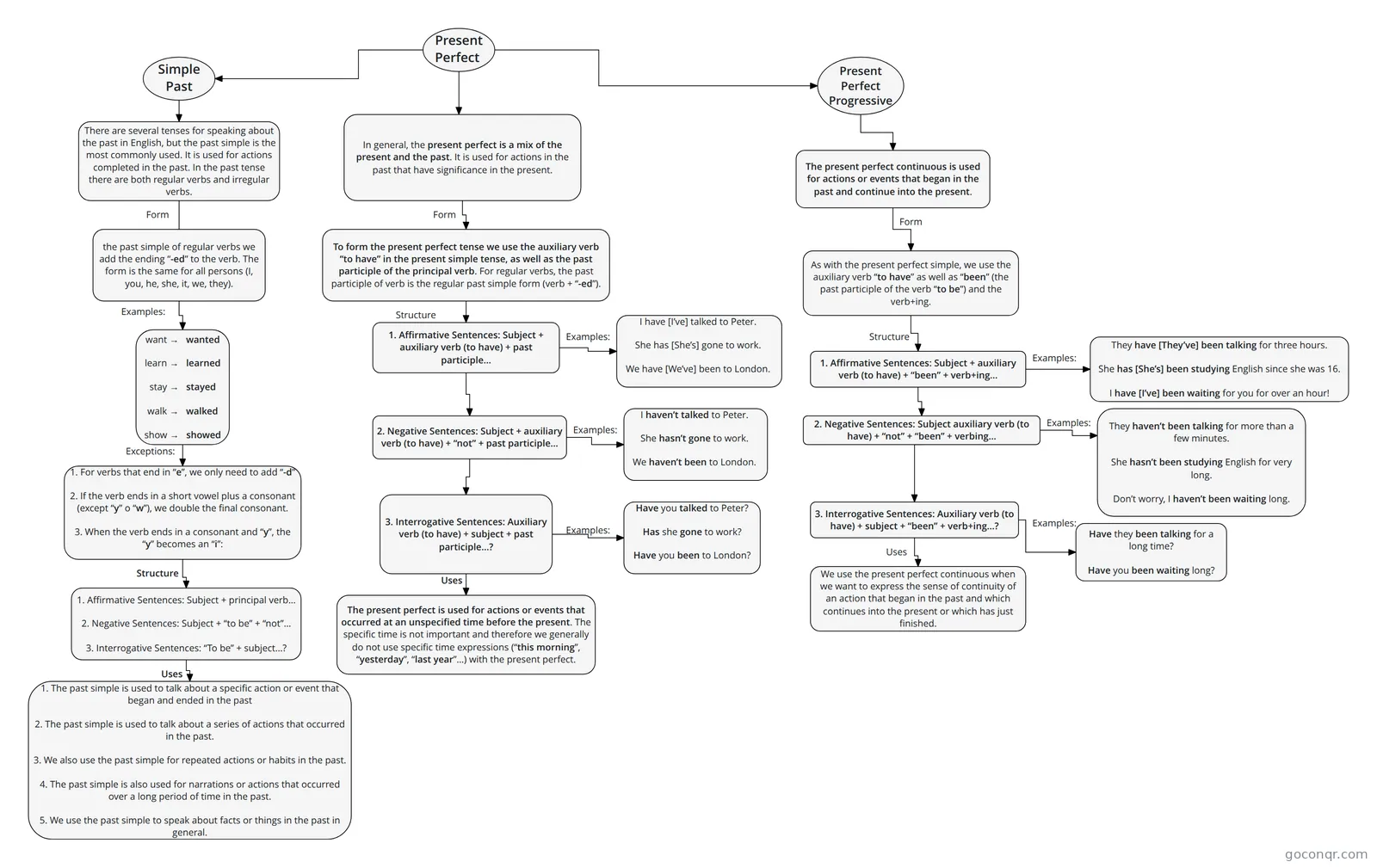
Flowchart: Simple past and present perfect tenses in English
Inhalt des Flussdiagramms
Simple Past
Present Perfect
Present Perfect Progressive
There are several tenses for speaking about the past in English, but the past simple is the most commonly used. It is used for actions completed in the past. In the past tense there are both regular verbs and irregular verbs.
In general, the present perfect is a mix of the present and the past. It is used for actions in the past that have significance in the present.
The present perfect continuous is used for actions or events that began in the past and continue into the present.
the past simple of regular verbs we add the ending “-ed” to the verb. The form is the same for all persons (I, you, he, she, it, we, they).
Form
want → wanted
learn → learned
stay → stayed
walk → walked
show → showed
Examples:
1. For verbs that end in “e”, we only need to add “-d”
2. If the verb ends in a short vowel plus a consonant (except “y” o “w”), we double the final consonant.
3. When the verb ends in a consonant and “y”, the “y” becomes an “i”:
Exceptions:
Structure
1. Affirmative Sentences: Subject + principal verb…
2. Negative Sentences: Subject + “to be” + “not”…
3. Interrogative Sentences: “To be” + subject…?
Form
To form the present perfect tense we use the auxiliary verb “to have” in the present simple tense, as well as the past participle of the principal verb. For regular verbs, the past participle of verb is the regular past simple form (verb + “-ed”).
1. Affirmative Sentences: Subject + auxiliary verb (to have) + past participle…
Structure
I have [I’ve] talked to Peter.
She has [She’s] gone to work.
We have [We’ve] been to London.
They have [They’ve] learned English.
Examples:
2. Negative Sentences: Subject + auxiliary verb (to have) + “not” + past participle…
I haven’t talked to Peter.
She hasn’t gone to work.
We haven’t been to London.
They haven’t learned English.
Examples:
3. Interrogative Sentences: Auxiliary verb (to have) + subject + past participle…?
Have you talked to Peter?
Has she gone to work?
Have you been to London?
Have they learned English?
Examples:
Uses
The present perfect is used for actions or events that occurred at an unspecified time before the present. The specific time is not important and therefore we generally do not use specific time expressions (“this morning”, “yesterday”, “last year”…) with the present perfect.
As with the present perfect simple, we use the auxiliary verb “to have” as well as “been” (the past participle of the verb “to be”) and the verb+ing.
Form
1. Affirmative Sentences: Subject + auxiliary verb (to have) + “been” + verb+ing…
They have [They’ve] been talking for three hours.
She has [She’s] been studying English since she was 16.
I have [I’ve] been waiting for you for over an hour!
Examples:
Structure
2. Negative Sentences: Subject auxiliary verb (to have) + “not” + “been” + verbing…
They haven’t been talking for more than a few minutes.
She hasn’t been studying English for very long.
Don’t worry, I haven’t been waiting long.
Examples:
3. Interrogative Sentences: Auxiliary verb (to have) + subject + “been” + verb+ing…?
Have they been talking for a long time?
Have you been waiting long?
Examples:
We use the present perfect continuous when we want to express the sense of continuity of an action that began in the past and which continues into the present or which has just finished.
Uses
1. The past simple is used to talk about a specific action or event that began and ended in the past
2. The past simple is used to talk about a series of actions that occurred in the past.
3. We also use the past simple for repeated actions or habits in the past.
4. The past simple is also used for narrations or actions that occurred over a long period of time in the past.
5. We use the past simple to speak about facts or things in the past in general.
Uses
Informationen
- Beschreibung
- Flussdiagramm am Ohne Titel, erstellt von edgar nuñez am 26/04/2021.
- Erstellt von
- edgar nuñez
- Aufrufe
- 0
- Bewertung