
Mindmap
Machine Learning Strategies
Inhalt der Mindmap
Machine Learning Strategies
Orthogonality of Tuning Parameters
- Like a TV screen, try using tuning parameters that directly affect the issue (e.g. affect only trapezoidicity of tv screen), and does not make the side-effect. This is the orthogonality, using tuning parameters which are orthogonal to each other
Single Number evaluation metric
- Based on multiple performance measuring metrics, try to build one value formula, which would help you pick easier to right option.
Human-level Performance
- In Machine Learning, algorithm accuracy grows over time, might pass above the human level performance, but will saturate over limit that is called Bayes optimal error
- Avoidable bias
- Is the difference between between human level performance and training set error. if you assume that human level performance is almost as good as bayes optimal error, it defines a limit to what accuracy machine learning can achieve.
- Can be corrected with: (1) Train bigger model, (2) Train longer/better optimization algorithms (momentum, RMSprop, adam), (3) better NN architecture / hyperparameter search
Reducing (avoidable) bias and variance
- Variance
- Can be corrected with: (1) More Data, (2) Regularization (L2, dropout, data augmentation), (3) NN Architecture / hyperparameter search
- Variance
Error Analysis
- 1) "ceiling" look on the problem
- Should you take another classifier (train for picture of dogs): Take around ~100 mislabeled samples, and count manually how many are actually mislabeled as another class (dogs),
- So if it is low percentage of such mislabeling, your effort to add another classifier would not reduce error
- If it is high percentage, it is worth the effort, as it would reduce the error
- Should you take another classifier (train for picture of dogs): Take around ~100 mislabeled samples, and count manually how many are actually mislabeled as another class (dogs),
- 2) Evaluate multiple ideas in parallel
- Create a table with all ideas, and cross compare the percentage of how much each idea is appearing in dataset of mislabeled samples, and thus how much would they affect your performance
- 3) Correcting incorrect dev/test sets (incorrectly labeled)
- 4) Build quickly, and then iterate
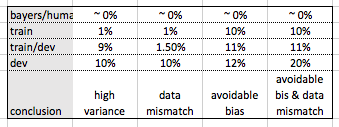
- Mismatched distributions of training set and test set
- Issue here is: if your train error is 1% but test error is 10%, you cant be sure if it is high variance problem of data mismatch problem.
- Addressing data mismatch problem:
- 1) carry out error analysis (e.g. car noise, backgroudn music...)
- 2) Make training data more similar to dev/test set
- Addressing data mismatch problem:
- Can be fixed by introducing training/dev set which is of the same distribution like training set
- Issue here is: if your train error is 1% but test error is 10%, you cant be sure if it is high variance problem of data mismatch problem.
- 1) "ceiling" look on the problem
When Transfer learning from Task A to Task B makes sense?
- When Task A and Task B have the same input
- You have a lot more data for Task A than Task B
- Low level features of task A could be helpful for Task B
When multitask learning makes sense?
- a set of tasks can benefit from low level features of NN
- amount of input data for each task is similar
end-to-end deep learning
- when u have a pipeline of tasks to learn - deep NNs perform better, only when there is a large input training data available.
- Pro: Let the data speak (not inventing something and distract NN, e.g. phonemes)
- Pro: Less hand-designing components needed
- con: May need large amount of data
- con: Excludes potentially useful hand-designed components
Bilder und Dateien der Mindmap
Informationen
- Beschreibung
- Very High Data Science Mindmap am Machine Learning Strategies, erstellt von Aleksandar Kovacevic am 07/10/2017.
- Erstellt von
- Aleksandar Kovacevic
- Aufrufe
- 3
- Bewertung