
Artificial Intelligence and Machine Learning
675 resources created by 510 users
This Artificial Intelligence and Machine Learning page on GoConqr gathers community-made mind maps, flashcards, quizzes, notes and flowcharts, from search, expert systems and knowledge representation to neural networks, reinforcement learning and computer vision. It's built for university students and professional candidates, school students, and teachers after ready-made material. There are over 600 resources here, including more than 20 quizzes and over 400 mind maps, mostly at university level. Pick a topic that matches your course, test yourself, then make your own revision sets.
Select topic
Top Artificial Intelligence and Machine Learning resources
-
12 cardsMachine Translator
-
Mind map Deep Feed forward Neural Networks
-
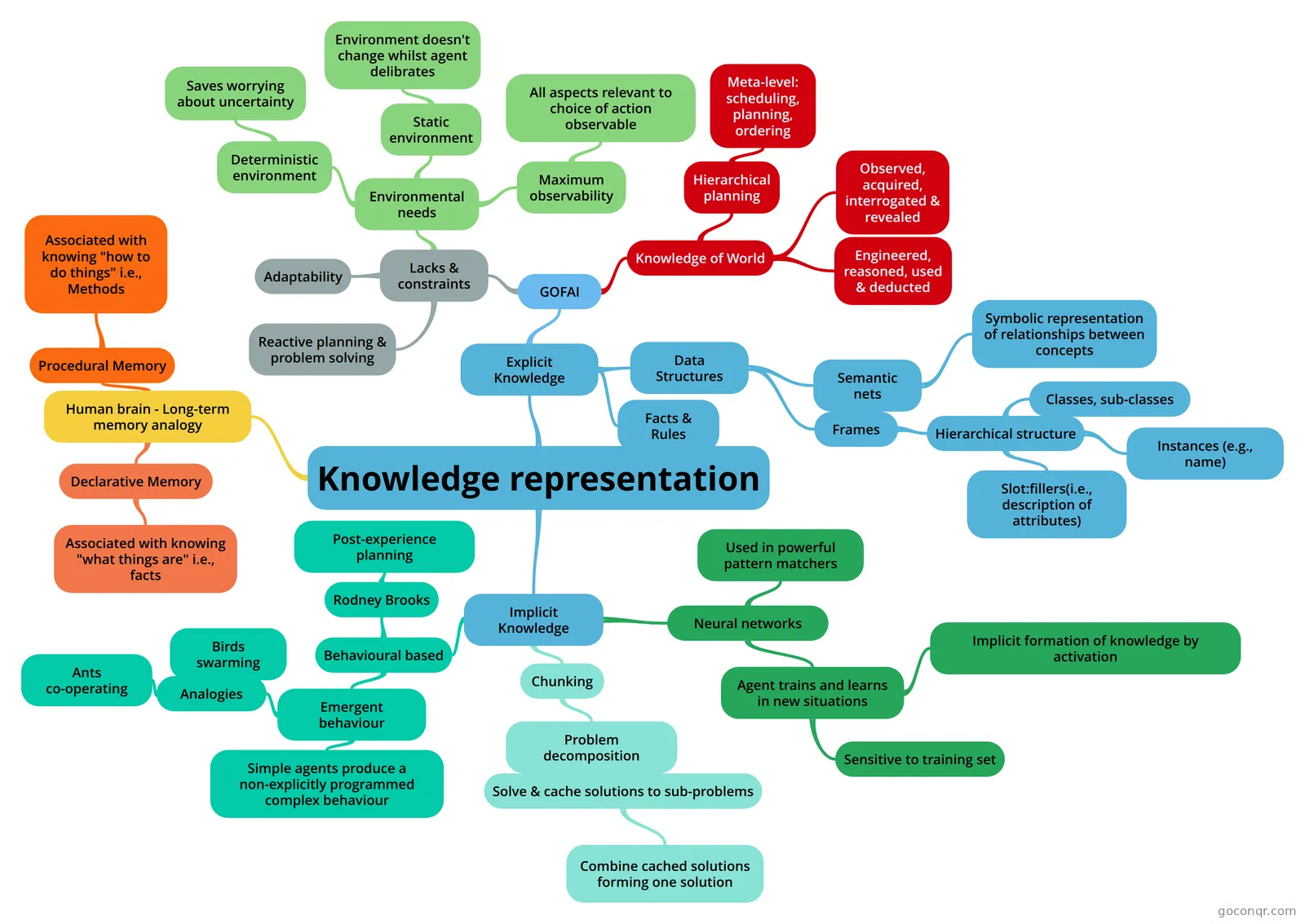 Mind map Knowledge representation something
-
Mind map agar.IA
-
68 cardsDLDM 2022 What is a transformer ?
-
50 cardsNN1 How would you define machine learning?
-
Mind map Artificial Intelligence Artificial Intelligence
-
46 cardsG51FAI - Fundamentals of Artificial Intelligence What is AlphaGo?
Quizzes
See all 32 quizzes-
84 questionsAI Quiz What is the analogy in Artificial Neural Networks to synaptic efficiencies in biological neurons?
-
35 questionsAi Khara omtenta Below is a truth table for a simple classification problem. Four labelled objects are required to be classi...
-
59 questionsFSIV Natural light is the best possible in all cases:
-
59 questionsArtificial Intelligence Foundation Simulator From the EU's ethics guidelines for AI, what does 'The Principle of Autonomy,' mean?
-
44 questionsUntitled Reinforcement Learning WHAT IS?
-
33 questionsUntitled In standard SGD with Momentum (SGDM), which statement best describes the update?
-
40 questionsEWM Prüfung - Quiz Bellman (1978) defined AI as “[The automation of] activities that we associate with human thinking, such ...
-
26 questionsChapter 11 Which of the following is an example of procedural knowledge
Mind maps
See all 460 mind mapsFlashcards
See all 98 flashcards-
12 cardsMachine Translator
-
68 cardsDLDM 2022 What is a transformer ?
-
50 cardsNN1 How would you define machine learning?
-
46 cardsG51FAI - Fundamentals of Artificial Intelligence What is AlphaGo?
-
158 cards361 - Artificial Intelligence What is Turing original imitation game?
-
149 cards361 What is the definition of artificial intelligence?
-
200 cardsExam Vocab
-
123 cardsCS 580 - Intro to AI What Is AI?
Flowcharts
See all 34 flowchartsNotes
See all 43 notes-
Expert Systems Created via:1. Knowledge acquisition via domain expert, knowledge engineer and domain user. Can be difficult - vague answers, intuition, lack of support for change by expert.2. Knowledge representation (Prolog, IF &nb...
-
8 Applications of Computer Vision in Artificial Intelligence (AI) Computer vision and human vision are similar, but humans have the advantage of experience, which is a considerable advantage. Humans acquire contextual information throughout their lives, which aids with object recogn...
-
Natural Language Processing
-
AI SECOND QUESTIONS 2015 2 (i) Give a description and example of a Simple Agent with no internal states and how it works using only the surface appearance of the language. [4 marks] In a simple agent it has no internal state. The environ...
-
Google's Five key Problems for Robot Safety Google's AI researchers say these are the five key problems for robot safety The robots are perfectly safe; it's you Google's worried about Google is worried about artificial intelligence. No, not that it will become ...
-
Past Paper AI 2016
-
Week 6 when errors exist in ML algorithm ? - add more training data - add more features - remove features - try polynomial fit - try increasing lambda -Try decreasing lambda Use diagnostic: that tells how accurately t...
-
Machine learning paper explained LOOK AHEAD OPTIMIZER : K STEPS FORWARD 1 STEP BACKWARD https://www.youtube.com/watch?v=ypqf7UUird4 Stochastic weight optimizing : taking weight average when in weight space Regularized non linear acc...
Slides
Topics in Artificial Intelligence and Machine Learning
More Computing and ICT (programming, computer science, digital skills, educational technology) topics
About Artificial Intelligence and Machine Learning
GoConqr OriginalWhat this unit covers
The unit mixes classic artificial intelligence with modern machine learning. The Mind Map called Artificial Intelligence runs from abstraction and symbolic representation to trees, graphs, heuristics, hill climbing, best first search, A* and MiniMax. The Knowledge representation Mind Map compares declarative and procedural memory, using the long-term memory analogy.
On the learning side, Intro of Reinforcement Learning (2) sets out supervised, unsupervised and reinforcement learning and the idea of reward. Deep Feed forward Neural Networks explains multilayer perceptrons, starting from the perceptron. The flashcards in DLDM 2022 ask what a transformer is and how attention works.
Where to start
- Begin with a broad overview, such as the Mind Map Introduction to AI or the flashcards Artificial Intelligence - Introduction.
- Move on to search, constraint satisfaction problems and logical agents, which have their own flashcard decks.
- Then look at expert systems. There are many Mind Maps on them, and the notes on Expert Systems describe how such systems are built from a domain expert's knowledge.
- Finish with machine learning, neural networks and language or vision topics.
Using quizzes and maps together
Read a mind map first to see how the ideas connect. Then take a quiz such as Computer Vision, Deep Learning or Artificial Neural Networks to see what you remember. Go back to the map for anything you missed, and use flashcards for definitions you need to recall quickly.
Other formats
Flowcharts such as Hough Transform and Best-first recursive search show processes step by step. The Machine Translator flashcards and the natural language decks cover language topics. One listed resource mentions GCSE Computer Science, so school students will find a few items pitched for them, though most of the material is university level.
Where it fits
This unit sits in the Data, Information Systems and AI strand of Computing and ICT. It suits revision alongside lectures, or a quick refresher before an assessment.
Choose one resource that matches your current topic and work through it, then try making a map of your own.
Frequently asked questions
Which resource should I open first?
For a broad overview, try the Mind Map Introduction to AI or the flashcards Artificial Intelligence - Introduction. They set out the main ideas before you move to search, logic, expert systems and learning methods. If you already know the basics, go straight to the topic you are studying.
What do the mind maps cover?
There are over 400 mind maps. They cover knowledge representation, search strategies, intelligent agents, planning, expert systems, reinforcement learning, neural networks, representation learning and generative image models. Some also cover TensorFlow and stereo calibration, so you can match a map to your course topic.
Are the resources free to use?
Yes. Every resource listed here is free to open, study and take, with no account needed. They were made by GoConqr users, not by GoConqr itself, so style and depth vary. A free account saves your quiz scores and lets you make your own quizzes, mind maps, flashcards and notes.
Which levels do these resources suit?
Most are at university level, with a smaller share for school students and some for professional candidates. One listed resource mentions GCSE Computer Science. Check each title and excerpt to see whether the depth fits your course.
Are there quizzes on this page?
Yes, there are more than 20 quizzes. Topics include Computer Vision, Deep Learning, Artificial Neural Networks and Machine Learning for Audio and Acoustics. Use them after reading a mind map or flashcard deck to check what you remember.
What if I can't find my topic?
Look through related resources first, since topics often appear under different names, such as Expert Systems and Knowledge Based Systems. If nothing fits, make your own mind map, flashcards or notes on the topic and use them for revision.