
Mindmap
Systems level architecture
Inhalt der Mindmap
Systems level architecture
- See lecture for summary slides
Evolution
- Brains a product of
- Essential concepts
- All biological systems produce more offspring than can survive
- Probabilistic nature of conception leads to variability in offspring
- The world is a harsh place where only those able solve the problems of life survive and reproduce – natural selection
- Therefore, biological characteristics (including the brain) ‘sculpted’ by evolution to solve life’s problems
- This process has been going for millions of years so there is a profusion of solutions running around
- Therefore, biological characteristics (including the brain) ‘sculpted’ by evolution to solve life’s problems
- Problems solved by nervous systems
- Basic problems associated with:
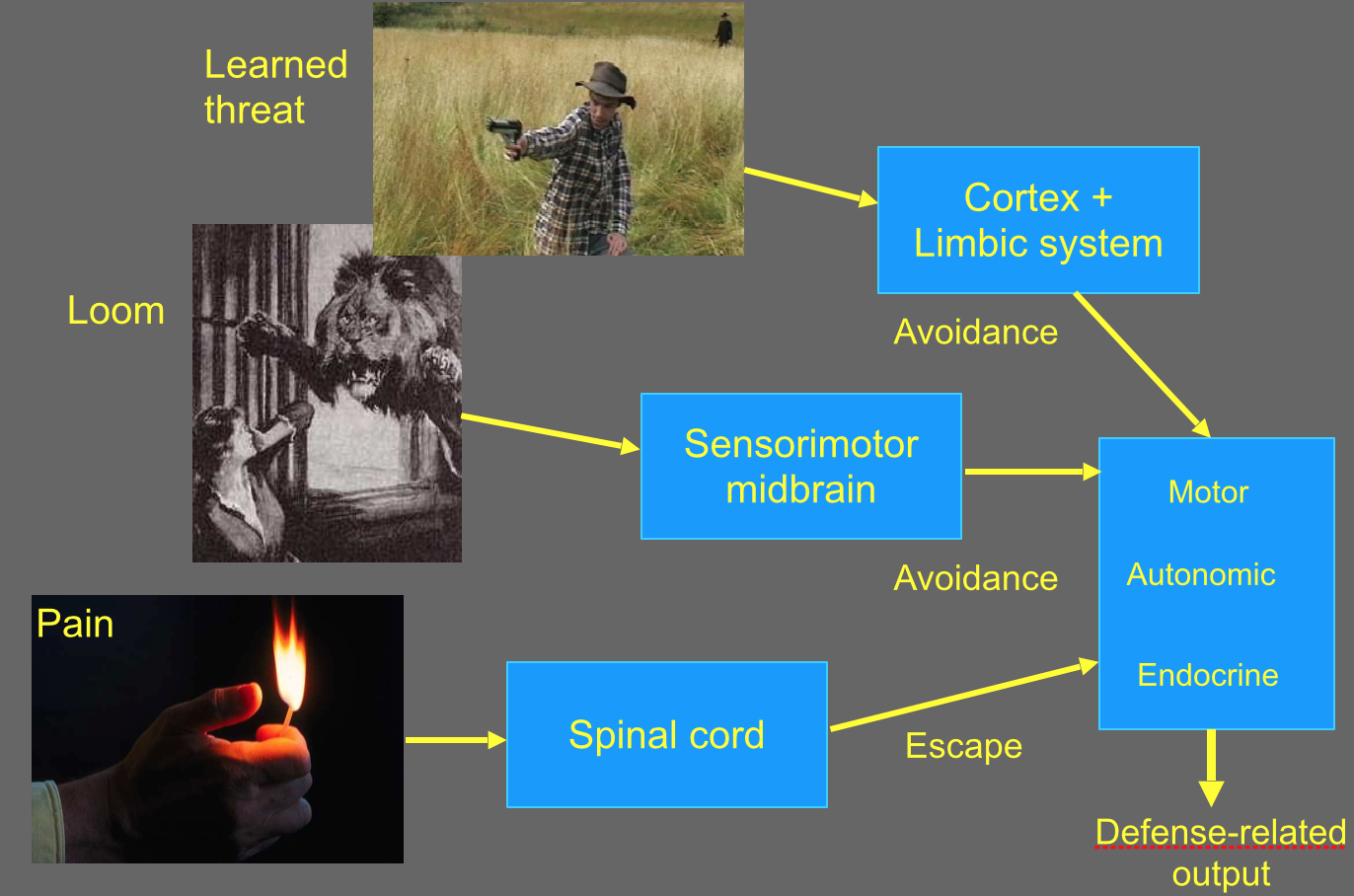
- Staying alive: avoidance of harm, body maintenance (feeding/drinking/temperature)
- Reproduction: sex and nurturing
- In a changing world flexibility is the key to survival
- The ability to model many aspects of the physical world (external and internal) accurately
- Sensory/motivational processes
- The ability to move and interact with the physical world
- Motor systems
- An appreciation of context and ability to integrate information from different sources
- Cognition
- The ability to model many aspects of the physical world (external and internal) accurately
- Basic problems associated with:
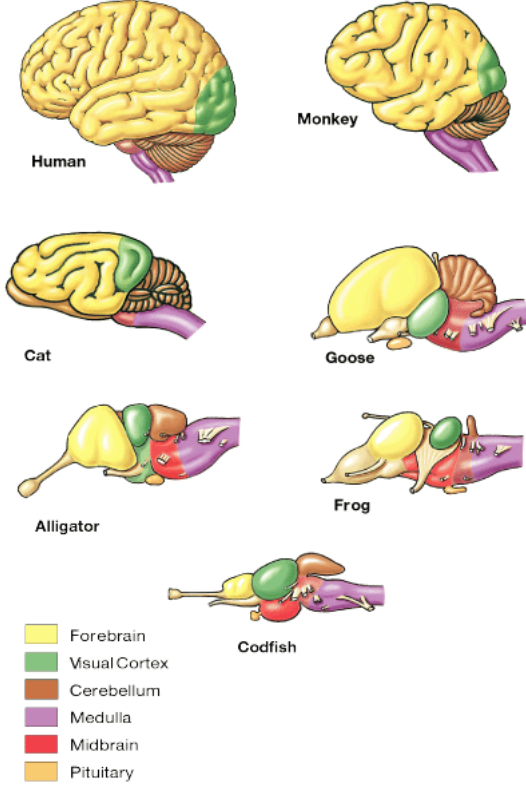
- Phylogenetic scale
- We see increasingly sophisticated solutions
- Fundamental architecture remains the same
- This is reflected in systematic changes in brain structures – e.g. some have got bigger/more elaborate
- But the basic architectural organisation has been retained within the brains of all vertebrates
- Indicates why studies of lower species e.g. rats can inform us about how the human brain operates
- Evolution develops increasingly sophisticated functional systems
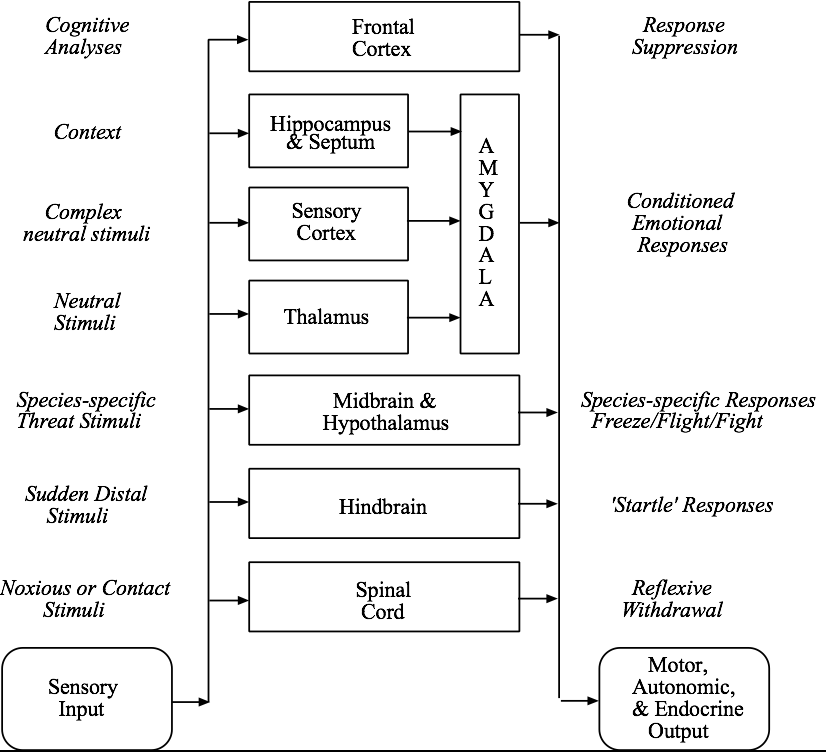
- Brain comprises hierarchy of functional systems providing increasingly sophisticated competences
- Fundamental architecture remains the same
- We see increasingly sophisticated solutions
Fundamental processing units
- If we want to know what the vertebrate brain does…important to identify the fundamental architectural components and determine their functions
- Localisation of function
- Different areas of the brain perform different tasks
- 1. Cortical and brainstem structures with specific function:
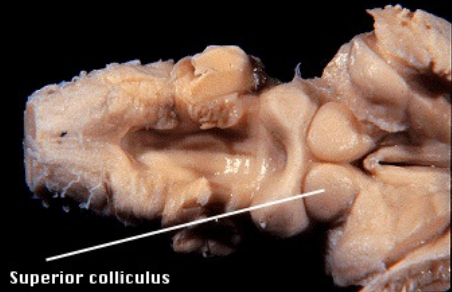
- Visual cortex/midbrain superior colliculus primary sensory areas processing information from eye
- Hand area in motor cortex/trigeminal motor nucleus primary motor structures providing commands for fine movements of fingers and mouth
- 2. Neural systems with a generic function
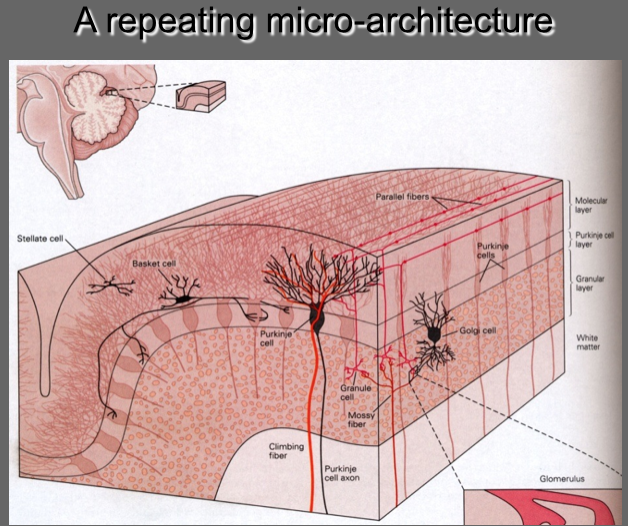
- A structure with repeating micro-architecture that processes information received from regions performing widely differing functions
- leads to idea of general/generic functions required for most/all tasks…e.g. attention, honing skills, memories of events, reward
- 1. Cortical and brainstem structures with specific function:
- Different areas of the brain perform different tasks
- Basic processing unit 1: Regions that generate behavioural options
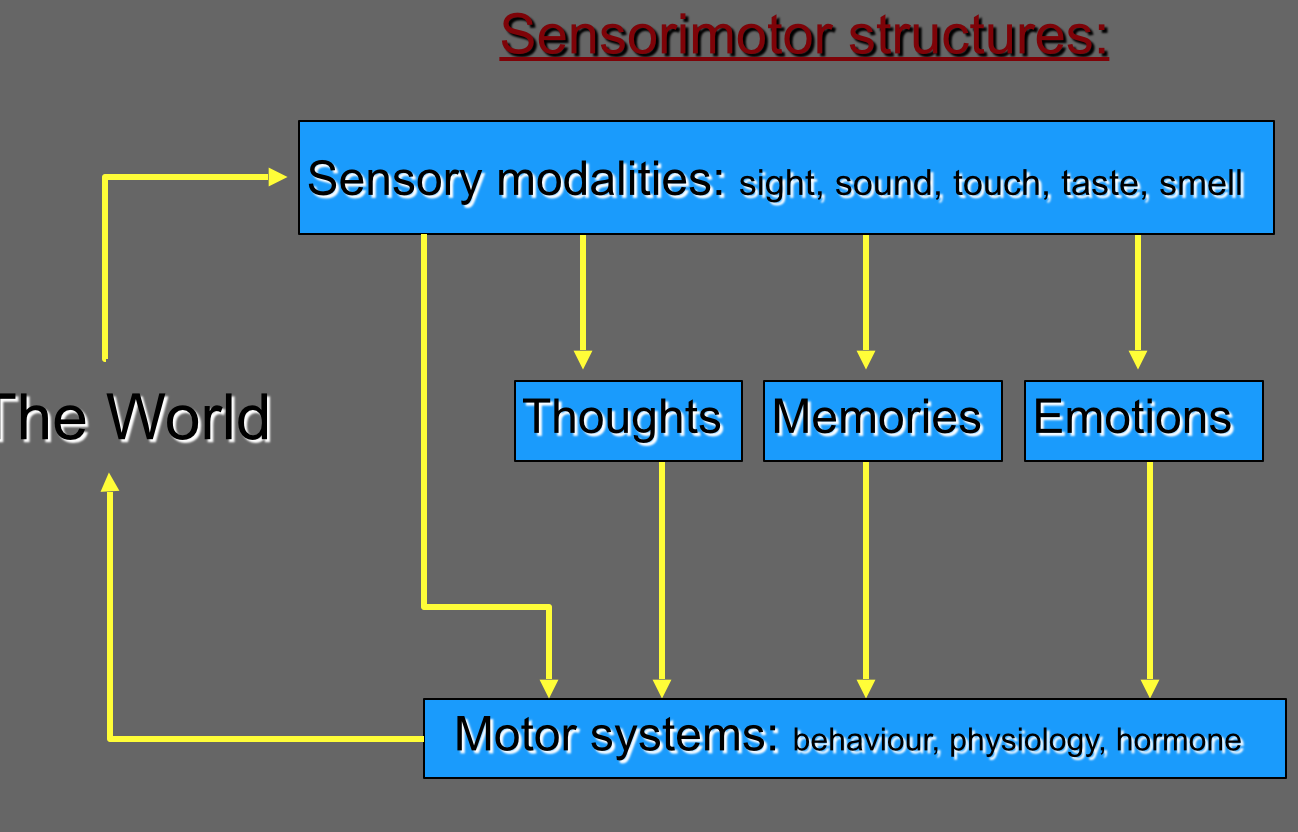
- Sensorimotor structures
- cerebral cortex
- Midbrain
- Hindbrain
- Each of these general brain divisions have sensory areas that project to motor areas that produce movement
- Example
- The midbrain superior colliculus
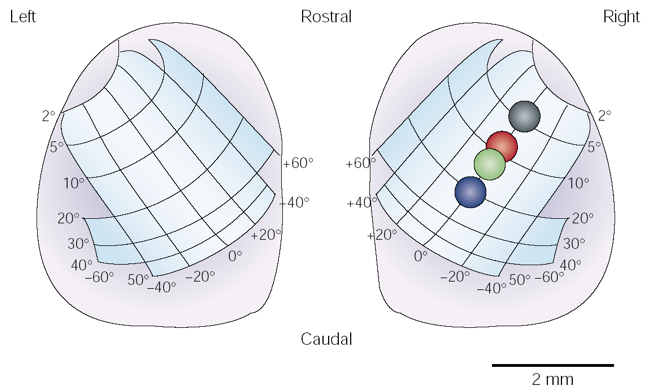
- Input from the retina
- Output to the eye muscles
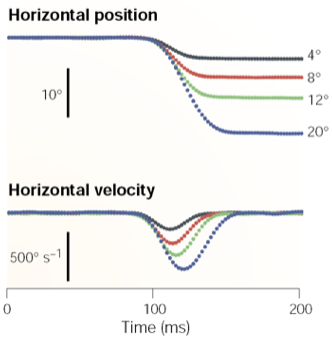
- Evoked eye movements
- Bring novel events onto the fovea
- Evoked eye movements
- Output to the eye muscles
- Retinotopic map of the visual world
- Input from the retina
- The midbrain superior colliculus
- Sensorimotor structures
The cerebellum
- Re-entrant loop architecture
- All sensorimotor, cognitive and motivational/affective structures connect to the cerebellum via re-entrant loops
- Structure of origin
- Pons
- Cerebellum
- (Thalamus)
- Structure of origin
- (Thalamus)
- Cerebellum
- Pons
- Structure of origin
- All sensorimotor, cognitive and motivational/affective structures connect to the cerebellum via re-entrant loops
- Architecture
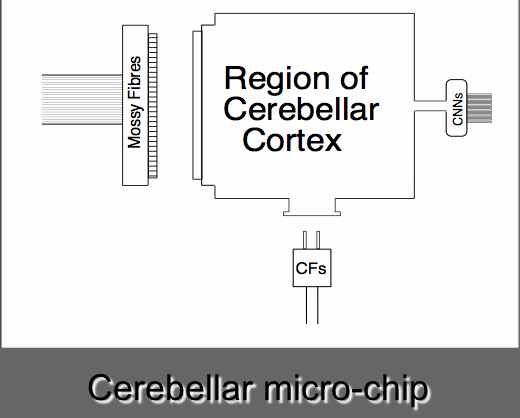
- Structure of cerebellar cortex has uniform microarchitecture over its entire surface
- Different cerebellar regions have different inputs and outputs, but same basic organization
- Therefore repeating microarchitecture is performing the same operation on different inputs
- Generic function
- Damage makes many movements inaccurate, slow and uncoordinated
- Other parts of the brain issue movement commands - cerebellum ensures they are carried out properly
- Predicts sensory consequences of own actions….so they can be ignored…..or improved if there is an error….skill development
- Re-entrant loop architecture
The Hippocampus
- Located in the temporal lobe
- Part of the limbic system
- External inputs
- Different (sensorimotor, cognitive motivational/affective) functional systems contact different territories
- Territories spatially distributed
- Microarchitecture common to all terrritories
- Generic function
- Critical for episodic memory
- Essential for construction of mental images
- Vital role in short term memory
- Spatial memory and navigation
Basal ganglia
- Function
- Selection
- Reinforcement
- Function
See lecture for summary slides
Bilder und Dateien der Mindmap
Informationen
- Beschreibung
- Undergraduate BMS236 Building Nervous Systems (Basal ganglia/Pete redgrave lectures) Mindmap am Systems level architecture, erstellt von Kristi Brogden am 07/08/2014.
- Erstellt von
- Kristi Brogden
- Aufrufe
- 22
- Bewertung