
Mindmap
Disney Identities Case Study
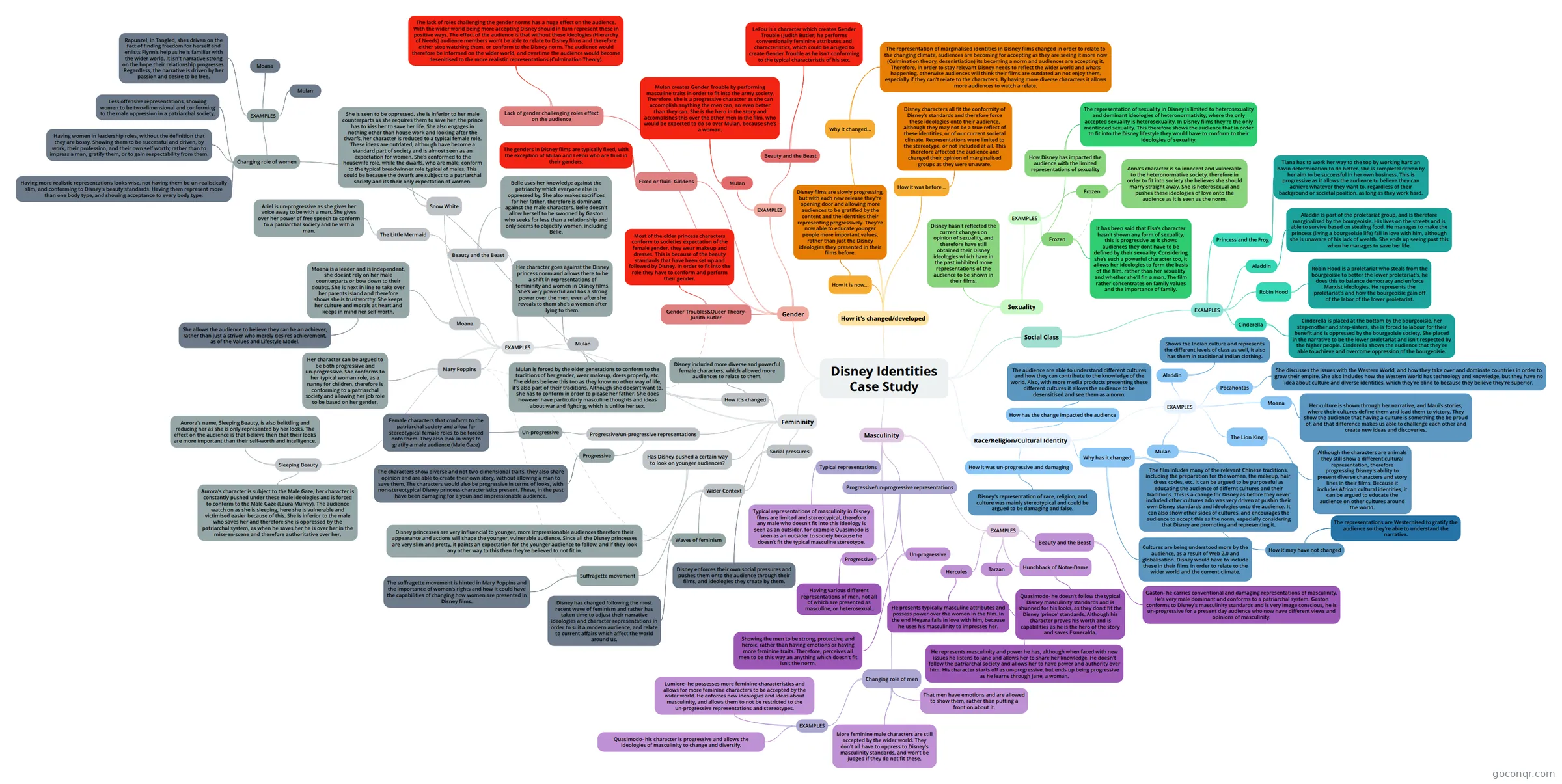
Mind map: Disney identities case study
Inhalt der Mindmap
Disney Identities Case Study
Masculinity
- Typical representations
- Typical representations of masculinity in Disney films are limited and stereotypical, therefore any male who doesn't fit into this ideology is seen as an outsider, for example Quasimodo is seen as an outsider to society because he doesn't fit the typical masculine stereotype.
- Progressive/un-progressive representations
- Progressive
- Having various different representations of men, not all of which are presented as masculine, or heterosexual.
- Un-progressive
- Showing the men to be strong, protective, and heroic, rather than having emotions or having more feminine traits. Therefore, perceives all men to be this way an anything which doesn't fit isn't the norm.
- Progressive
- EXAMPLES
- Hercules
- He presents typically masculine attributes and possess power over the women in the film. In the end Megara falls in love with him, because he uses his masculinity to impresses her.
- Tarzan
- He represents masculinity and power he has, although when faced with new issues he listens to Jane and allows her to share her knowledge. He doesn't follow the patriarchal society and allows her to have power and authority over him. His character starts off as un-progressive, but ends up being progressive as he learns through Jane, a woman.
- Hunchback of Notre-Dame
- Quasimodo- he doesn't follow the typical Disney masculinity standards and is shunned for his looks, as they don;t fit the Disney 'prince' standards. Although his character proves his worth and is capabilities as he is the hero of the story and saves Esmeralda.
- Beauty and the Beast
- Gaston- he carries conventional and damaging representations of masculinity. He's very male dominant and conforms to a patriarchal system. Gaston conforms to Disney's masculinity standards and is very image conscious, he is un-progressive for a present day audience who now have different views and opinions of masculinity.
- Hercules
- Changing role of men
- EXAMPLES
- Quasimodo- his character is progressive and allows the ideologies of masculinity to change and diversify.
- Lumiere- he possesses more feminine characteristics and allows for more feminine characters to be accepted by the wider world. He enforces new ideologies and ideas about masculinity, and allows them to not be restricted to the un-progressive representations and stereotypes.
- More feminine male characters are still accepted by the wider world. They don't all have to oppress to Disney's masculinity standards, and won't be judged if they do not fit these.
- That men have emotions and are allowed to show them, rather than putting a front on about it.
- EXAMPLES
- Typical representations
Race/Religion/Cultural Identity
- How it was un-progressive and damaging
- Disney's representation of race, religion, and culture was mainly stereotypical and could be argued to be damaging and false.
- Why has it changed
- Cultures are being understood more by the audience, as a result of Web 2.0 and globalisation. Disney would have to include these in their films in order to relate to the wider world and the current climate.
- How it may have not changed
- The representations are Westernised to gratify the audience so they're able to understand the narrative.
- How has the change impacted the audience
- The audience are able to understand different cultures and how they can contribute to the knowledge of the world. Also, with more media products presenting these different cultures it allows the audience to be desensitised and see them as a norm.
- EXAMPLES
- Mulan
- The film inludes many of the relevant Chinese traditions, including the preparation for the women, the makeup, hair, dress codes, etc. It can be argued to be purposeful as educating the audience of differnt cultures and their traditions. This is a change for Disney as before they never included other cultures adn was very driven at pushin their own Disney standards and ideologies onto the audience. It can also show other sides of cultures, and encourages the audience to accept this as the norm, especially considering that Disney are promoting and representing it.
- Moana
- Her culture is shown through her narrative, and Maui's stories, where their cultures define them and lead them to victory. They show the audience that having a culture is something the be proud of, and that difference makes us able to challenge each other and create new ideas and discoveries.
- Pocahontas
- She discusses the issues with the Western World, and how they take over and dominate countries in order to grow their empire. She also includes how the Western World has technology and knowledge, but they have no idea about culture and diverse identities, which they're blind to because they believe they're superior.
- Aladdin
- Shows the Indian culture and represents the different levels of class as well, it also has them in traditional Indian clothing.
- The Lion King
- Although the characters are animals they still show a different cultural representation, therefore progressing Disney's ability to present diverse characters and story lines in their films. Because it includes African cultural identities, it can be argued to educate the audience on other cultures around the world.
- Mulan
- How it was un-progressive and damaging
Sexuality
- How Disney has impacted the audience with the limited representations of sexuality
- The representation of sexuality in Disney is limited to heterosexuality and dominant ideologies of heteronormativity, where the only accepted sexuality is heterosexuality. In Disney films they're the only mentioned sexuality. This therefore shows the audience that in order to fit into the Disney lifestyle they would have to conform to their ideologies of sexuality.
- EXAMPLES
- Frozen
- It has been said that Elsa's character hasn't shown any form of sexuality, this is progressive as it shows audiences they dont have to be defined by their sexuality. Considering she's such a powerful character too, it allows her ideologies to form the basis of the film, rather than her sexuality and whether she'll fin a man. The film rather concentrates on family values and the importance of family.
- Frozen
- Anna's character is so innocent and vulnerable to the heteronormative society, therefore in order to fit into society she believes she should marry straight away. She is heterosexual and pushes these ideologies of love onto the audience as it is seen as the norm.
- Frozen
- Disney hasn't reflected the current changes on opinion of sexuality, and therefore have still obtained their Disney ideologies which have in the past inhibited more representations of the audience to be shown in their films.
- How Disney has impacted the audience with the limited representations of sexuality
How it's changed/developed
- How it was before...
- Disney characters all fit the conformity of Disney's standards and therefore force these ideologies onto their audience, although they may not be a true reflect of these identities, or of our current societal climate. Representations were limited to the stereotype, or not included at all. This therefore affected the audience and changed their opinion of marginalised groups as they were unaware.
- How it is now...
- Disney films are slowly progressing, but with each new release they're opening door and allowing more audiences to be gratified by the content and the identities their representing progressively. They're now able to educate younger people more important values, rather than just the Disney ideologies they presented in their films before.
- Why it changed...
- The representation of marginalised identities in Disney films changed in order to relate to the changing climate, audiences are becoming for accepting as they are seeing it more now (Culmination theory, desenistiation) its becoming a norm and audiences are accepting it. Therefore, in order to stay relevant Disney needs to reflect the wider world and whats happening, otherwise audiences will think their films are outdated an not enjoy them, especially if they can't relate to the characters. By having more diverse characters it allows more audiences to watch a relate.
- How it was before...
Gender
- Gender Troubles&Queer Theory- Judith Butler
- Most of the older princess characters conform to societies expectation of the female gender, they wear makeup and dresses. This is because of the beauty standards that have been set up and followed by Disney. In order to fit into the role they have to conform and perform their gender.
- Fixed or fluid- Giddens
- The genders in Disney films are typically fixed, with the exception of Mulan and LeFou who are fluid in their genders.
- EXAMPLES
- Mulan
- Mulan creates Gender Trouble by performing masculine traits in order to fit into the army society. Therefore, she is a progressive character as she can accomplish anything the men can, an even better than they can. She is the hero in the story and accomplishes this over the other men in the film, who would be expected to do so over Mulan, because she's a woman.
- Beauty and the Beast
- LeFou is a character which creates Gender Trouble (Judith Butler) he performs conventionally feminine attributes and characteristics, which could be aruged to create Gender Trouble as he isn't conforming to the typical characteristis of his sex.
- Mulan
- Lack of gender challenging roles effect on the audience
- The lack of roles challenging the gender norms has a huge effect on the audience. With the wider world being more accepting Disney should in turn represent these in positive ways. The effect of the audience is that without these ideologies (Hierarchy of Needs) audience members won't be able to relate to Disney films and therefore either stop watching them, or conform to the Disney norm. The audience would therefore be informed on the wider world, and overtime the audience would become desenitised to the more realistic representations (Culmination Theory).
- Gender Troubles&Queer Theory- Judith Butler
Femininity
- Social pressures
- Disney enforces their own social pressures and pushes them onto the audience through their films, and ideologies they create by them.
- Has Disney pushed a certain way to look on younger audiences?
- Disney princesses are very influencial to younger, more impressionable audiences therefore their appearance and actions will shape the younger, vulnerable audience. Since all the Disney princesses are very slim and pretty, it paints an expectation for the younger audience to follow, and if they look any other way to this then they're believed to not fit in.
- Progressive/un-progressive representations
- Progressive
- The characters show diverse and not two-dimensional traits, they also share opinion and are able to create their own story, without allowing a man to save them. The characters would also be progressive in terms of looks, with non-stereotypical Disney princess characteristics present. These, in the past have been damaging for a youn and impressionable audience.
- Un-progressive
- Female characters that conform to the patriarchal society and allow for stereotypical female roles to be forced onto them. They also look in ways to gratify a male audience (Male Gaze)
- Progressive
- How it's changed
- Disney included more diverse and powerful female characters, which allowed more audiences to relate to them.
- Changing role of women
- Having more realistic representations looks wise, not having them be un-realistically slim, and conforming to Disney's beauty standards. Having them represent more than one body type, and showing acceptance to every body type.
- EXAMPLES
- Rapunzel, in Tangled, shes driven on the fact of finding freedom for herself and enlists Flynn's help as he is familiar with the wider world. It isn't narrative strong on the hope their relationship progresses. Regardless, the narrative is driven by her passion and desire to be free.
- Moana
- Mulan
- Less offensive representations, showing women to be two-dimensional and conforming to the male oppression in a patriarchal society.
- Having women in leadership roles, without the definition that they are bossy. Showing them to be successful and driven, by work, their profession, and their own self worth; rather than to impress a man, gratify them, or to gain respectability from them.
- Wider Context
- Suffragette movement
- The suffragette movement is hinted in Mary Poppins and the importance of women's rights and how it could have the capabilities of changing how women are presented in Disney films.
- Waves of feminism
- Disney has changed following the most recent wave of feminism and rather has taken time to adjust their narrative ideologies and character representations in order to suit a modern audience, and relate to current affairs which affect the world around us.
- Suffragette movement
- EXAMPLES
- Mary Poppins
- Her character can be argued to be both progressive and un-progressive. She conforms to her typical woman role, as a nanny for children, therefore is conforming to a patriarchal society and allowing her job role to be based on her gender.
- Moana
- Moana is a leader and is independent, she doesnt rely on her male counterparts or bow down to their doubts. She is next in line to take over her parents island and therefore shows she is trustworthy. She keeps her culture and morals at heart and keeps in mind her self-worth.
- She allows the audience to believe they can be an achiever, rather than just a striver who merely desires achievement, as of the Values and Lifestyle Model.
- Moana is a leader and is independent, she doesnt rely on her male counterparts or bow down to their doubts. She is next in line to take over her parents island and therefore shows she is trustworthy. She keeps her culture and morals at heart and keeps in mind her self-worth.
- Beauty and the Beast
- Belle uses her knowledge against the patriarchy which everyone else is oppressed by. She also makes sacrifices for her father, therefore is dominant against the male characters. Belle doesn't allow herself to be swooned by Gaston who seeks for less than a relationship and only seems to objectify women, including Belle.
- Mulan
- Mulan is forced by the older generations to conform to the traditions of her gender, wear makeup, dress properly, etc. The elders believe this too as they know no other way of life; it's also part of their traditions. Although she doesn't want to, she has to conform in order to please her father. She does however have particularly masculine thoughts and ideas about war and fighting, which is unlike her sex.
- Her character goes against the Disney princess norm and allows there to be a shift in representations of femininity and women in Disney films. She's very powerful and has a strong power over the men, even after she reveals to them she's a women after lying to them.
- The Little Mermaid
- Ariel is un-progressive as she gives her voice away to be with a man. She gives over her power of free speech to conform to a patriarchal society and be with a man.
- Snow White
- She is seen to be oppressed, she is inferior to her male counterparts as she requires them to save her, the prince has to kiss her to save her life. She also engages in nothing other than house work and looking after the dwarfs, her character is reduced to a typical female role. These ideas are outdated, although have become a standard part of society and is almost seen as an expectation for women. She's conformed to the housewife role, while the dwarfs, who are male, conform to the typical breadwinner role typical of males. This could be because the dwarfs are subject to a patriarchal society and its their only expectation of women.
- Sleeping Beauty
- Aurora's character is subject to the Male Gaze, her character is constantly pushed under these male ideologies and is forced to conform to the Male Gaze (Laura Mulvey). The audience watch on as she is sleeping, here she is vulnerable and victimised easier because of this. She is inferior to the male who saves her and therefore she is oppressed by the patriarchal system, as when he saves her he is over her in the mise-en-scene and therefore authoritative over her.
- Aurora's name, Sleeping Beauty, is also belittling and reducing her as she is only represented by her looks. The effect on the audience is that believe then that their looks are more important than their self-worth and intelligence.
- Mary Poppins
- Social pressures
Social Class
- EXAMPLES
- Cinderella
- Cinderella is placed at the bottom by the bourgeoisie, her step-mother and step-sisters, she is forced to labour for their benefit and is oppressed by the bourgeoisie society. She placed in the narrative to be the lower proletariat and isn't respected by the higher people. Cinderella shows the audience that they're able to achieve and overcome oppression of the bourgeoisie.
- Aladdin
- Aladdin is part of the proletariat group, and is therefore marginalised by the bourgeoisie. His lives on the streets and is able to survive based on stealing food. He manages to make the princess (living a bourgeoisie life) fall in love with him, although she is unaware of his lack of wealth. She ends up seeing past this when he manages to save her life.
- Robin Hood
- Robin Hood is a proletariat who steals from the bourgeoisie to better the lower proletariat's, he does this to balance democracy and enforce Marxist ideologies. He represents the proletariat's and how the bourgeoisie gain off of the labor of the lower proletariat.
- Princess and the Frog
- Tiana has to work her way to the top by working hard an havin determination to do better. She is completel driven by her aim to be successful in her own business. This is progressive as it allows the audience to believe they can achieve whatever they want to, regardless of their background or societal position, as long as they work hard.
- Cinderella
- EXAMPLES
Informationen
- Beschreibung
- Mindmap am Disney Identities Case Study, erstellt von Lauren Solly am 17/05/2018.
- Erstellt von
- Lauren Solly
- Aufrufe
- 3
- Bewertung