
Mindmap
Science - Biodiversity
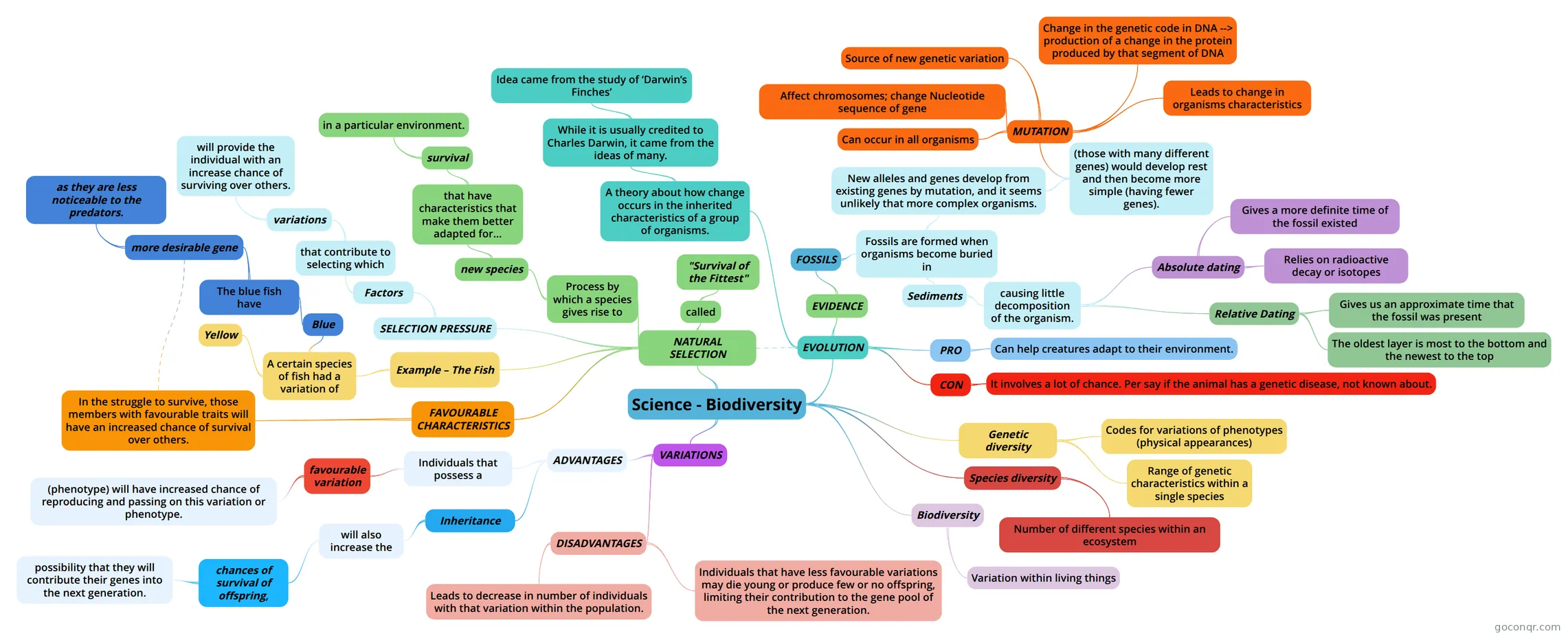
Mind map: Science biodiversity
Inhalt der Mindmap
Science - Biodiversity
NATURAL SELECTION
- Process by which a species gives rise to
- new species
- that have characteristics that make them better adapted for...
- survival
- in a particular environment.
- survival
- that have characteristics that make them better adapted for...
- new species
- SELECTION PRESSURE
- Factors
- that contribute to selecting which
- variations
- will provide the individual with an increase chance of surviving over others.
- variations
- that contribute to selecting which
- Factors
- Example – The Fish
- A certain species of fish had a variation of
- Blue
- The blue fish have
- more desirable gene
- as they are less noticeable to the predators.
- more desirable gene
- The blue fish have
- Yellow
- Blue
- A certain species of fish had a variation of
- FAVOURABLE CHARACTERISTICS
- In the struggle to survive, those members with favourable traits will have an increased chance of survival over others.
- called
- "Survival of the Fittest"
- Process by which a species gives rise to
EVOLUTION
- A theory about how change occurs in the inherited characteristics of a group of organisms.
- While it is usually credited to Charles Darwin, it came from the ideas of many.
- Idea came from the study of ‘Darwin’s Finches’
- While it is usually credited to Charles Darwin, it came from the ideas of many.
- PRO
- Can help creatures adapt to their environment.
- CON
- It involves a lot of chance. Per say if the animal has a genetic disease, not known about.
- EVIDENCE
- FOSSILS
- Fossils are formed when organisms become buried in
- New alleles and genes develop from existing genes by mutation, and it seems unlikely that more complex organisms.
- (those with many different genes) would develop rest and then become more simple (having fewer genes).
- MUTATION
- Can occur in all organisms
- Affect chromosomes; change Nucleotide sequence of gene
- Source of new genetic variation
- Change in the genetic code in DNA --> production of a change in the protein produced by that segment of DNA
- Leads to change in organisms characteristics
- MUTATION
- (those with many different genes) would develop rest and then become more simple (having fewer genes).
- Sediments
- causing little decomposition of the organism.
- Absolute dating
- Gives a more definite time of the fossil existed
- Relies on radioactive decay or isotopes
- Relative Dating
- Gives us an approximate time that the fossil was present
- The oldest layer is most to the bottom and the newest to the top
- Absolute dating
- causing little decomposition of the organism.
- New alleles and genes develop from existing genes by mutation, and it seems unlikely that more complex organisms.
- Fossils are formed when organisms become buried in
- FOSSILS
- A theory about how change occurs in the inherited characteristics of a group of organisms.
Biodiversity
- Variation within living things
Species diversity
- Number of different species within an ecosystem
Genetic diversity
- Range of genetic characteristics within a single species
- Codes for variations of phenotypes (physical appearances)
VARIATIONS
- ADVANTAGES
- Individuals that possess a
- favourable variation
- (phenotype) will have increased chance of reproducing and passing on this variation or phenotype.
- favourable variation
- Inheritance
- will also increase the
- chances of survival of offspring,
- possibility that they will contribute their genes into the next generation.
- chances of survival of offspring,
- will also increase the
- Individuals that possess a
- DISADVANTAGES
- Individuals that have less favourable variations may die young or produce few or no offspring, limiting their contribution to the gene pool of the next generation.
- Leads to decrease in number of individuals with that variation within the population.
- ADVANTAGES
Informationen
- Beschreibung
- Mindmap am Science - Biodiversity, erstellt von Maria Interino am 07/06/2018.
- Erstellt von
- Maria Interino
- Aufrufe
- 0
- Bewertung