
Mindmap
Software Development Life Cycle
Inhalt der Mindmap
Software Development Life Cycle
SOFTWARE DEVELOPMENT LIFE CYCLE MODEL
- coThe term software development life cycle model is a way of describing the planning, designing, ding, and testing of a software system, as well as the method in which these steps are implemented.
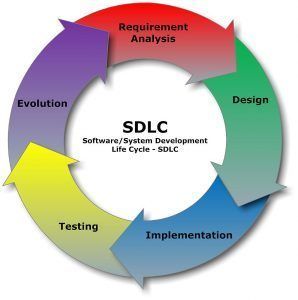
- All life cycle models take a project through several primary phases: a requirements-gathering phase, a design phase, a construction or implementation phase, and a testing phase. Figure 4-1 provides a simplified illustration of the general software development life cycle model.
- Figure 4-1
- Each phase produces feedback that affects the next phase. For instance, the requirements gathered during the requirements phase influence the design, which is translated into working software code during the implementation phase. The software code is verified against the requirements during the testing phase.
- Requirements
- Design
- Implementation
- Testing
- In the testing phase, the results of the implementation phase are run through a series of tests to verify that it functions and that it meets goals of the requirements phase. A testing plan is created to describe the unit tests and system tests that will be performed. Unit testing is performed on individual software components. The process of integration brings together all the software components to create a complete system. System testing is performed on the software system as a whole.
- In the implementation phase, the results of the design phase are translated into program code. Software that does not meet the needs of the company is wasteful. During this phase the programmers should make it their central goal to fulfill the requirements of the company and to meet the design outlined in the design phase.
- Testing
- In the design phase, the results of the requirements-gathering phase are translated into a software design plan. Focus shifts from the system's results to the way in which those results will be achieved and how the ideas of the requirements-gathering phase are accomplished. Designers consider many different criteria, from the hardware and operating system platform that hosting the software to the way subsystems will communicate with each other.
- Implementation
- During the requirements-gathering phase, the needs of the company are outlined. Managers and users (and in some cases, clients) make their “wish-lists” about what they would like the software to do. Analysts ask questions about the intended use of the software, what type of data will be processed, how the software should handle the data, and how the data can be accessed once in the system.
- Design
- Figure 4-1
- All life cycle models take a project through several primary phases: a requirements-gathering phase, a design phase, a construction or implementation phase, and a testing phase. Figure 4-1 provides a simplified illustration of the general software development life cycle model.
- coThe term software development life cycle model is a way of describing the planning, designing, ding, and testing of a software system, as well as the method in which these steps are implemented.
WATERFALL LIFE CYCLE MODEL
- The Waterfall life cycle model, also known as the classic or linear-sequential life cycle model, is one of the simplest to understand and use. The Waterfall model is characterized by a series of steps that must be completed in a linear, sequential order. Each phase is completed and verified before development progresses to the next phase. Figure 4-2 illustrates the Waterfall life cycle model.
- Following each phase is a formal review process that results in the decision to proceed to the next phase. Testing is performed late in the development process, and phases do not overlap. When one phase is completed, the entire development effort shifts to the next phase. This cascading flow from one phase to another is the basis of the Waterfall model’s name.
- Advantages of the Waterfall model
- This model can be easy to implement and manage because each phase has a specific purpose, and development occurs in only one phase at a time.
- Disadvantages of the Waterfall model
- If requirements change or are added, the project must start over from the beginning. No working software is developed until very late in the process, and this delay creates a great deal of uncertainty and risk. If errors are made in requirements-gathering or design, they may not be discovered until very late in the implementation or testing phases.
- Advantages of the Waterfall model
- Following each phase is a formal review process that results in the decision to proceed to the next phase. Testing is performed late in the development process, and phases do not overlap. When one phase is completed, the entire development effort shifts to the next phase. This cascading flow from one phase to another is the basis of the Waterfall model’s name.
- figure 4-2
- Requirements
- Design
- Implementation and Unit Testing
- Integration and System Testing
- Operation
- Integration and System Testing
- Implementation and Unit Testing
- Design
- Requirements
- The Waterfall life cycle model, also known as the classic or linear-sequential life cycle model, is one of the simplest to understand and use. The Waterfall model is characterized by a series of steps that must be completed in a linear, sequential order. Each phase is completed and verified before development progresses to the next phase. Figure 4-2 illustrates the Waterfall life cycle model.
V-SHAPED LIFE CYCLE MODEL
- Like the Waterfall model, the V-Shaped life cycle model provides a sequential path of discrete phases that must each be completed before development proceeds to the next phase.
- figure 4-3
- Requirements
- High Level Design
- Low Level Design
- Implementation
- Unit Test Planning
- Unit Testing
- Integration Test Planning
- Integration Testing
- Low Level Design
- System Test Planning
- System Testing
- High Level Design
- Requirements
- Advantages of the V-Shaped model
- Like the Waterfall model, the V-Shaped model is appropriate for small development projects in which requirements are well understood.
- Disadvantages of the V-Shaped model
- The emphasis in test planning appears to reduce risk, but, like the Waterfall model, the V-shaped model risks time and energy in the absence of careful planning.
INCREMENTAL LIFE CYCLE MODEL
- The Incremental life cycle model builds an iterative approach into the Waterfall model.
- Figure 4-4 illustrates the Incremental life cycle model.
- Figure 4-4
- Requirements
- Design
- Implementation and Unit Testing
- Integration and System Testing
- Operation
- Integration and System Testing
- Implementation and Unit Testing
- Design
- Requirements
- Figure 4-4
- Figure 4-4 illustrates the Incremental life cycle model.
- Advantages of the Incremental model
- The iterative nature of the Incremental model makes it more flexible when adding or changing requirements.
- Disadvantages of the Incremental model
- Like the Waterfall model, the Incremental model exhibits some rigidity in that phases cannot be overlapped.
- The Incremental life cycle model builds an iterative approach into the Waterfall model.
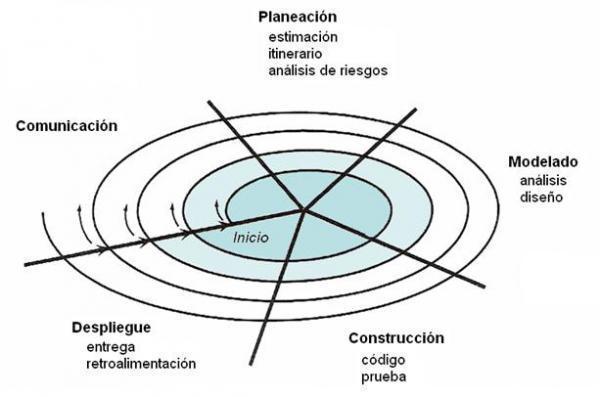
SPIRAL LIFE CYCLE MODEL
- is similar to the Incremental model but incorporates risk analysis. It is divided into four phases: planning, risk analysis, engineering, and evaluation.
- Advantages of the Spiral model
- The focus on risk avoidance makes the Spiral model ideal for large-scale and missioncritical products.
- Disadvantages of the Spiral model
- The Spiral model is inappropriate for use in small and medium-scale projects that are not mission-critical.
- figure 5-5
Bilder und Dateien der Mindmap
Informationen
- Beschreibung
- programacion de software Mindmap am Software Development Life Cycle, erstellt von santiago acevedo am 28/08/2018.
- Erstellt von
- santiago acevedo
- Aufrufe
- 0
- Verlauf
-
- Erstellt von santiago acevedo · 28 Aug 2018
- Kopiert von santiago acevedo · 28 Aug 2018
- Bewertung