
Mindmap
UNIT 3
Inhalt der Mindmap
UNIT 3
HAVE / HAVE GOT = tengo (no cambia el significado).
- HAVE
- Expresiones como:
- Comer / Beber algo
- I don't usually HAVE breakfast.
- I HAD two cups of coffee this morning.
- DAR a party a walk a look
- We ARE HAVING a party nex week.
- Can I HAVE a look at your newspaper?
- TENER a holiday a good trip a dream a baby
- Sandra has just HAD a baby.
- a bath a game a rest a swim a good time
- Did you HAVE a good time in London?
- Comer / Beber algo
- Expresiones como:
- HAVE GOT
- Afirmación
- I´VE GOT a motorbike
- Negación
- Tracey and Jeff HAVEN´T GOT any children.
- DON'T / DOESN'T
- They DON'T HAVE any children. (= They HAVEN'T GOT any children)
- It's a nice house, but it DOESN'T HAVE a garden. ( = ...it HASN'T GOT a garden)
- Interrogación
- HAVE you GOT a camera?
- DO / DOES
- DOES Helen HAVE a car? = HAS Helen GOT a car?
- What DO you HAVE in your bag? = What HAVE you GOT in your bag?
- HAVE vs HAVE GOT
- I HAVE/HAVE GOT a new shower. It's very good
- I HAVE a shower every morning. (no I've got...)
- Afirmación
- I HAVE/HAVE GOT blue eyes.
- Our car HAS /HAS GOT four doors.
- They HAVE/HAVE GOT a dog.
- HAVE
Preposiciones de MOVIMIENTO
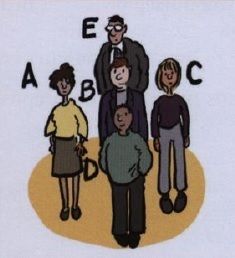
- BETWEEN (entre)
- E is BEHIND B
- B is BETWEEN A and C.
- A is NEXT/BESIDE to B
- NEXT TO / BESIDE (junto a / al lado de)
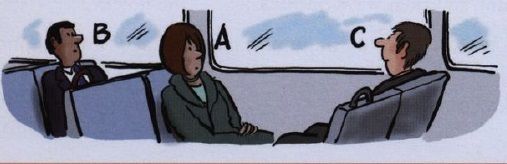
- OPPOSITE / IN FRONT OF (en frente de/ delante de)
- A is sitting OPPOSITE C.
- A is sitting IN FRONT OF B.
- TO / FROM
- TO
- Que va hacia ...
- Jane is going TO France next week.
- Que va hacia ...
- FROM
- Que viene desde ...
- A lot of English words come FROME Latin.
- We walked FROM the hotel TO the station.
- A lot of English words come FROME Latin.
- Que viene desde ...
- TO
- BEHIND (detras de)
- ABOVE y BELOW (por encima de/por debajo de) (sin contacto)
- The pictures are ABOVE THE SHELVES.
- The shelves are BELOW THE PICTURES.
- INTO / OUT OF
- INTO
- Que va hacia dentro de algo
- We jumped INTO the water.
- Que va hacia dentro de algo
- OUT OF
- Que sale de algo.
- I took the old batteries OUT OF the radio.
- A man came OUT OF the house and got INTO a car
- I took the old batteries OUT OF the radio.
- Que sale de algo.
- INTO
- UNDER (debajo de...)
- The girl is standing UNDER a tree.
- The cat is UNDER the table
- UP / DOWN
- UP
- Hacia arriba
- We walked UP the hill to the house.
- Hacia arriba
- DOWN
- Hacia abajo
- Be careful! Don't fall DOWN the stairs.
- Hacia abajo
- UP
- ON / OFF
- ON
- Que está sobre (haciendo contacto)
- Don't put your feet ON the table.
- Que está sobre (haciendo contacto)
- OFF
- Está callendo o a punto de caer.
- Please take your feet OFF the table.
- Está callendo o a punto de caer.
- ON
- OVER / UNDER
- OVER
- Por encima (sin hacer contacto).
- The plane flew OVER the mountains.
- Por encima (sin hacer contacto).
- UNDER
- Por debajo de
- Some people say it's unlucky to walk UNDER a ladder.
- Por debajo de
- OVER
- ALONG / AROUND
- AROUND / ROUND
- Alrededor de ...
- We walked AROUND the town.
- Alrededor de ...
- ALONG
- A lo largo de...
- I was walking ALONG the road.
- A lo largo de...
- AROUND / ROUND
- THROUGH / ACROSS = através de...
- THROUGH
- Para algo vertical
- una ventana un bosque
- The old road goes THROUGH the village.
- A bird flew into the room THROUGH a window.
- una ventana un bosque
- Para algo vertical
- ACROSS
- Para algo horizontal
- un valle la calle un río
- The dog swam ACROSS the river
- We ran ACROSS the road.
- un valle la calle un río
- Para algo horizontal
- THROUGH
- BY / PAST = al lado/junto de...
- PAST
- They walked PAST me without speaking.
- BY
- Our house is BY the sea.
- PAST
- BETWEEN (entre)
Preposiciones de LUGAR
- AT = EN (un lugar).
- Pero NO dentro o rodeado por ese lugar
- AT the bus stop
- at the bus stop at the door at the traffic lights at her desk
- AT the door
- AT the traffic lights
- AT her desk
- AT the bus stop
- AT (the top/the bottom/the end). = al principio / al final de ...
- Write your name AT the top
- My house is AT the end of the street.
- Expresiones como:
- at home
- at work / at school
- at university
- at the station/airport
- at (a concert / a party / a football).
- home / at home = en casa
- go/come/walk etc HOME
- I'm tired. I'm GOING HOME.
- Did you WALKHOME?
- be/stay/do something AT HOME
- I'm STAYING AT HOME tonight
- go/come/walk etc HOME
- Pero NO dentro o rodeado por ese lugar
- ON = EN (sobre / encima de...)
- on the ceiling on a plate on a bicycle on the table on the floor on a horse on a shelf on a balcony
- Who is that man ON the horse?
- Expresiones como:
- ON a (bus/train/plane/ship)
- Did you come here ON the bus?
- ON the (right/left)
- My desk is ON THE LEFT of the window.
- ON the (first/ground floor)
- ON a (bus/train/plane/ship)
- on the ceiling on a plate on a bicycle on the table on the floor on a horse on a shelf on a balcony
- TO = A (dirección)
- We walked from my house TO the center of town.
- You must come TO our house.
- IN = EN (un lugar).
- Dentro o rodeado por un lugar o área delimitada
- Jim works IN A (SHOP/BANK/FACTORY).
- Kevin is IN (THE KITCHEN/THE GARDEN/LONDON).
- What's IN THAT (BOX/BAG/CUPBOARD)?
- I went for a swim IN THE (POOL/RIVER/SEA).
- Expresiones como:
- in the middle of / in bed / in a newspaper / in a book / in hospital / in the sky
- David's father is ill. He's IN HOSPITAL
- in the middle of / in bed / in a newspaper / in a book / in hospital / in the sky
- Detrás de un superlativo: IN = DE
- Whast's the largest city IN the world?
- IN vs AT
- Para edificios
- We stayed IN / AT nice hotel
- Situaciones be/stay/do something ...
- The main shops ARE IN THE CENTER OF TOWN
- I like READING IN BED.
- The bus IS AT THE AIRPORT.
- I meet a lot of people at the party
- ARRIVE / GET TO
- ARRIVE IN + país / ciudad
- Arrive IN Germany
- ARRIVE AT + otros lugares
- Arrive AT the station/hotel.
- GET TO + lugar = llegar a...
- What time did you GET TO the hotel?
- sin preposición
- I was tired when I got home.
- I was tired when I arrived home.
- ARRIVE IN + país / ciudad
- Para edificios
- Dentro o rodeado por un lugar o área delimitada
- AT = EN (un lugar).
Preposiciones de TIEMPO
- AT / ON / IN
- AT
- La hora
- I start work AT 8 O'CLOCK
- Se dice:
- AT the weekend = el fin de semana
- AT night = por la noche
- AT Chrismas = en Navidad
- AT the end of = al final de
- AT the moment = ahora
- La hora
- ON
- Días y fechas
- The concert is ON 22 November
- ON Monday morning/afternoon/evening/etc. = El Lunes por la mañana/tarde/noche
- Días y fechas
- IN
- Meses / años / estaciones
- Emma was born IN 1983
- IN the morning/afternon/evening = por la mañana/tarde/noche
- IN = dentro de..
- I will see you IN a few days.
- Meses / años / estaciones
- No se usan delante de: THIS / LAST / NEXT / EVERY
- We go on holiday EVERY SUMMER.
- I'm living NEXT MONDAY.
- Are you going out THIS EVENING?
- AT
- FROM... TO / UNTIL / SINCE / FOR
- FROM...TO... = desde...hasta...
- We lived in Japan FROM 1992 TO/UNTIL 2000
- UNTIL (TILL) = hasta/hasta que
- Wait here UNTIL/TILL I come back.
- SINCE = desde.../desde que...
- Se usa detrás del Present Perfect (have been/done)
- Sue and Dave HAVE BEEN married SINCE 1999.
- Joe is in hospital. He has been in hospital SINCE Monday
- It HAS BEEN raining SINCE I arrived
- Con un periodo de tiempo determinado se usa FOR
- Joe has been in hospital FOR THREE DAYS. (...desde hace 3 días)
- They've been married FOR TEN YEARS.
- Se usa detrás del Present Perfect (have been/done)
- FOR = "durante" o sin esquivalente en español
- Gary stayed with me FOR three days
- I'm going away FOR a few weeks. (Me voy fuera UNAS semnas)
- FROM...TO... = desde...hasta...
- BEFORE / AFTER / DURING / WHILE
- BEFORE = antes
- Everybody feel nervous BEFORE exams.
- NUNCA pueden llevar detrás un INFINITIVO:
- BEFORE EATING the apple, I washed it carefully. (no BEFORE TO EAT)
- I started work AFTER READING the newspaper. (no AFTER TO READ)
- AFTER = después
- We were tired AFTER our visit to the museum.
- DURING + nombre = durante
- We didn't speak DURING THE MEAT.
- WHILE + verbo = mientras
- We didn't speak WHILE WE WERE EATING.
- BEFORE = antes
- AT / ON / IN
Bilder und Dateien der Mindmap
Informationen
- Beschreibung
- Mapa de unidad 3 comprensión de lectura de textos en inglés
- Erstellt von
- Luis Arellano · Nov 2018
- Aktualisiert
- 3 Nov 2018
- Aufrufe
- 7
- Bewertung