
Mindmap
Basal Tetrapods
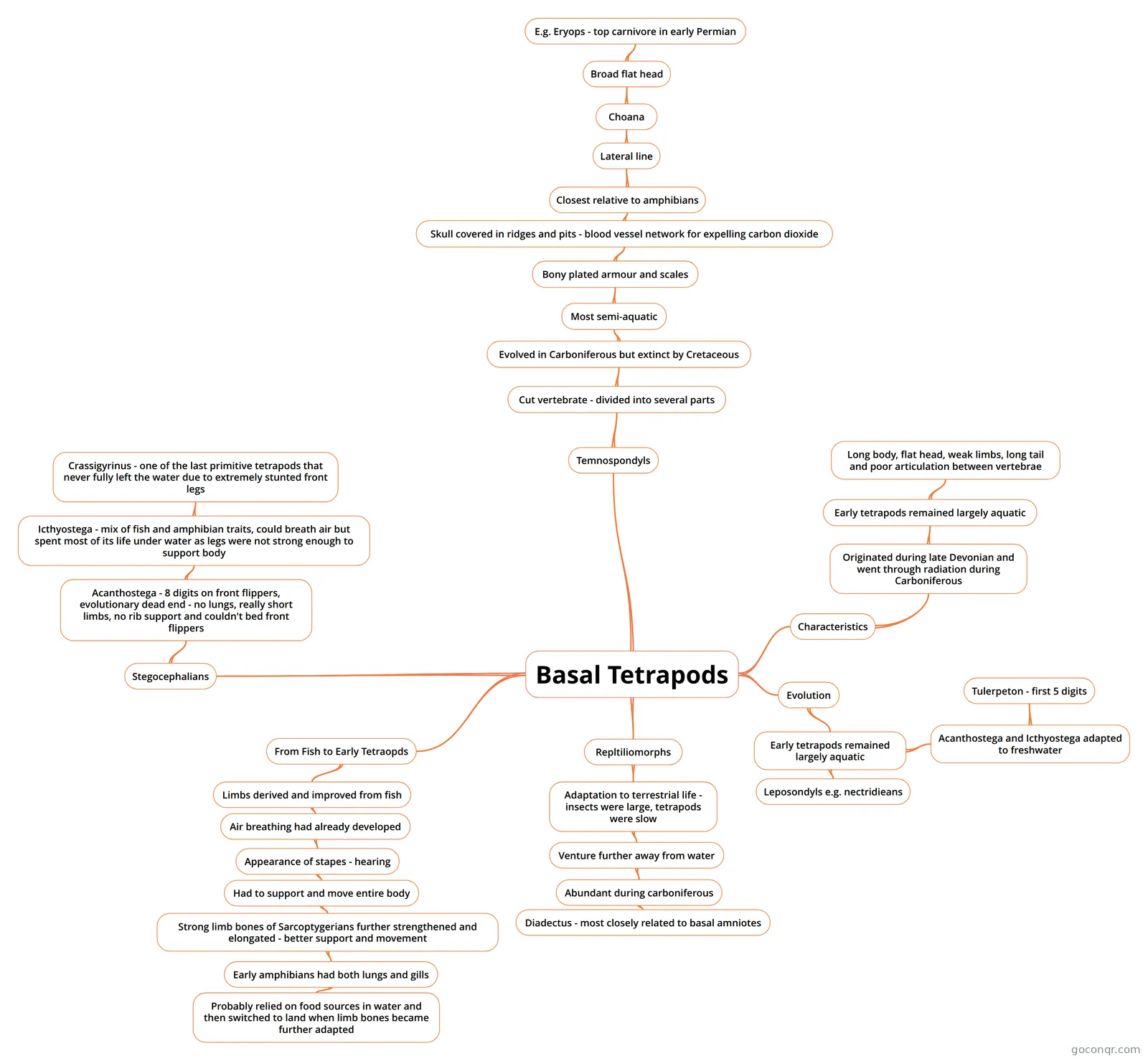
Mind map: Basal tetrapods
Inhalt der Mindmap
Basal Tetrapods
Evolution
- Early tetrapods remained largely aquatic
- Acanthostega and Icthyostega adapted to freshwater
- Tulerpeton - first 5 digits
- Leposondyls e.g. nectridieans
- Acanthostega and Icthyostega adapted to freshwater
- Early tetrapods remained largely aquatic
From Fish to Early Tetraopds
- Limbs derived and improved from fish
- Air breathing had already developed
- Appearance of stapes - hearing
- Had to support and move entire body
- Strong limb bones of Sarcoptygerians further strengthened and elongated - better support and movement
- Early amphibians had both lungs and gills
- Probably relied on food sources in water and then switched to land when limb bones became further adapted
- Early amphibians had both lungs and gills
- Strong limb bones of Sarcoptygerians further strengthened and elongated - better support and movement
- Had to support and move entire body
- Appearance of stapes - hearing
- Air breathing had already developed
- Limbs derived and improved from fish
Stegocephalians
- Acanthostega - 8 digits on front flippers, evolutionary dead end - no lungs, really short limbs, no rib support and couldn't bed front flippers
- Icthyostega - mix of fish and amphibian traits, could breath air but spent most of its life under water as legs were not strong enough to support body
- Crassigyrinus - one of the last primitive tetrapods that never fully left the water due to extremely stunted front legs
- Icthyostega - mix of fish and amphibian traits, could breath air but spent most of its life under water as legs were not strong enough to support body
- Acanthostega - 8 digits on front flippers, evolutionary dead end - no lungs, really short limbs, no rib support and couldn't bed front flippers
Temnospondyls
- Cut vertebrate - divided into several parts
- Evolved in Carboniferous but extinct by Cretaceous
- Most semi-aquatic
- Bony plated armour and scales
- Skull covered in ridges and pits - blood vessel network for expelling carbon dioxide
- Closest relative to amphibians
- Lateral line
- Choana
- Broad flat head
- E.g. Eryops - top carnivore in early Permian
- Broad flat head
- Choana
- Lateral line
- Closest relative to amphibians
- Skull covered in ridges and pits - blood vessel network for expelling carbon dioxide
- Bony plated armour and scales
- Most semi-aquatic
- Evolved in Carboniferous but extinct by Cretaceous
- Cut vertebrate - divided into several parts
Characteristics
- Originated during late Devonian and went through radiation during Carboniferous
- Early tetrapods remained largely aquatic
- Long body, flat head, weak limbs, long tail and poor articulation between vertebrae
- Early tetrapods remained largely aquatic
- Originated during late Devonian and went through radiation during Carboniferous
Repltiliomorphs
- Adaptation to terrestrial life - insects were large, tetrapods were slow
- Venture further away from water
- Abundant during carboniferous
- Diadectus - most closely related to basal amniotes
- Abundant during carboniferous
- Venture further away from water
- Adaptation to terrestrial life - insects were large, tetrapods were slow
Informationen
- Beschreibung
- ES2266 Mindmap am Basal Tetrapods, erstellt von Bayley Cooper am 12/02/2019.
- Erstellt von
- Bayley Cooper
- Aufrufe
- 0
- Bewertung