
Mindmap
Evol Lecture 7- Macroevolution
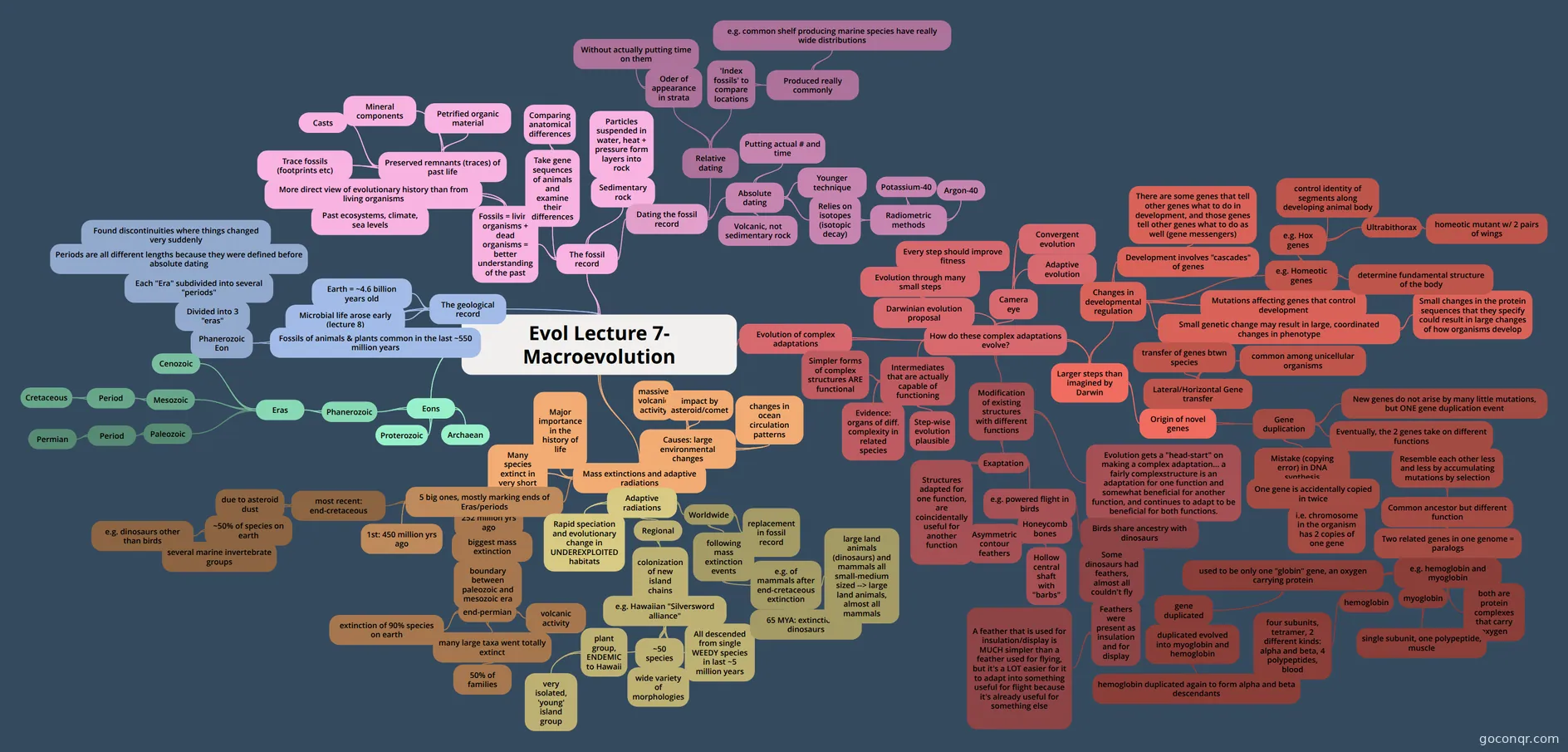
Mind map: Macroevolution, fossil record, and geological time
Inhalt der Mindmap
Evol Lecture 7- Macroevolution
The fossil record
- Fossils = living organisms + dead organisms = better understanding of the past
- Preserved remnants (traces) of past life
- Mineral components
- Petrified organic material
- Casts
- Trace fossils (footprints etc)
- More direct view of evolutionary history than from living organisms
- Past ecosystems, climate, sea levels
- Preserved remnants (traces) of past life
- Take gene sequences of animals and examine their differences
- Comparing anatomical differences
- Sedimentary rock
- Particles suspended in water, heat + pressure form layers into rock
- Dating the fossil record
- Relative dating
- Oder of appearance in strata
- Without actually putting time on them
- 'Index fossils' to compare locations
- Produced really commonly
- e.g. common shelf producing marine species have really wide distributions
- Produced really commonly
- Oder of appearance in strata
- Absolute dating
- Putting actual # and time
- Younger technique
- Relies on isotopes (isotopic decay)
- Radiometric methods
- Potassium-40
- Argon-40
- Radiometric methods
- Volcanic, not sedimentary rock
- Relative dating
- Fossils = living organisms + dead organisms = better understanding of the past
Mass extinctions and adaptive radiations
- Many species extinct in very short time
- Causes: large environmental changes
- massive volcanic activity
- impact by asteroid/comet
- changes in ocean circulation patterns
- Major importance in the history of life
- 5 big ones, mostly marking ends of Eras/periods
- 1st: 450 million yrs ago
- 252 million yrs ago
- biggest mass extinction
- boundary between paleozoic and mesozoic era
- end-permian
- extinction of 90% species on earth
- many large taxa went totally extinct
- 50% of families
- volcanic activity
- end-permian
- boundary between paleozoic and mesozoic era
- biggest mass extinction
- most recent: end-cretaceous
- due to asteroid dust
- ~50% of species on earth
- e.g. dinosaurs other than birds
- several marine invertebrate groups
- Adaptive radiations
- Rapid speciation and evolutionary change in UNDEREXPLOITED habitats
- Regional
- colonization of new island chains
- e.g. Hawaiian "Silversword alliance"
- plant group, ENDEMIC to Hawaii
- very isolated, 'young' island group
- ~50 species
- wide variety of morphologies
- All descended from single WEEDY species in last ~5 million years
- plant group, ENDEMIC to Hawaii
- e.g. Hawaiian "Silversword alliance"
- colonization of new island chains
- Worldwide
- following mass extinction events
- e.g. of mammals after end-cretaceous extinction
- 65 MYA: extinction of dinosaurs
- large land animals (dinosaurs) and mammals all small-medium sized --> large land animals, almost all mammals
- e.g. of mammals after end-cretaceous extinction
- replacement in fossil record
- following mass extinction events
Evolution of complex adaptations
- How do these complex adaptations evolve?
- Darwinian evolution proposal
- Evolution through many small steps
- Every step should improve fitness
- Evolution through many small steps
- Camera eye
- Convergent evolution
- Adaptive evolution
- Intermediates that are actually capable of functioning
- Simpler forms of complex structures ARE functional
- Evidence: organs of diff. complexity in related species
- Step-wise evolution plausible
- Modification of existing structures with different functions
- Exaptation
- Structures adapted for one function, are coincidentally useful for another function
- e.g. powered flight in birds
- Asymmetric contour feathers
- Honeycomb bones
- Hollow central shaft with "barbs"
- Birds share ancestry with dinosaurs
- Some dinosaurs had feathers, almost all couldn't fly
- Feathers were present as insulation and for display
- A feather that is used for insulation/display is MUCH simpler than a feather used for flying, but it's a LOT easier for it to adapt into something useful for flight because it's already useful for something else
- Feathers were present as insulation and for display
- Some dinosaurs had feathers, almost all couldn't fly
- Evolution gets a "head-start" on making a complex adaptation... a fairly complexstructure is an adaptation for one function and somewhat beneficial for another function, and continues to adapt to be beneficial for both functions.
- Exaptation
- Larger steps than imagined by Darwin
- Changes in developmental regulation
- Development involves "cascades" of genes
- There are some genes that tell other genes what to do in development, and those genes tell other genes what to do as well (gene messengers)
- Small genetic change may result in large, coordinated changes in phenotype
- Small changes in the protein sequences that they specify could result in large changes of how organisms develop
- Mutations affecting genes that control development
- e.g. Homeotic genes
- e.g. Hox genes
- control identity of segments along developing animal body
- Ultrabithorax
- homeotic mutant w/ 2 pairs of wings
- determine fundamental structure of the body
- e.g. Hox genes
- Development involves "cascades" of genes
- Origin of novel genes
- Gene duplication
- Mistake (copying error) in DNA synthesis
- One gene is accidentally copied in twice
- i.e. chromosome in the organism has 2 copies of one gene
- One gene is accidentally copied in twice
- Eventually, the 2 genes take on different functions
- Resemble each other less and less by accumulating mutations by selection
- Common ancestor but different function
- Two related genes in one genome = paralogs
- e.g. hemoglobin and myoglobin
- hemoglobin
- four subunits, tetramer, 2 different kinds: alpha and beta, 4 polypeptides, blood
- myoglobin
- single subunit, one polypeptide, muscle
- both are protein complexes that carry oxygen
- used to be only one "globin" gene, an oxygen carrying protein
- gene duplicated
- duplicated evolved into myoglobin and hemoglobin
- hemoglobin duplicated again to form alpha and beta descendants
- duplicated evolved into myoglobin and hemoglobin
- gene duplicated
- hemoglobin
- e.g. hemoglobin and myoglobin
- Two related genes in one genome = paralogs
- Common ancestor but different function
- Resemble each other less and less by accumulating mutations by selection
- New genes do not arise by many little mutations, but ONE gene duplication event
- Mistake (copying error) in DNA synthesis
- Lateral/Horizontal Gene transfer
- transfer of genes btwn species
- common among unicellular organisms
- Gene duplication
- Changes in developmental regulation
- Darwinian evolution proposal
- How do these complex adaptations evolve?
The geological record
- Earth = ~4.6 billion years old
- Microbial life arose early (lecture 8)
- Fossils of animals & plants common in the last ~550 million years
- Phanerozoic Eon
- Divided into 3 "eras"
- Each "Era" subdivided into several "periods"
- Periods are all different lengths because they were defined before absolute dating
- Found discontinuities where things changed very suddenly
- Periods are all different lengths because they were defined before absolute dating
- Each "Era" subdivided into several "periods"
- Divided into 3 "eras"
- Phanerozoic Eon
Eons
- Phanerozoic
- Eras
- Cenozoic
- Mesozoic
- Period
- Cretaceous
- Period
- Paleozoic
- Period
- Permian
- Period
- Eras
- Proterozoic
- Archaean
- Phanerozoic
Informationen
- Beschreibung
- Mindmap am Evol Lecture 7- Macroevolution, erstellt von julia guk am 03/12/2014.
- Erstellt von
- julia guk
- Aufrufe
- 5
- Bewertung