
Mindmap
Congestive Heart Failure
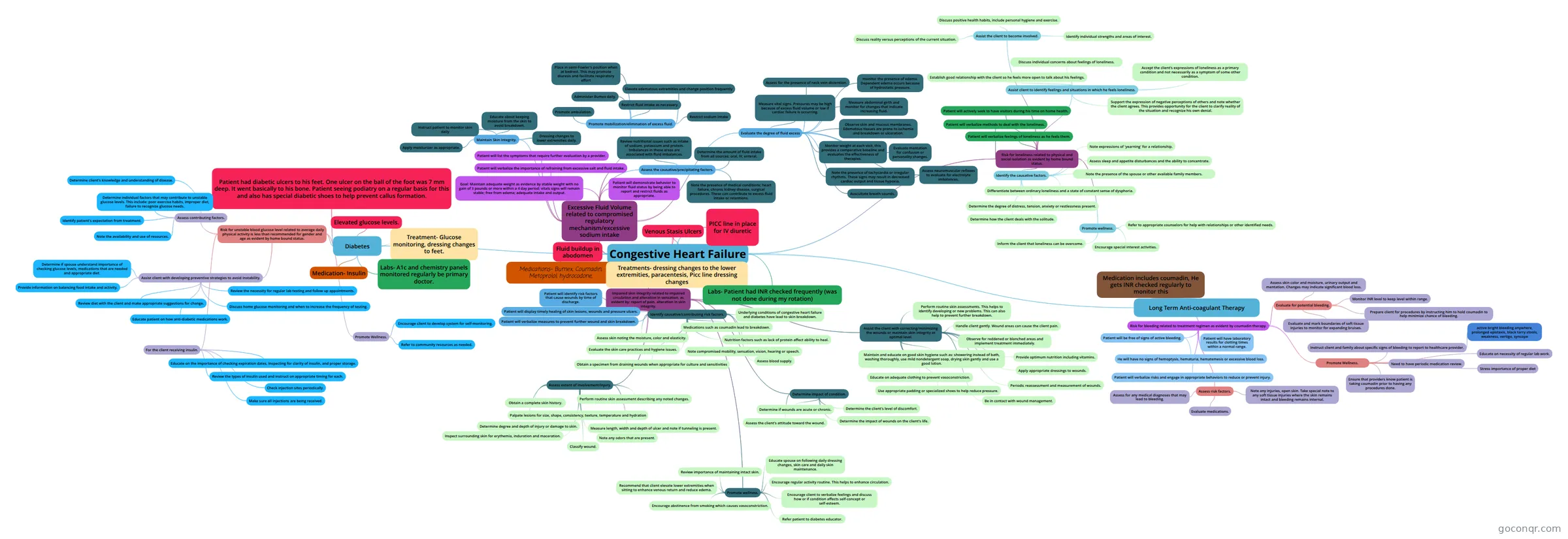
Mind map: Congestive heart failure
Inhalt der Mindmap
Congestive Heart Failure
Diabetes
- Medication- Insulin
- Treatment- Glucose monitoring, dressing changes to feet.
- Labs- A1c and chemistry panels monitored regularly be primary doctor.
- Patient had diabetic ulcers to his feet. One ulcer on the ball of the foot was 7 mm deep. It went basically to his bone. Patient seeing podiatry on a regular basis for this and also has special diabetic shoes to help prevent callus formation.
- Elevated glucose levels.
- Risk for unstable blood glucose level related to average daily physical activity is less than recommended for gender and age as evident by home bound status.
- Assess contributing factors.
- Determine individual factors that may contribute to unstable glucose levels. This include: poor exercise habits, improper diet, failure to recognize glucose needs.
- Determine client's knowledge and understanding of disease.
- Identify patient's expectation from treatment.
- Note the availability and use of resources.
- Assist client with developing preventive strategies to avoid instability.
- Determine if spouse understand importance of checking glucose levels, medications that are needed and appropriate diet.
- Provide information on balancing food intake and activity.
- Review the necessity for regular lab testing and follow up appointments.
- Discuss home glucose monitoring and when to increase the frequency of testing.
- Review diet with the client and make appropriate suggestions for change.
- Educate patient on how anti-diabetic medications work.
- For the client receiving insulin.
- Educate on the importance of checking expiration dates, inspecting for clarity of insulin, and proper storage.
- Review the types of insulin used and instruct on appropriate timing for each.
- Check injection sites periodically.
- Make sure all injections are being received.
- Promote Wellness.
- Encourage client to develop system for self-monitoring.
- Refer to community resources as needed.
- Assess contributing factors.
Long Term Anti-coagulant Therapy
- Medication includes coumadin, He gets INR checked regularly to monitor this
- Risk for bleeding related to treatment regimen as evident by coumadin therapy.
- Patient will be free of signs of active bleeding.
- He will have no signs of hemoptysis, hematuria, hematemesis or excessive blood loss.
- Patient will have laboratory results for clotting times within a normal range.
- Patient will verbalize risks and engage in appropriate behaviors to reduce or prevent injury.
- Assess risk factors.
- Assess for any medical diagnoses that may lead to bleeding.
- Note any injuries, open skin. Take special note to any soft tissue injuries where the skin remains intact and bleeding remains internal.
- Evaluate medications.
- Evaluate for potential bleeding.
- Evaluate and mark boundaries of soft tissue injuries to monitor for expanding bruises.
- Assess skin color and moisture, urinary output and mentation. Changes may indicate significant blood loss.
- Monitor INR level to keep level within range.
- Prepare client for procedures by instructing him to hold coumadin to help minimize chance of bleeding.
- Promote Wellness.
- Instruct client and family about specific signs of bleeding to report to healthcare provider.
- active bright bleeding anywhere, prolonged epistaxis, black tarry stools, weakness, vertigo, syncope
- Ensure that providers know patient is taking coumadin prior to having any procedures done.
- Need to have periodic medication review.
- Educate on necessity of regular lab work.
- Stress importance of proper diet
- Instruct client and family about specific signs of bleeding to report to healthcare provider.
- Patient will be free of signs of active bleeding.
Medications- Bumex, Coumadin, Metoprolol, hydrocodone,
Treatments- dressing changes to the lower extremities, paracentesis, Picc line dressing changes
Labs- Patient had INR checked frequently (was not done during my rotation)
Fluid buildup in abodomen
Venous Stasis Ulcers
- Impaired skin integrity related to impaired circulation and alteration in sensation, as evident by: report of pain, alteration in skin integrity.
- Patient will identify risk factors that cause wounds by time of discharge.
- Patient will display timely healing of skin lesions, wounds and pressure ulcers.
- Patient will verbalize measures to prevent further wound and skin breakdown.
- Identify causative/contributing risk factors.
- Underlying conditions of congestive heart failure and diabetes have lead to skin breakdown.
- Medications such as coumadin lead to breakdown.
- Nutrition factors such as lack of protein affect ability to heal.
- Assess skin noting the moisture, color and elasticity.
- Evaluate the skin care practices and hygiene issues.
- Note compromised mobility, sensation, vision, hearing or speech.
- Assess blood supply.
- Obtain a specimen from draining wounds when appropriate for culture and sensitivities
- Assess extent of involvement/injury.
- Obtain a complete skin history.
- Perform routine skin assessment describing any noted changes.
- Palpate lesions for size, shape, consistency, texture, temperature and hydration
- Determine degree and depth of injury or damage to skin.
- Measure length, width and depth of ulcer and note if tunneling is present.
- Inspect surrounding skin for erythemia, induration and maceration.
- Note any odors that are present.
- Classify wound.
- Determine impact of condition.
- Determine if wounds are acute or chronic.
- Determine the client's level of discomfort.
- Assess the client's attitude toward the wound.
- Determine the impact of wounds on the client's life.
- Assist the client with correcting/minimizing the wounds or maintain skin integrity at optimal level.
- Perform routine skin assessments. This helps to identify developing or new problems. This can also help to prevent further breakdown.
- Handle client gently. Wound areas can cause the client pain.
- Observe for reddened or blanched areas and implement treatment immediately.
- Maintain and educate on good skin hygiene such as: showering instead of bath, washing thoroughly, use mild nondetergent soap, drying skin gently and use a good lotion.
- Educate on adequate clothing to prevent vasoconstriction.
- Use appropriate padding or specialized shoes to help reduce pressure.
- Provide optimum nutrition including vitamins.
- Apply appropriate dressings to wounds.
- Periodic reassessment and measurement of wounds.
- Be in contact with wound management.
- Promote wellness.
- Review importance of maintaining intact skin.
- Educate spouse on following daily dressing changes, skin care and daily skin maintenance.
- Encourage regular activity routine. This helps to enhance circulation.
- Recommend that client elevate lower extremities when sitting to enhance venous return and reduce edema.
- Encourage abstinence from smoking which causes vasoconstriction.
- Encourage client to verbalize feelings and discuss how or if condition affects self-concept or self-esteem.
- Refer patient to diabetes educator.
- Impaired skin integrity related to impaired circulation and alteration in sensation, as evident by: report of pain, alteration in skin integrity.
PICC line in place for IV diuretic
Excessive Fluid Volume related to compromised regulatory mechanism/excessive sodium intake
- Goal: Maintain adequate weight as evidence by stable weight with no gain of 3 pounds or more within a 4 day period; vitals signs will remain stable; free from edema; adequate intake and output.
- Patient will verbalize the importance of refraining from excessive salt and fluid intake.
- Patient will demonstrate behavior to monitor fluid status by being able to report and restrict fluids as appropriate.
- Patient will list the symptoms that require further evaluation by a provider.
- Assess the causative/precipitating factors.
- Note the presence of medical conditions; heart failure, chronic kidney disease, surgical procedures. These can contribute to excess fluid intake or retentions.
- Determine the amount of fluid intake from all sources: oral, IV, enteral.
- Review nutritional issues such as intake of sodium, potassium and protein. Imbalances in these areas are associated with fluid imbalances.
- Evaluate the degree of fluid excess
- Monitor weight at each visit, this provides a comparative baseline and evaluates the effectiveness of therapies.
- Measure vital signs. Pressures may be high because of excess fluid volume or low if cardiac failure is occurring.
- Note the presence of tachycardia or irregular rhythms. These signs may result in decreased cardiac output and tissue hypoxia.
- Auscultate breath sounds.
- Assess for the presence of neck vein distention.
- monitor the presence of edema. Dependent edema occurs because of hydrostatic pressure.
- Measure abdominal girth and monitor for changes that indicate increasing fluid.
- Evaluate mentation for confusion or personality changes.
- Assess neuromuscular reflexes to evaluate for electrolyte imbalances.
- Observe skin and mucous membranes. Edematous tissues are prone to ischemia and breakdown or ulceration.
- Promote mobilization/elimination of excess fluid.
- Administer Bumex daily.
- Restrict fluid intake as necessary.
- Restrict sodium intake
- Elevate edematous extremities and change position frequently
- Place in semi-Fowler's position when at bedrest. This may promote diuresis and facilitate respiratory effort
- Promote ambulation.
- Maintain Skin Integrity.
- Instruct patient to monitor skin daily
- Apply moisturizer as appropriate.
- Dressing changes to lower extremities daily.
- Educate about keeping moisture from the skin to avoid breakdown.
Risk for loneliness related to physical and social isolation as evident by home bound status.
- Patient will verbalize feelings of loneliness as he feels them.
- Patient will verbalize methods to deal with the loneliness.
- Patient will actively seek to have visitors during his time on home health.
- Identify the causative factors.
- Differentiate between ordinary loneliness and a state of constant sense of dysphoria.
- Determine the degree of distress, tension, anxiety or restlessness present.
- Note the presence of the spouse or other available family members.
- Determine how the client deals with the solitude.
- Assess sleep and appetite disturbances and the ability to concentrate.
- Note expressions of 'yearning' for a relationship.
- Assist client to identify feelings and situations in which he feels loneliness.
- Establish good relationship with the client so he feels more open to talk about his feelings.
- Discuss individual concerns about feelings of loneliness.
- Support the expression of negative perceptions of others and note whether the client agrees. This provides opportunity for the client to clarify reality of the situation and recognize his own denial.
- Accept the client's expressions of loneliness as a primary condition and not necessarily as a symptom of some other condition.
- Assist the client to become involved.
- Discuss reality versus perceptions of the current situation.
- Discuss positive health habits, include personal hygiene and exercise.
- Identify individual strengths and areas of interest.
- Promote wellness.
- Inform the client that loneliness can be overcome.
- Encourage special interest activities.
- Refer to appropriate counselors for help with relationships or other identified needs.
Informationen
- Beschreibung
- Mindmap am Congestive Heart Failure, erstellt von Heidi Shimek am 11/04/2019.
- Erstellt von
- Heidi Shimek
- Aufrufe
- 0
- Bewertung