
Mindmap
C2: Chemical Patterns

Inhalt der Mindmap
C2: Chemical Patterns
History of the Atom
- John Dalton
- Described atoms as solid spheres.
- JJ Thomson
- 1904 - Concluded that atoms weren't solid spheres. His measurements of charge and mass showed that it must contain electrons. His theory was the 'plum pudding model'. It showed the atom as a ball of positive charges with electrons in it.
- Ernest Rutherford
- 1911 - The experiment he carried out involved gold foil and alpha particles. He discovered the nucleus which was surrounded by electrons and that the atom was mostly empty space.
- Niels Bohr
- Discovered the electrons would be attracted to the nucleus, causing the atom to collapse, suggesting that all the electrons were contained in shells.
- John Dalton
The Atom
- Protons
- Positively charged
- Neutrons
- No charge
- Electrons
- Negatively charged
- Protons
Group 1 Elements
- All have one electron in the outer shell - very reactive.
- As you go down Group 1: Increasing reactivity, lower melting/boiling points and higher density.
Group 0 Elements
- Knows as the noble gases
- All have a full outer shell (apart from helium), so they don't have to lose/gain an electron
- This includes:
Ionic Bonding
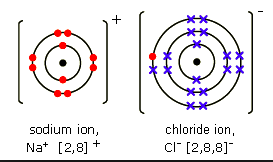
- Simple ions form when atoms lose/gain an electron.
- Can predict the ions formed by elements in Groups 1&2 and 6&7
- It means the transfer of electrons
Ionic Compounds
- Can be shown using the Dot and Cross Diagram
- Have similar properties:
- High melting/boiling points
- Solid ionic compounds don't conduct electricity - ions are fixed in place
- Dissolves easilty
Bilder und Dateien der Mindmap
Informationen
- Beschreibung
- GCSE Core Science Mindmap am C2: Chemical Patterns, erstellt von Blerta Morina am 19/04/2019.
- Erstellt von
- Blerta Morina
- Aufrufe
- 10
- Tags
- Bewertung