
Mindmap
week 10: spatial
Inhalt der Mindmap
week 10: spatial
3 learning systems. CEREBRAL CORTEX - unsupervised relational learning. BASAL GANGLIA - reinforcement + reward learning. CEREBELLUM - supervised + error learning
- spatial cognition involved in 2 important and different systems - Posterior Parietal Cortex + Hippocampus
- hippocampus - RELATIONAL LEARNING. contains a map of our environment. forming memories, when damaged = anterograde amnesia. environment - finding our way back home, HM could still remember events before the surgery but could not form new memories.
- HM = bilateral removal of the temporal lobe - could form intact perceptual learning, stimulus-response and motor learning
- relational learning = establishment and retrieval of memories and events and episodes or spatial relationships. hippocampus is a critical structure for spatial memory
- hippocampus - RELATIONAL LEARNING. contains a map of our environment. forming memories, when damaged = anterograde amnesia. environment - finding our way back home, HM could still remember events before the surgery but could not form new memories.
- spatial cognition involved in 2 important and different systems - Posterior Parietal Cortex + Hippocampus
size and activity of hippocampus increases with navigation experience - Maguire et al 1997, London taxi drivers, higher activation of hippocampus with longer navigational experience. VOLUME OF HIPPOCAMPUS IS THE FUNCTION OF EXPERIENCE
- Neurogenesis happens well into adulthood with 700 neurons in hippocampus on a daily basis, annual 1.75% turnover rate
relational learning in lab animals- Morris Water Maze = opaque water so position of platform is only known from relative landmark objects in the room. Dependent on MDMA-dependent learning.
- Rats can learn to swin to the platform if always released in the same place (S-R learning) Lesions to temporal lobe = couldnt find/use map and unable to navigate its environment
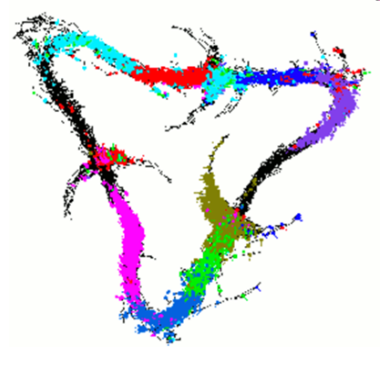
place cells in dorsal posterior hippocampus (CA1) - hippocampal cells demonstrate 'place cells' and individual cells fire sequentially as rats run along the track.
- coloured dots indicate action potentials, one colour for each cell, certain cells only fire in certain locations of the maze to indicate location.
- when the animal stops the cells rapidly fire in reverse order > a functional role for spontaneous activity in learning and memory consolidation. re-play to strengthen the sequence
- coloured dots indicate action potentials, one colour for each cell, certain cells only fire in certain locations of the maze to indicate location.
gird cells in the entorhinal cortex - regular patterns of place cell responses and individual cells fire whenever the rat passes the intersections in the virtual grid
- place cells recieve input from grid cells >> tell them where to fire
- grid cells of different spatial scale combine to activate place cells for unique locations. grid cells recieve high level spatial information from the neocortex (post parietal cortex)
- grid cells have different resolutions/layers - hexoderm structure forming a 5 point grid. Overlay all and feed down to place cells to tell them when to fire
- GRID CELLS < MERGE ONTO OTHER CELLS < PLACE CELLS
- place cells recieve input from grid cells >> tell them where to fire
Virtual reality in humans - cell recordings from generate grid cells which help us navigate our environment. Damage to hippocampus - lost ability to navigate our environment
posterior parietal cortex - top of the ventral/where pathway. Where calculated in the egocentric> allocentric coordinate framework.
- apraxia = results from damage to the left parietal lobe, difficulty carrying out purposeful movement - muscular weakness. Apraxia of speech
- neglect = damage to right parietal lobe. difficulty detecting information about items in external space.
- LEFT - holds info about just the right, RIGHT = info about left and right. damage to the right = LEFT SIDE OF SPACE SUBJECT TO NEGLECT
- Neglected info may still be available - BISIACH 1978 - PIAZZA DEL DUOMO. would only imagine the left side of the landmark, when told to imagine turning 180' they would describe the now right side. attention was pulled to their right. Saliency map = combining visual input with attention
- neglect = damage to right parietal lobe. difficulty detecting information about items in external space.
- apraxia = results from damage to the left parietal lobe, difficulty carrying out purposeful movement - muscular weakness. Apraxia of speech
parietal cortex = sits between sensory areas, visual, auditory and somatosensory. projects to premotor, M1 and the cerebellum
- association area, a lot of information which feeds into it. Where pathway - action and how we interact with our environment. Lots of subdivisons becoming ever more tightly asosciated with specific functions e.g. eye movements, spatial coding, reaching and pointing.
- mulitmodal integreation = multi-sensory guidance and planning of actions, combining retinal and eye position signals,combining visual and auditory tactile signals.
- LIP - intended saccade, forward planning. predictive remapping of the parietal receptive fields in area LIP with intended eye movement. cell responds before stimulus arrive in the receptive fields. maintain mapping across sacades, update of attention to final eye positive before saccade starts
- AIP grasping, hand-centric > whole field. form of neglect which = object centered neglect. left side of each object will be neglected.
- tool use and functional imaging, activation in superior parietal lobe with recognition and executive aspects of tool use
- AIP grasping, hand-centric > whole field. form of neglect which = object centered neglect. left side of each object will be neglected.
- VIP - head-centered processing. encodes objects which are closer/near. multimodal encoding of space and motion around the head. tactile inputs on face, corresponding to visual fields. e.g. a ball moving closer to your face
- MIP -reaching and grasping - optic-ataxia. misreaching to peripheral visual targets but accurate reaching to centrally fixated targets. updating of body scheme so you can make use of it in reaching and grasping actions
- association area, a lot of information which feeds into it. Where pathway - action and how we interact with our environment. Lots of subdivisons becoming ever more tightly asosciated with specific functions e.g. eye movements, spatial coding, reaching and pointing.
motor cognition = broadly concerned with understanding action representations and associated with higher mental processes
- motor imagery - motor cognition, our needs to interact with the environment >>> multiple maps
- hippocampus - critical for spatial memory, place cells fire in unique spatial locations, a substrate for episodic/relational memory of landmarks in allocentric coordinate system
- posterior parietal cortex = a complex association area, mulitmodal representations of space in egocentric coordinate system. hierarchy of representations (retinal, head-centered, body-centered, arm-centered) Representations are task dependent and updated into egocentric body scheme
Bilder und Dateien der Mindmap
Informationen
- Beschreibung
- Neural Mindmap am week 10: spatial, erstellt von Katie gavriel am 08/05/2019.
- Erstellt von
- Katie gavriel
- Aufrufe
- 2
- Bewertung