
Mindmap
Classroom management
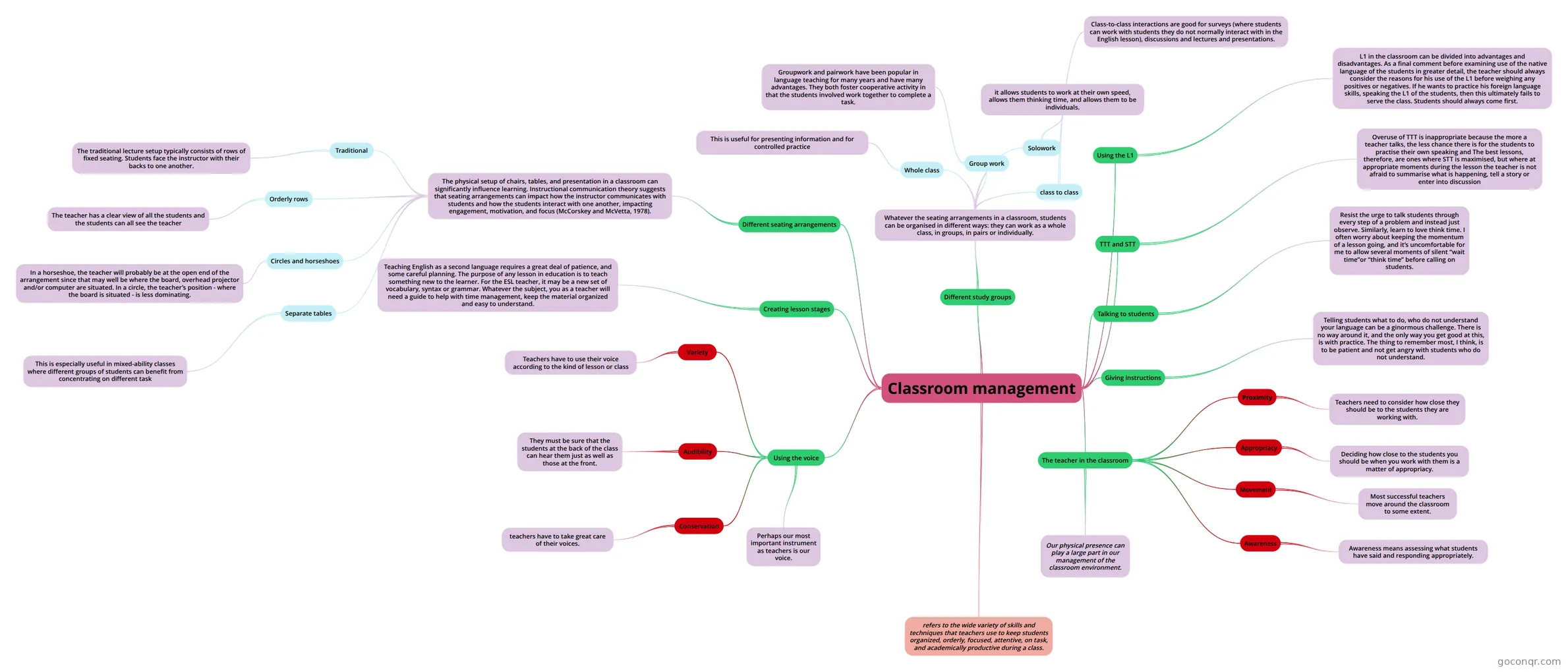
Mind map: Classroom management
Inhalt der Mindmap
Classroom management
refers to the wide variety of skills and techniques that teachers use to keep students organized, orderly, focused, attentive, on task, and academically productive during a class.
The teacher in the classroom
- Our physical presence can play a large part in our management of the classroom environment.
- Proximity
- Teachers need to consider how close they should be to the students they are working with.
- Appropriacy
- Deciding how close to the students you should be when you work with them is a matter of appropriacy.
- Movement
- Most successful teachers move around the classroom to some extent.
- Awareness
- Awareness means assessing what students have said and responding appropriately.
Using the voice
- Perhaps our most important instrument as teachers is our voice.
- Audibility
- They must be sure that the students at the back of the class can hear them just as well as those at the front.
- Variety
- Teachers have to use their voice according to the kind of lesson or class
- Conservation
- teachers have to take great care of their voices.
Talking to students
- Resist the urge to talk students through every step of a problem and instead just observe. Similarly, learn to love think time. I often worry about keeping the momentum of a lesson going, and it’s uncomfortable for me to allow several moments of silent “wait time”or “think time” before calling on students.
Giving instructions
- Telling students what to do, who do not understand your language can be a ginormous challenge. There is no way around it, and the only way you get good at this, is with practice. The thing to remember most, I think, is to be patient and not get angry with students who do not understand.
TTT and STT
- Overuse of TTT is inappropriate because the more a teacher talks, the less chance there is for the students to practise their own speaking and The best lessons, therefore, are ones where STT is maximised, but where at appropriate moments during the lesson the teacher is not afraid to summarise what is happening, tell a story or enter into discussion
Using the L1
- L1 in the classroom can be divided into advantages and disadvantages. As a final comment before examining use of the native language of the students in greater detail, the teacher should always consider the reasons for his use of the L1 before weighing any positives or negatives. If he wants to practice his foreign language skills, speaking the L1 of the students, then this ultimately fails to serve the class. Students should always come first.
Creating lesson stages
- Teaching English as a second language requires a great deal of patience, and some careful planning. The purpose of any lesson in education is to teach something new to the learner. For the ESL teacher, it may be a new set of vocabulary, syntax or grammar. Whatever the subject, you as a teacher will need a guide to help with time management, keep the material organized and easy to understand.
Different seating arrangements
- The physical setup of chairs, tables, and presentation in a classroom can significantly influence learning. Instructional communication theory suggests that seating arrangements can impact how the instructor communicates with students and how the students interact with one another, impacting engagement, motivation, and focus (McCorskey and McVetta, 1978).
- Traditional
- The traditional lecture setup typically consists of rows of fixed seating. Students face the instructor with their backs to one another.
- Orderly rows
- The teacher has a clear view of all the students and the students can all see the teacher
- Circles and horseshoes
- In a horseshoe, the teacher will probably be at the open end of the arrangement since that may well be where the board, overhead projector and/or computer are situated. In a circle, the teacher’s position - where the board is situated - is less dominating.
- Separate tables
- This is especially useful in mixed-ability classes where different groups of students can benefit from concentrating on different task
- Traditional
- The physical setup of chairs, tables, and presentation in a classroom can significantly influence learning. Instructional communication theory suggests that seating arrangements can impact how the instructor communicates with students and how the students interact with one another, impacting engagement, motivation, and focus (McCorskey and McVetta, 1978).
Different study groups
- Whatever the seating arrangements in a classroom, students can be organised in different ways: they can work as a whole class, in groups, in pairs or individually.
- Whole class
- This is useful for presenting information and for controlled practice
- Group work
- Groupwork and pairwork have been popular in language teaching for many years and have many advantages. They both foster cooperative activity in that the students involved work together to complete a task.
- Solowork
- it allows students to work at their own speed, allows them thinking time, and allows them to be individuals.
- class to class
- Class-to-class interactions are good for surveys (where students can work with students they do not normally interact with in the English lesson), discussions and lectures and presentations.
- Whole class
- Whatever the seating arrangements in a classroom, students can be organised in different ways: they can work as a whole class, in groups, in pairs or individually.
Informationen
- Beschreibung
- Mindmap am Classroom management, erstellt von Ilbea Flores am 21/05/2019.
- Erstellt von
- Ilbea Flores
- Aufrufe
- 2
- Bewertung