
Mindmap
The Critical Period Hypothesis
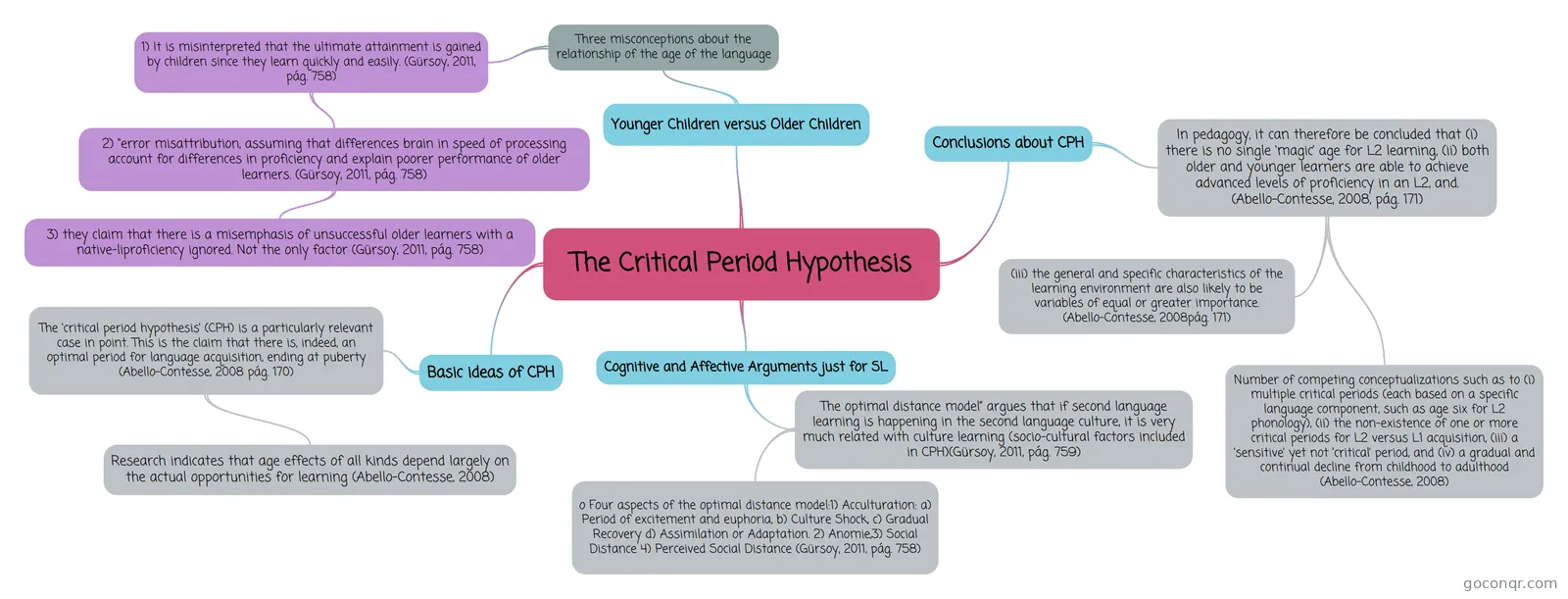
Mind map: The Critical Period Hypothesis
Inhalt der Mindmap
The Critical Period Hypothesis
Cognitive and Affective Arguments just for SL
- The optimal distance model” argues that if second language learning is happening in the second language culture, it is very much related with culture learning (socio-cultural factors included in CPH)(Gürsoy, 2011, pág. 759)
- o Four aspects of the optimal distance model:1) Acculturation: a) Period of excitement and euphoria, b) Culture Shock, c) Gradual Recovery d) Assimilation or Adaptation. 2) Anomie,3) Social Distance 4) Perceived Social Distance (Gürsoy, 2011, pág. 758)
- The optimal distance model” argues that if second language learning is happening in the second language culture, it is very much related with culture learning (socio-cultural factors included in CPH)(Gürsoy, 2011, pág. 759)
Conclusions about CPH
- In pedagogy, it can therefore be concluded that (i) there is no single ‘magic’ age for L2 learning, (ii) both older and younger learners are able to achieve advanced levels of proficiency in an L2, and. (Abello-Contesse, 2008, pág. 171)
- Number of competing conceptualizations such as to (i) multiple critical periods (each based on a specific language component, such as age six for L2 phonology), (ii) the non-existence of one or more critical periods for L2 versus L1 acquisition, (iii) a ‘sensitive’ yet not ‘critical’ period, and (iv) a gradual and continual decline from childhood to adulthood (Abello-Contesse, 2008)
- (iii) the general and specific characteristics of the learning environment are also likely to be variables of equal or greater importance. (Abello-Contesse, 2008pág. 171)
- In pedagogy, it can therefore be concluded that (i) there is no single ‘magic’ age for L2 learning, (ii) both older and younger learners are able to achieve advanced levels of proficiency in an L2, and. (Abello-Contesse, 2008, pág. 171)
Basic ideas of CPH
- The ‘critical period hypothesis’ (CPH) is a particularly relevant case in point. This is the claim that there is, indeed, an optimal period for language acquisition, ending at puberty (Abello-Contesse, 2008 pág. 170)
- Research indicates that age effects of all kinds depend largely on the actual opportunities for learning (Abello-Contesse, 2008)
- The ‘critical period hypothesis’ (CPH) is a particularly relevant case in point. This is the claim that there is, indeed, an optimal period for language acquisition, ending at puberty (Abello-Contesse, 2008 pág. 170)
Younger Children versus Older Children
- Three misconceptions about the relationship of the age of the language
- 1) It is misinterpreted that the ultimate attainment is gained by children since they learn quickly and easily. (Gürsoy, 2011, pág. 758)
- 2) “error misattribution, assuming that differences brain in speed of processing account for differences in proficiency and explain poorer performance of older learners. (Gürsoy, 2011, pág. 758)
- 3) they claim that there is a misemphasis of unsuccessful older learners with a native-liproficiency ignored. Not the only factor (Gürsoy, 2011, pág. 758)
- 2) “error misattribution, assuming that differences brain in speed of processing account for differences in proficiency and explain poorer performance of older learners. (Gürsoy, 2011, pág. 758)
- 1) It is misinterpreted that the ultimate attainment is gained by children since they learn quickly and easily. (Gürsoy, 2011, pág. 758)
- Three misconceptions about the relationship of the age of the language
Informationen
- Beschreibung
- Mindmap am The Critical Period Hypothesis, erstellt von Eunice Funes am 18/07/2019.
- Erstellt von
- Eunice Funes
- Aufrufe
- 4
- Bewertung
Mehr zu Age and Language Acquisition