
Mindmap
Animals and human language
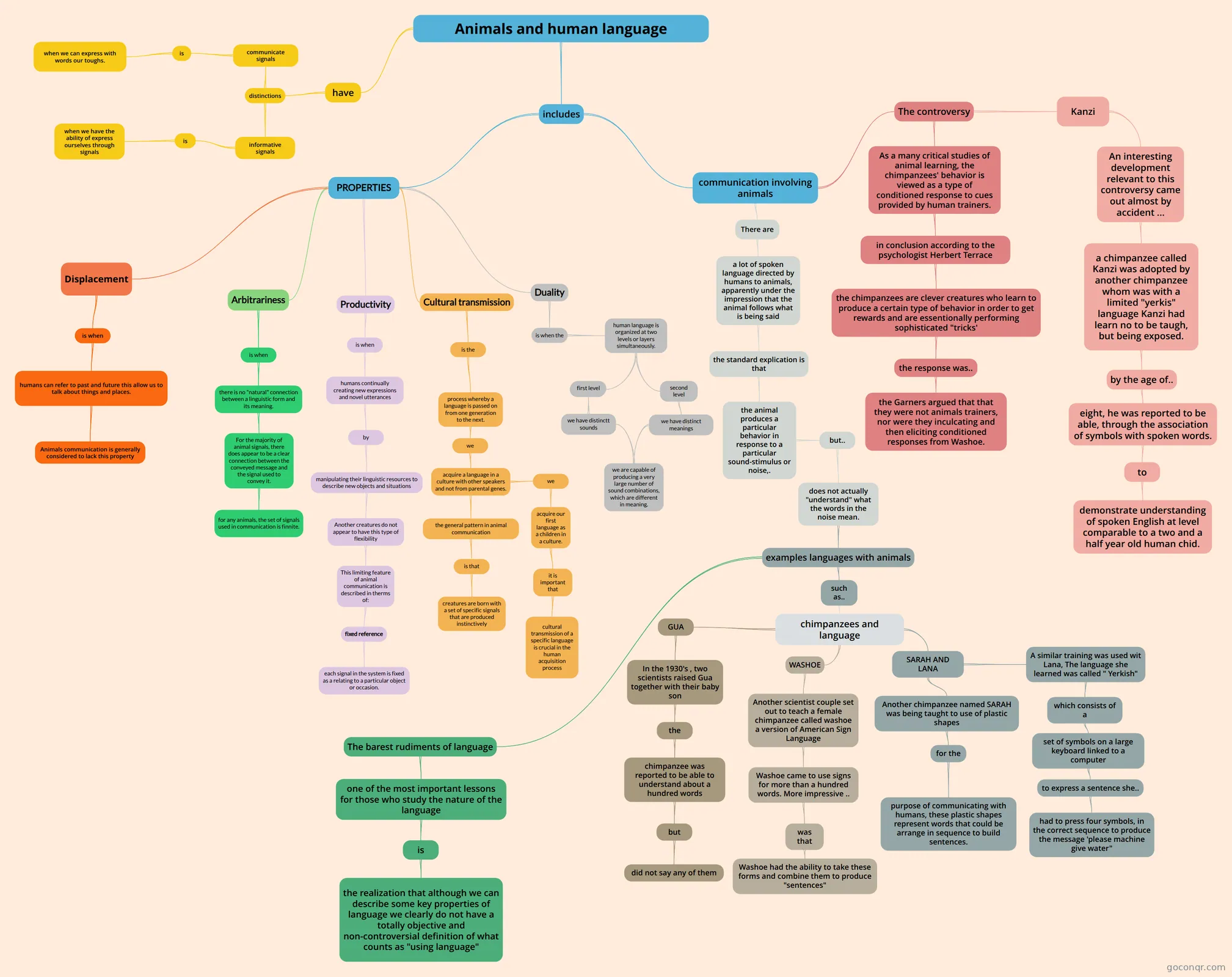
Mind map: animals and human language
Inhalt der Mindmap
Animals and human language
have
- distinctions
- communicate signals
- is
- when we can express with words our toughs.
- is
- informative signals
- is
- when we have the ability of express ourselves through signals
- is
- communicate signals
- distinctions
includes
- PROPERTIES
- Displacement
- is when
- humans can refer to past and future this allow us to talk about things and places.
- Animals communication is generally considered to lack this property
- humans can refer to past and future this allow us to talk about things and places.
- is when
- Arbitrariness
- is when
- there is no "natural" connection between a linguistic form and its meaning.
- For the majority of animal signals, there does appear to be a clear connection between the conveyed message and the signal used to convey it.
- for any animals, the set of signals used in communication is finnite.
- For the majority of animal signals, there does appear to be a clear connection between the conveyed message and the signal used to convey it.
- there is no "natural" connection between a linguistic form and its meaning.
- is when
- Productivity
- is when
- humans continually creating new expressions and novel utterances
- by
- manipulating their linguistic resources to describe new objects and situations
- Another creatures do not appear to have this type of flexibility
- This limiting feature of animal communication is described in therms of:
- fixed reference
- each signal in the system is fixed as a relating to a particular object or occasion.
- fixed reference
- This limiting feature of animal communication is described in therms of:
- Another creatures do not appear to have this type of flexibility
- manipulating their linguistic resources to describe new objects and situations
- by
- humans continually creating new expressions and novel utterances
- is when
- Cultural transmission
- is the
- process whereby a language is passed on from one generation to the next.
- we
- acquire a language in a culture with other speakers and not from parental genes.
- we
- acquire our first language as a children in a culture.
- it is important that
- cultural transmission of a specific language is crucial in the human acquisition process
- it is important that
- acquire our first language as a children in a culture.
- the general pattern in animal communication
- is that
- creatures are born with a set of specific signals that are produced instinctively
- is that
- we
- acquire a language in a culture with other speakers and not from parental genes.
- we
- process whereby a language is passed on from one generation to the next.
- is the
- Duality
- is when the
- human language is organized at two levels or layers simultaneously.
- first level
- second level
- we have distinct meanings
- we are capable of producing a very large number of sound combinations, which are different in meaning.
- we have distinctt sounds
- first level
- we have distinctt sounds
- we are capable of producing a very large number of sound combinations, which are different in meaning.
- we have distinct meanings
- human language is organized at two levels or layers simultaneously.
- is when the
- Displacement
- communication involving animals
- There are
- a lot of spoken language directed by humans to animals, apparently under the impression that the animal follows what is being said
- the standard explication is that
- the animal produces a particular behavior in response to a particular sound-stimulus or noise,.
- but..
- does not actually "understand" what the words in the noise mean.
- examples languages with animals
- such as..
- chimpanzees and language
- GUA
- In the 1930's , two scientists raised Gua together with their baby son
- the
- chimpanzee was reported to be able to understand about a hundred words
- but
- did not say any of them
- but
- chimpanzee was reported to be able to understand about a hundred words
- the
- In the 1930's , two scientists raised Gua together with their baby son
- WASHOE
- Another scientist couple set out to teach a female chimpanzee called washoe a version of American Sign Language
- Washoe came to use signs for more than a hundred words. More impressive ..
- was that
- Washoe had the ability to take these forms and combine them to produce "sentences"
- was that
- Washoe came to use signs for more than a hundred words. More impressive ..
- Another scientist couple set out to teach a female chimpanzee called washoe a version of American Sign Language
- SARAH AND LANA
- Another chimpanzee named SARAH was being taught to use of plastic shapes
- for the
- purpose of communicating with humans, these plastic shapes represent words that could be arrange in sequence to build sentences.
- for the
- A similar training was used wit Lana, The language she learned was called " Yerkish"
- which consists of a
- set of symbols on a large keyboard linked to a computer
- to express a sentence she..
- had to press four symbols, in the correct sequence to produce the message 'please machine give water"
- to express a sentence she..
- set of symbols on a large keyboard linked to a computer
- which consists of a
- Another chimpanzee named SARAH was being taught to use of plastic shapes
- GUA
- chimpanzees and language
- The barest rudiments of language
- one of the most important lessons for those who study the nature of the language
- is
- the realization that although we can describe some key properties of language we clearly do not have a totally objective and non-controversial definition of what counts as "using language"
- is
- one of the most important lessons for those who study the nature of the language
- such as..
- examples languages with animals
- does not actually "understand" what the words in the noise mean.
- but..
- the animal produces a particular behavior in response to a particular sound-stimulus or noise,.
- the standard explication is that
- a lot of spoken language directed by humans to animals, apparently under the impression that the animal follows what is being said
- The controversy
- As a many critical studies of animal learning, the chimpanzees' behavior is viewed as a type of conditioned response to cues provided by human trainers.
- in conclusion according to the psychologist Herbert Terrace
- the chimpanzees are clever creatures who learn to produce a certain type of behavior in order to get rewards and are essentionally performing sophisticated "tricks'
- the response was..
- the Garners argued that that they were not animals trainers, nor were they inculcating and then eliciting conditioned responses from Washoe.
- the response was..
- the chimpanzees are clever creatures who learn to produce a certain type of behavior in order to get rewards and are essentionally performing sophisticated "tricks'
- in conclusion according to the psychologist Herbert Terrace
- Kanzi
- An interesting development relevant to this controversy came out almost by accident ...
- a chimpanzee called Kanzi was adopted by another chimpanzee whom was with a limited "yerkis" language Kanzi had learn no to be taugh, but being exposed.
- by the age of..
- eight, he was reported to be able, through the association of symbols with spoken words.
- to
- demonstrate understanding of spoken English at level comparable to a two and a half year old human chid.
- to
- eight, he was reported to be able, through the association of symbols with spoken words.
- by the age of..
- a chimpanzee called Kanzi was adopted by another chimpanzee whom was with a limited "yerkis" language Kanzi had learn no to be taugh, but being exposed.
- An interesting development relevant to this controversy came out almost by accident ...
- As a many critical studies of animal learning, the chimpanzees' behavior is viewed as a type of conditioned response to cues provided by human trainers.
- There are
- PROPERTIES
Informationen
- Beschreibung
- Mindmap am Animals and human language, erstellt von ANA G Jimenez am 17/01/2015.
- Erstellt von
- ANA G Jimenez
- Aufrufe
- 9
- Bewertung
Mehr zu Human Language and Animal Communication