
Mindmap
Public Body Liability
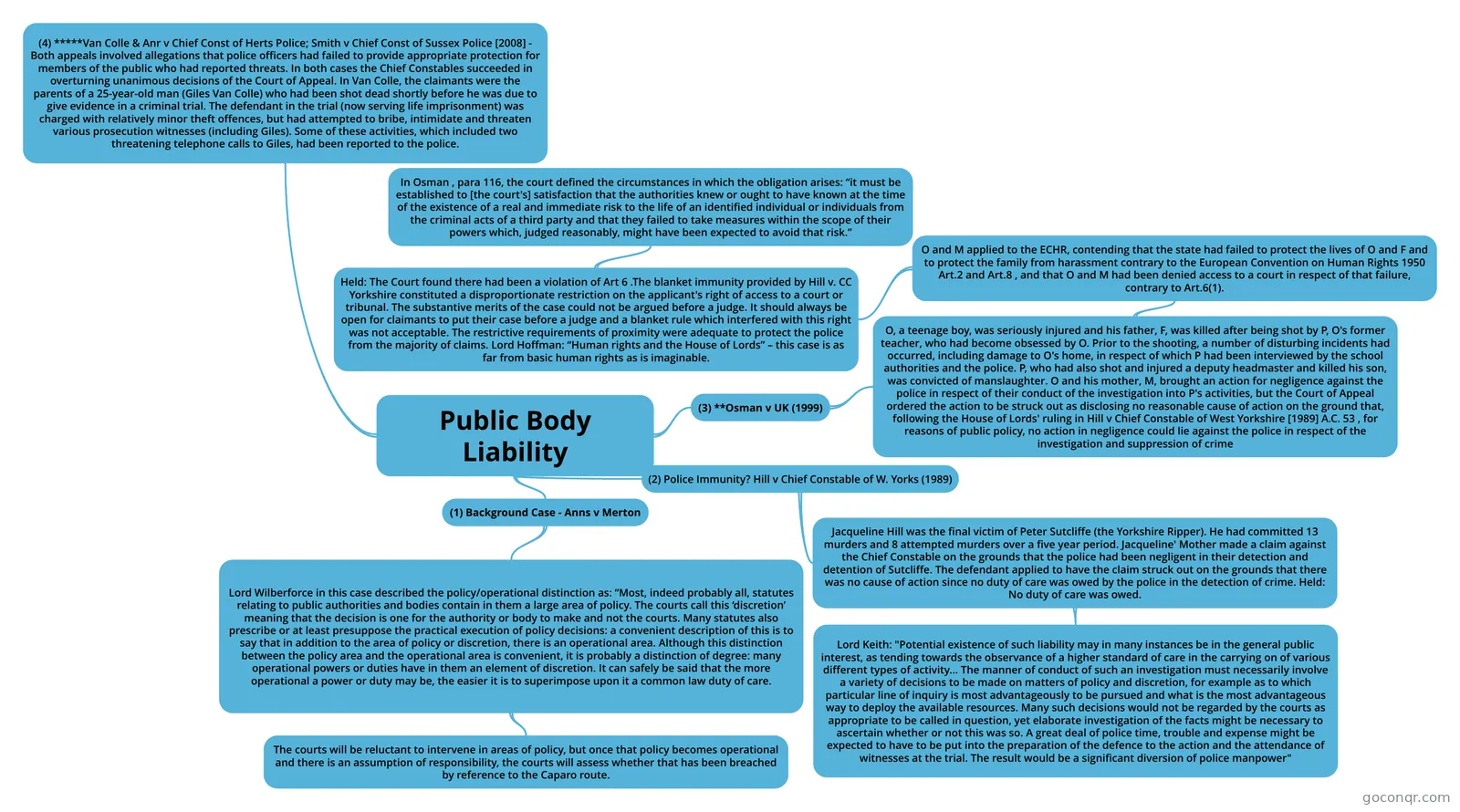
Mind map: Public body liability
Inhalt der Mindmap
Public Body Liability
(1) Background Case - Anns v Merton
- Lord Wilberforce in this case described the policy/operational distinction as: “Most, indeed probably all, statutes relating to public authorities and bodies contain in them a large area of policy. The courts call this ‘discretion’ meaning that the decision is one for the authority or body to make and not the courts. Many statutes also prescribe or at least presuppose the practical execution of policy decisions: a convenient description of this is to say that in addition to the area of policy or discretion, there is an operational area. Although this distinction between the policy area and the operational area is convenient, it is probably a distinction of degree: many operational powers or duties have in them an element of discretion. It can safely be said that the more operational a power or duty may be, the easier it is to superimpose upon it a common law duty of care.
- The courts will be reluctant to intervene in areas of policy, but once that policy becomes operational and there is an assumption of responsibility, the courts will assess whether that has been breached by reference to the Caparo route.
- Lord Wilberforce in this case described the policy/operational distinction as: “Most, indeed probably all, statutes relating to public authorities and bodies contain in them a large area of policy. The courts call this ‘discretion’ meaning that the decision is one for the authority or body to make and not the courts. Many statutes also prescribe or at least presuppose the practical execution of policy decisions: a convenient description of this is to say that in addition to the area of policy or discretion, there is an operational area. Although this distinction between the policy area and the operational area is convenient, it is probably a distinction of degree: many operational powers or duties have in them an element of discretion. It can safely be said that the more operational a power or duty may be, the easier it is to superimpose upon it a common law duty of care.
(2) Police Immunity? Hill v Chief Constable of W. Yorks (1989)
- Jacqueline Hill was the final victim of Peter Sutcliffe (the Yorkshire Ripper). He had committed 13 murders and 8 attempted murders over a five year period. Jacqueline' Mother made a claim against the Chief Constable on the grounds that the police had been negligent in their detection and detention of Sutcliffe. The defendant applied to have the claim struck out on the grounds that there was no cause of action since no duty of care was owed by the police in the detection of crime. Held: No duty of care was owed.
- Lord Keith: "Potential existence of such liability may in many instances be in the general public interest, as tending towards the observance of a higher standard of care in the carrying on of various different types of activity... The manner of conduct of such an investigation must necessarily involve a variety of decisions to be made on matters of policy and discretion, for example as to which particular line of inquiry is most advantageously to be pursued and what is the most advantageous way to deploy the available resources. Many such decisions would not be regarded by the courts as appropriate to be called in question, yet elaborate investigation of the facts might be necessary to ascertain whether or not this was so. A great deal of police time, trouble and expense might be expected to have to be put into the preparation of the defence to the action and the attendance of witnesses at the trial. The result would be a significant diversion of police manpower"
- Jacqueline Hill was the final victim of Peter Sutcliffe (the Yorkshire Ripper). He had committed 13 murders and 8 attempted murders over a five year period. Jacqueline' Mother made a claim against the Chief Constable on the grounds that the police had been negligent in their detection and detention of Sutcliffe. The defendant applied to have the claim struck out on the grounds that there was no cause of action since no duty of care was owed by the police in the detection of crime. Held: No duty of care was owed.
(3) **Osman v UK (1999)
- O, a teenage boy, was seriously injured and his father, F, was killed after being shot by P, O's former teacher, who had become obsessed by O. Prior to the shooting, a number of disturbing incidents had occurred, including damage to O's home, in respect of which P had been interviewed by the school authorities and the police. P, who had also shot and injured a deputy headmaster and killed his son, was convicted of manslaughter. O and his mother, M, brought an action for negligence against the police in respect of their conduct of the investigation into P's activities, but the Court of Appeal ordered the action to be struck out as disclosing no reasonable cause of action on the ground that, following the House of Lords' ruling in Hill v Chief Constable of West Yorkshire [1989] A.C. 53 , for reasons of public policy, no action in negligence could lie against the police in respect of the investigation and suppression of crime
- O and M applied to the ECHR, contending that the state had failed to protect the lives of O and F and to protect the family from harassment contrary to the European Convention on Human Rights 1950 Art.2 and Art.8 , and that O and M had been denied access to a court in respect of that failure, contrary to Art.6(1).
- Held: The Court found there had been a violation of Art 6 .The blanket immunity provided by Hill v. CC Yorkshire constituted a disproportionate restriction on the applicant's right of access to a court or tribunal. The substantive merits of the case could not be argued before a judge. It should always be open for claimants to put their case before a judge and a blanket rule which interfered with this right was not acceptable. The restrictive requirements of proximity were adequate to protect the police from the majority of claims. Lord Hoffman: “Human rights and the House of Lords” – this case is as far from basic human rights as is imaginable.
- In Osman , para 116, the court defined the circumstances in which the obligation arises: “it must be established to [the court's] satisfaction that the authorities knew or ought to have known at the time of the existence of a real and immediate risk to the life of an identified individual or individuals from the criminal acts of a third party and that they failed to take measures within the scope of their powers which, judged reasonably, might have been expected to avoid that risk.”
- Held: The Court found there had been a violation of Art 6 .The blanket immunity provided by Hill v. CC Yorkshire constituted a disproportionate restriction on the applicant's right of access to a court or tribunal. The substantive merits of the case could not be argued before a judge. It should always be open for claimants to put their case before a judge and a blanket rule which interfered with this right was not acceptable. The restrictive requirements of proximity were adequate to protect the police from the majority of claims. Lord Hoffman: “Human rights and the House of Lords” – this case is as far from basic human rights as is imaginable.
- O and M applied to the ECHR, contending that the state had failed to protect the lives of O and F and to protect the family from harassment contrary to the European Convention on Human Rights 1950 Art.2 and Art.8 , and that O and M had been denied access to a court in respect of that failure, contrary to Art.6(1).
- O, a teenage boy, was seriously injured and his father, F, was killed after being shot by P, O's former teacher, who had become obsessed by O. Prior to the shooting, a number of disturbing incidents had occurred, including damage to O's home, in respect of which P had been interviewed by the school authorities and the police. P, who had also shot and injured a deputy headmaster and killed his son, was convicted of manslaughter. O and his mother, M, brought an action for negligence against the police in respect of their conduct of the investigation into P's activities, but the Court of Appeal ordered the action to be struck out as disclosing no reasonable cause of action on the ground that, following the House of Lords' ruling in Hill v Chief Constable of West Yorkshire [1989] A.C. 53 , for reasons of public policy, no action in negligence could lie against the police in respect of the investigation and suppression of crime
(4) *****Van Colle & Anr v Chief Const of Herts Police; Smith v Chief Const of Sussex Police [2008] - Both appeals involved allegations that police officers had failed to provide appropriate protection for members of the public who had reported threats. In both cases the Chief Constables succeeded in overturning unanimous decisions of the Court of Appeal. In Van Colle, the claimants were the parents of a 25-year-old man (Giles Van Colle) who had been shot dead shortly before he was due to give evidence in a criminal trial. The defendant in the trial (now serving life imprisonment) was charged with relatively minor theft offences, but had attempted to bribe, intimidate and threaten various prosecution witnesses (including Giles). Some of these activities, which included two threatening telephone calls to Giles, had been reported to the police.
Informationen
- Beschreibung
- Mindmap am Public Body Liability, erstellt von laughatit am 11/02/2015.
- Erstellt von
- laughatit
- Aufrufe
- 2
- Bewertung