
Mindmap
ECON 385
Inhalt der Mindmap
ECON 385
Foreign exchange market
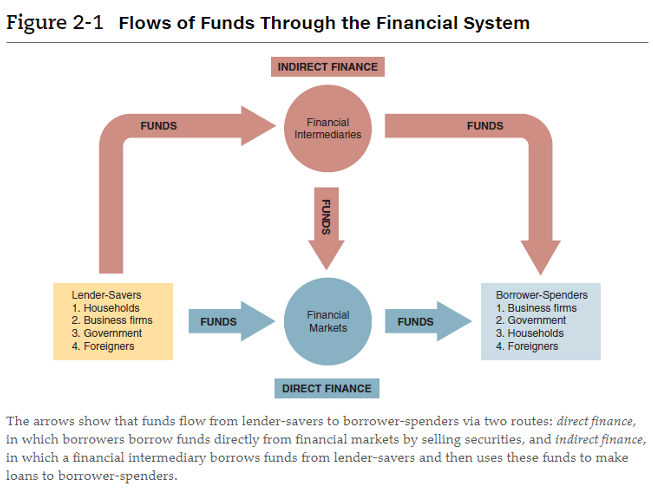
Indirect Finance
- Financial Intermediaries
- Transaction Costs
- the time and money spent in carrying out fin transactions, are a major problem for people who have excess funds to lend.
- Economies Of Scale
- Fin intermediaries can substantially reduce transaction costs because they have developed expertise in lowering them and because their large size allows them to take advantage of economies of scale, the reduction in transaction costs per dollar of transactions as the size(scale) of transaction increases.
- Risk Sharing
- Another benefit made possible by the low transaction costs of fin institutions is that these institutions can help reduce the exposure of investors to risk- that is, uncertainty about the returns investors will earn on assets.
- asset transformation
- Low transaction costs allow fin intermediaries to share risk at low cost, enabling them to earn a profit on the spread between the returns they earn on risky assets and the payments they make on the assets they have sold. This process of risk sharing is also sometimes referred to as asset transformation, because in a sense, risky assets are turned into safer assets for investors. Fin intermediaries also promote risk sharing by helping individuals to diversify and thereby lower the amount of risk to which they are exposed.
- Diversification
- Diversification entails investing in a collection(Portfolio) of assets whose returns do not always more together, with the result that overall risk is lower than for individual assets. Low transaction costs allow fin intermediaries to pool a collection of assets into a new asset and then sell it to individuals.
- Function of FI
- Fin intermediaries are fin institutions that acquire funds by issuing liabilities and, in turn use those funds to acquire assets by purchasing securities or making loans.
- Fin intermediaries play an important role in the fin system because they reduce transaction costs, allow risk sharing, and solve problems created by adverse selection and moral hazard
- Types of FI
- Depository Institutions (Banks)
- Depository institutions(for simplicity, we refer to these as banks throughout this text) are fin inter that accept deposits from individuals and institutions and make loans.
- Chartered Bank
- raise funds primarily by issuing chequable deposits(deposits on which cheques can be written), savings deposits(deposits that are payable on demand by do not allow their owner to write cheque), and term deposits(deposits with fixed terms to maturity). They then use these funds to make commercial, consumer, and mortgage loans to buy Canada gov securities and provincial and municipal bonds. There are 81 chartered banks in Canada, and as a group they are the largest type of fin inter with the most diversified portfolio(collections) of assets in this country.
- Trust and Loan companies
- These depository institutions obtain funds primarily through chequable and nonchequable savings deposits, term deposits, guaranteed investment certificates, and debentures. In the past, these institutions were constrained in their activities and mostly made mortgages loans for residential housing. Over time, these restrictions have been loosened so that the distinction between these depository institutions and chartered bank has blurred. These inter have become alike and are now more competitive with each other.
- Credit union and Caisse populaire
- Credit unions and caisses pop are very small coop lending institutions organized around a particular group: union members, employees of a particular firm, and so forth. They acquire funds from deposits and primarily make mortgage and consumer loans.
- Contractual savings institutions
- Contractual savings institutions, such as insurance companies and pension funds, are fin inter that acquire funds at periodic intervals on a contractual basis. Because they can predict with reasonable accuracy how much they will have to pay out in benefits in the coming years, they do not have to worry as much as depository institutions about losing funds. As a result, the liquidity of assets is not as important a consideration for them as it is for depository institutions, and they tend to invest their funds primarily in long-term securities such as corp bonds, stock , and mortgages.
- Life insurance companies
- Numbering 74 in Canada, insure people against fin hazard following a death, and sell annuities(annual income payments upon retirement). They acquire funds from the premiums that people pay to keep their policies in force and use those funds mainly to buy corp bonds and mortgages. They also purchase stock, but are restricted in the amount that they can hold. Currently, with close to $1.2 trillion in assets, they are among the largest of the contractual savings institutions.
- Property and casualty (P&C) companies
- These companies, numbering 164 in Canada, insure their policyholders against loss from theft, and accidents. They are very much like life insurance companies, receiving funds through premiums for their policies, but they have a greater possibility of loss of funds if major disasters occur. For this reason, they use their funds to buy more liquid assets than life insurance companies do. Their largest holding of assets is gov bonds and debentures; they also hold corp bonds and stocks.
- Pension funds and government retirement
- Private pension funds and provincial and municipal retirement funds provide retirement income in the form of annuities to employees who are covered by a pension plan. Funds are acquired by contributions from employers and/or from employees who either have a contribution automatically deducted from their paycheques or contribute voluntarily. The largest asset holdings of pension funds are corp bonds and stocks. The establishment of pension funds has been actively encouraged by the fed gov, both through legislation requiring pension plans and through tax incentives to encourage contributions.
- Investment intermediaries
- Finance Companies
- Fin companies raise funds by selling commercial paper(a short-term debt instrument) and by issuing stocks and bonds. They lend these funds to small businesses and to consumers, who use them to purchase such items as furniture, auto, and home improvements. Some fin companies are organized by a parent corp to help sell its product.
- Mutual Funds
- These fin inter acquire funds by selling shares to many individuals and then using the proceeds to purchase diversified portfolios of stocks and bonds. Mutual funds allow shareholders to pool their resources so that they can take advantage of lower transaction costs when buying large blocks of stocks or bonds. In addition, MF allow shareholders to hold more diversified portfolios than they otherwise would. Shareholders can sell(redeem) shares at any time, but the value of these shares will be determined by the value of the MF's holdings of securities. Because these fluctuate greatly, the value of MF shares will, too; therefore, investments in MF can be risky.
- Money Market Mutual Funds
- These fin institutions are similar to MF but also function to some extent as depository institutions because they offer deposit-type accounts. Like most MF, they sell shares to acquire funds that are then used to buy money market instruments that are both safe and very liquid. The interest on these assets is paid out to the shareholders.
- Hedge Funds
- HF are a type of MF with special characteristics. HF are organized as limited partnership with minimum investments ranging from $100,000 to, more typically, $1 million or more. These limitation mean that HF are subject to much weaker regulation than other MF. HF invest in many types of assets, with some specializing in stocks, others in bonds, others in foreign currencies, and still others in far more exotic assets.
- Investment Banks
- Despite its name, investment bank is not a bank or a fin inter in the ordinary sense; that ism it does not take in funds and then lend them out. Instead, an investment bank is a different type of intermediary that helps a corp issue securities. First it advises the corp on which type of securities to issue(stock or bonds); then it helps sell(underwrite) the securities by purchasing them from the corp at a predetermined price and reselling them in the market. Investment banks also act as deal makers, earning enormous fee by helping corp acquire other companies through mergers or acquisitions.
- Finance Companies
- Depository Institutions (Banks)
- Transaction Costs
- Asymmetric Information
- The presence of transaction costs in fin market explains, in part, why fin intermediaries and indirect finance play such an important role in fin markets. An additional reason is that in fin markets, one party often does not know enough about the other party to make accurate decisions. This inequality is called asymmetric information. Lack of information creates problems in the fin system on two front: before the transaction is entered into, and afterward. Asymmetric information and the adverse selection and moral hazard concepts are also crucial for the insurance industry.
- Adverse Selection
- Adverse selection in fin markets occurs when the potential borrowers who are the most likely to produce an undesirable (adverse) outcome – the bas credit risks – are the ones who most actively seek out a loan and are thus most likely to be selected. Because adverse selection makes it more likely that loans might be made to bad credit risks, lenders may decide not to make any loans, even though goods credit risks exists in the marketplace.
- problem created by asymmetric information before the transaction occurs.
- Moral Hazard
- Moral hazard in fin markets is the risk(hazard) that the borrower might engage in activities that are undesirable(immoral) from the lender's point of view, because they make it less likely that the loan will be paid back. Because moral hazard lowers the probability that the loan will be repaid, lenders may decide that they would rather not make a loan.
- problem created by asymmetric information after the transaction occurs.
- Economies of Scope
- fin intermediaries play such an important part in the econ is that by providing multiple fin services to their customers, such as offering them bank loans or selling their bonds for them, they can also achieve economies of scope
- they can lower the cost of information production for each service by applying one information resource to many different services.
- Conflict of Interest
- Conflict of interest, a type of moral hazard problem, arise when a person or institution has multiple objectives(interests), some of which conflict with each other. substantial reduction in the quality of information in fin markets increases asymmetric information problems and prevents fin markets from channeling funds into the most productive investment opportunities.
- Conflict of Interest
- Financial Intermediaries
Direct Finance
- Financial Market
- Types of Markets
- Debt and Equity Market
- Equity Market
- The second method of raising funds is through the issuance of equities, such as common stock, which are claims to the net income(income after expenses and taxes) and the assets of a business. Equities often make periodic payment(dividends) to their holders and are considered long-term securities because their have no maturity date. owning a stock means that you own a portion of the firm and thus have the right to vote on issues important to the firm and elect its directors. The main disadvantage of owning a corporation's equities rather than its debt is that an equity holder is a residual claimant; that is, the corp must pay all its debt holders before it pays its equity holders. advantage of holding equities is that equity holders benefit directly from any increases in the corp profitability or asset value because equities confer ownership rights on the equity holders.
- Primary market
- A primary market is a fin market in which new issues of a security, such as a bond or a stock, are sold to initial buyers by the corp or gov agency borrowing the funds. The primary markets for securities are not well known to the public because the selling of securities to initial buyers often take place behind close doors. investment bank fin institution that assists in the initial sale of securities in the primary market Investment bank are underwriting securities: it guarantees a price for a corp securities and then sell them to the public.
- Secondary Market
- A secondary market is a fin market in which securities that have been previously issued can be resold. It serves two important functions they make it easier and quicker to sell these fin instruments to raise cash; that is, they make the fin instruments more liquid. secondary markets determine the price of the security that the issuing firm sells in the primary market. investors who buy securities in the primary market will pay the issuing corp no more than the price they think the secondary market will set for this security. Conditions in the secondary market are therefore the most relevant to corp issuing securities. The Toronto Stock Exchange (TSX) and the TSX Venture exchange, in which previously issued stocks are traded, are the best-known examples of secondary markets, although the bond markets, in which previously-issued bonds of major corp and the Canadian gov are bought and sold, actually have a larger trading volume. Other examples of secondary markets are foreign exchange markets, futures markets, and options markets. Securities brokers and dealers are crucial to a well-functioning secondary market.
- Brokets
- Dealers
- 1. through exchanges, where buyers and sellers of securities(or their agents or brokers) meet in one central location to conduct trades. a. TSX for stock b. ICE Futures Canada for commodities i. wheat, oats, barley, and other agricultural commodities
- 2. over-the-counter(OTC) market, in which dealers at a different locations who have an inventory of securities stand ready to buy and sell securities "over the counter" to anyone who come to them and is willing to accept their prices.
- Debt Market
- The most common methods is through the issuance of a debt instrument, such as a bond or a mortgage, which is a contractual agreement by the borrower to pa the holder of the instrument fixes dollar amounts at regular intervals(interest and principal payments) until a specified date(the maturity date), when a final payment is made. The maturity of a debt instrument is the number of years(term) until that instrument's expiration date. A debt instrument is short-term if its maturity is less than a year and Debt instruments with a maturity term between one and ten years are said to be intermediate-term. long-term if its maturity is ten years or longer.
- Equity Market
- Money market
- The money market is a fin market in which only short-term debt instruments(generally those with original maturity terms of less than a year) are traded. Money market securities are usually more widely traded than longer-term securities and so tend to be more liquid. short-term securities have smaller fluctuations in prices than long-term securities, making them safer investment. corp and banks actively use the money market to earn interest on surplus funds that they accept to have only temporarily.
- Gov of Canada Treasury Bills
- These short-term debt instruments of the Canadian Gov are issued in 1, 3, 6, and 12 month maturities to finance the federal gov. pay a set amount at maturity with no additional interest payments; however, they effectively pay interest by initially selling at a discount the most liquid of all money market instruments because they are the most actively traded. the safest money market instrument because there is a low probability of default The fed gov can always meet its debt obligations because it can raise taxes or issue currency(paper money or coins) to pay off its debts. held mainly by banks, although small amounts are held by households, corp, and other financial intermediaries.
- Certificates of Deposit CDs
- debt instrument sold by a bank to depositors that pays annual interest of a given amount and at maturity pays back the original purchase price. often negotiable, meaning that they can be traded, and in bearer form(called bearer deposit notes), meaning that the buyer's name is not recorded in either the issuer's books or on the security itself.
- Non-Negotiable CDs
- cannot be sold to someone else and cannot be redeemed from the bank before maturity without paying a substantial penalty. issued in denomination ranging from $5000 to $100,000, with maturities of one day to five years. known as term deposit receipts or term notes. extremely important source of funds for trust and loan companies. institutions issue CDs under a variety of names; for example: DRs – Deposit Receipts GTCs – Guaranteed Trust Certificates GICs – Guaranteed Investment Certificates GIRs – Guaranteed investment receipts
- Commercial Paper
- short-term debt instrument issued in either Canadian dollars or other currencies by large banks and well-known corporations, such as BMO and Bombardier. unsecured, only the largest and most creditworthy corporations issue commercial paper. interest rate the corp is charged reflects the firm's level of risk. Low interest rate relative to those on other corp fixed-income securities and slightly higher than the rates of Gov of Canada T-bills.
- Repurchase Agreements
- Repurchase agreements, or repos, are effectively short-term loans(usually with a maturity of less than two weeks) for which T-bill serve as collateral, an asset that the lender receives if the borrower does not pay back the loan.
- Overnight Funds
- typically overnight loans between banks of their deposits with the BoC. market is very sensitive to the credit needs of the banks, so the interest rate on these loans, called the overnight interest rate, is a closely watched barometer of the tightness of credit market condition in the banking system and the stance of monetary policy. When it is high, the overnight interest rate indicates that the banks are strapped for funds; when low, it indicates that Banks's credit need are low.
- Rates
- Prime Rate
- The base interest rate on corp bank loans, an indicator of the cost to business borrowing from banks
- Overnight interest rate
- The interest rate charge on overnight loans in the overnight funds market, a sensitive indicator of the cost to bank of borrowing funds from other banks and the stance of monetary policy.
- Treasury Bill
- The interest rate on gov of Canada Treasury bills, an indicator of general interest-rate movements
- Libor Rate
- The Bristish Bankers' association average interbank rates for dollar deposits in the London Market
- Prime Rate
- Capital Market
- The Capital market is the market in which longer-term debt instruments(generally those with original maturity of one year or greater) and equity instruments are traded. Capital market securities, such as stock and long-term bonds, are often held by fin intermediaries such as insurance companies and pension funds, which have little uncertainty about the amount of funds they will have available in the future
- Stock
- Stocker are equity claims on the net income and assets of a corp. Individuals hold around half of the value of stocks; pension funds, mutual funds, and insurance company hold the rest.
- Mortgages
- Mortgages are loans to households or firms to purchase housing, land, or other real structures, where the structure or land serves as collateral for the loans. The mortgage market is the largest debt market in Canada, with the amount of residential mortgage(used to purchase residential mortgage) outstanding more than tenfold the amount of commercial and farm mortgages. Mortgages are provided by fin institutions such as chartered banks, trust and loan companies, and credit unions and caisses populaires. Banks and life insurance companies provide the majority of non-residential and farm mortgages. The federal gov also plays an active role in the mortgage market via the Canada Mortgage and Housing Corp (CMHC), which provides funds to the mortgage market by selling bonds and using the proceeds to buy mortgages.
- Mortgage Backed Securities
- bond-like debt instrument backed by a bundle of individual mortgages, whose interest and principal payments are collectively paid to the holders of the security. become notorious because they played a role in promoting the recent global fin crisis.
- Corporate Bonds
- long-term bonds are issued by corp with very strong credit ratings. The typical corp bond sends the holder an interest payment twice a year and pays off the face value when the bond matures. Some corp bonds, called convertible bonds, have the additional features of allowing the holder to convert them into a specified number of shares of stock at any time up to the maturity date. Corp bond market is substantially smaller than that of the stock market, with the amount of corp bonds outstanding less than one-third that of stock, the volume of new corporate bonds issued each year is substantially greater than the volume of new stock issues.
- Government of Canada Bonds
- Intermediate-term bonds(those with initial maturities from 1 to 10 years) are issued by the federal gov to finance the deficit if the fed gov. Because they are the most widely traded bonds in Canada, they are the most liquid security traded in the capital market. They are held by the BoC, banks, households, and foreigners.
- Provincial and Municipal Bonds
- Provincial and municipal gov also issue bonds to finance expenditures on schools, roads, and other large programs The securities issued by provincial gov are referred to as provincial bonds or provincials, and those issued by municipal gov as municipal bonds or municipals - the securities issued by the fed gov are referred to as Canadas. Provincials and municipals are denominated in either domestic currency or foreign currencies, mostly US dollars, Swiss francs, and Japanese Yen. Provincial and municipal gov bonds are mainly held by trusteed pension plans, social security funds (predominantly the Canada Pension Plan), and foreigners.
- Government Agencies Bonds
- Provincial and municipal gov also issue bonds to finance expenditures on schools, roads, and other large programs The securities issued by provincial gov are referred to as provincial bonds or provincials, and those issued by municipal gov as municipal bonds or municipals - the securities issued by the fed gov are referred to as Canadas. Provincials and municipals are denominated in either domestic currency or foreign currencies, mostly US dollars, Swiss francs, and Japanese Yen. Provincial and municipal gov bonds are mainly held by trusteed pension plans, social security funds (predominantly the Canada Pension Plan), and foreigners.
- Bank Loans
- These loans to consumers and businesses are made principally by banks, but in the case of consumer loans, also by finance companies.
- Canada Savings Bond
- These are nonmarketable bonds issued by the gov of Canada and sold each year from early Oct through to Apr 1. Offer a slightly higher coupon rate than CSBs offer, but can be redeemed only once a year
- Debt and Equity Market
- Meaning of interest Rate
- Measuring interest rate
- Present Value
- The concept of present value (or present discounted value) is based on the commonsense notion that a dollar paid to you one year from now is less valuable than a dollar paid to you today.
- Simple Loan P V = CF ( 1 + i ) n
- Credit Market Instrument
- Simple Loan
- the lender provides the borrower with an amount of funds that must be repaid to the lender at the maturity date, along with an additional payment for the interest. Many money market instruments are of this type—for example, commercial loans to businesses.
- YTM = PV = CF / (1 +i)n
- Fixed-payment Loan
- the lender provides the borrower with an amount of funds that the borrower must repay by making the same payment, consisting of part of the principal and interest, every period (such as a month) for a set number of years.
- Coupon Bond
- A coupon bond pays the owner of the bond a fixed-interest payment (coupon payment) every year until the maturity date, when a specified final amount (face value or par value) is repaid.
- Identification
- Bond's Face value
- Corporation or gov agency that issue the bond
- Bond's coupon rate
- Maturity
- Perpetuity
- Pc = C/ Ic
- Pc = price of the perpetuity (consol) C = yearly payment ic = yield to maturity of the perpetuity (consol)
- Pc = C/ Ic
- Discount bond
- A discount bond (also called a zero-coupon bond) is bought at a price below its face value (at a discount), and the face value is repaid at the maturity date. Unlike a coupon bond, a discount bond does not make any interest payments; it just pays off the face value.
- Simple Loan
- Yield to Maturity YTM
- the interest rate that equates the present value of cash flow payments received from a debt instrument with its value today. 1 Because the concept behind the calculation of the yield to maturity makes good economic sense, economists consider it the most accurate measure of interest rates.
- Present Value
- Distinction between interest rate and Return
- The distinction between Real and Nominal interest rate
- Measuring interest rate
- The behaviour of interest rate
- Determinant of Asset Demand
- Supply and demand in the Bond market
- Change in equilibrium interest rate
- Supply and demand in the market for money
- Change in equilibrium interest rate in the liquidity preference
- Does a higher rate of growth of the money supply lower interest rate
- The risk and term structure of interest rate
- Types of Markets
- Financial Market
Financial System
- Regulation of the Fin System
- Government regulate
- To increase the information available to investor
- Asymmetric info in fin markets means that investors may be subject to adverse selection and moral hazard problems that may hinder the efficient operation of fin markets. Risky firms or outright crooks may be the most eager to sell securities to unwary investors, and the resulting adverse selection problem may keep investors out of fin markets. Furthermore, once an investor has bought a security, thereby lending money to a firm, the borrower may have incentives to engage in risky activities or to commit outright fraud. The presence of this moral hazard problem may also keep investors away from fin markets. Gov regulation can reduce adverse selection and moral hazard problems in fin markets and enhance the efficiency of the markets by increasing the amount of information available to investors.
- Principal regulatory agencies of the Canadian Fin System
- Provincial securities and exchange commissions
- Organized exchanges and financial markets Requires disclosure of information and restricts insider trading
- Bank of Canada
- Office of the superintendent of financial institution Canada (OSFI)
- Canada deposit insurance corporation (CDIC)
- Quebec Deposit insurance board
- Canadian life and health insurance compensation corporation (COMPCORP)
- P&C insurance compensation corporation (PACIC)
- Provincial securities and exchange commissions
- • To ensure the soundness of the fin system.
- Asymmetric info can lead to the widespread collapse of fin inter, referred to as financial panic. Because providers of funds to fin inter may not be able to assess whether the institutions holding their funds are sound, if they have doubts about the overall health of fin inter, they may want to pull their funds out of both sound and unsound institutions. The possible outcome is a fin panic that produces large losses for the public and causes serious damage to the econ.
- Restriction on entry
- Provincial banking and insurance commission, the BoC, and the office of the Superintendent of Financial Institutions (OSFI), an agency of the fed gov, have created tight regulations governing who is allowed to set up a fin inter. Individuals or groups that want to establish a fin inter, such as a bank or an insurance company, must obtain a charter from the provincial or fed gov. Only if they are upstanding corp citizens with impeccable credentials and a large amount of initial funds will they be given a charter.
- Disclosure
- Reporting requirement for fin inter are stringent. Their bookkeeping must follow certain strict principles; their books are subject to periodic inspection; and they must make certain information available to the public.
- Restriction on assets and activities
- Deposit Insurance
- Limit on competition
- To increase the information available to investor
- Government regulate
- Regulation of the Fin System
Money
- Economists define money(also referred to as the money supply) as anything that is generally accepted as payment for goods and services or in the repayment of debts. When most people talk about money they're talking about currency(paper money and coins). Because cheques are also accepted as payment for purchases, chequing account deposits are considered money as well. Economists make a distinction between money - in the for of currency, demand deposits, and other items that are used to make purchases - and wealth, the total collection of pieces of property that serve to store value. Wealth includes not only money but also other assets such as bonds, common stock, art, land, furniture, cars, and houses. People also use the work money to describe what economists call income. Income is a flow of earnings per unit of time. Money, by contrast is a stock: it is a certain amount at a given point in time.
- Function of money
- Medium of Exchange
- Money in the form of currency or cheque is a medium of exchange; it is used to pay for goods and services. Money promotes economic efficiency by reducing the time spent in exchanging goods and services. The time spent trying to exchange a goods or services is called a transaction cost. In a barter econ, transaction costs are high because people have to satisfy a "double coincidence of wants" Money promote econ efficiency by eliminating much of the time spend exchanging goods and services. It also promote efficiency by allowing people to specialize in what they do best. For a commodity to function effectively as money, it has to meet several criteria: It must be easily standardized; making it simple to ascertain its value; It must be widely accepted; It must be divisible, so that it is east to "make change"; It must be easy to carry; and It must not deteriorate quickly.
- Unit of Account
- The second role of money is to provide a unit of account; that is it is used to measure value in an econ. We measure the value of goods and services in term of money. We can see that using money as a unit of account reduces transaction costs in an econ by reducing the number of prices that need to be considered. The benefits of this function of money grow as the econ becomes more complex.
- Store of Value
- Money also function as a store of value; it is a repository of purchasing power over time. A store of value is used to save purchasing power from the time income is received until it is spent. Money is not unique as a store of value; and asset - whether money, stocks, bonds, land, houses, art, or jewellery - can be used to store wealth. The important concept of liquidity, the relative ease and speed with which an asset can be converted into a medium of exchange. Liquidity is highly desirable. Money is the most liquid of asset of all because it is the medium of exchange; it does not have to be converted into anything else in order to make purchases. How good a store of value money is depends on the price level.
- Medium of Exchange
- Commodity money
- Fiat money
- Cheque
- E-Money
- Electronic Payment
- Measuring Money
- BOC's Money Aggregate
- M1_ and M1++
- Currency
- which is all the paper money and coins that are in circulation, where “in circulation” means not held by banks or the government. Surprisingly, there is close to $1500 cash in the hands of each person in Canada and more than US$2000 in the hands of each person in the United States
- The value of all chequable deposits at chartered banks, trust and mortgage loans companies (TMLs), and credit unions and caisses populaires (CUCPs).
- Currency
- M2, M2+, and M2++
- M3
- Another Definition of the money supply is called M3. As panel (c) of Figure 3-1 shows, M3 includes everything that is in M2, plus non-personal term deposits at chartered banks and foreign currency deposits of residents at chartered banks. The non-personal term deposits are held by provincial and municipal governments, corporations, and institutions, and also include deposits held by one bank with another, known as interbank deposits. The foreign currency deposits are mostly denominated in U.S. dollars. Notice that the M2 and M3 monetary aggregates do not include deposits with trust and mortgage loan companies and credit unions and caisses populaires.
- M1_ and M1++
- BOC's Money Aggregate
Bilder und Dateien der Mindmap
Informationen
- Beschreibung
- Mindmap am ECON 385, erstellt von Jeremy Cote am 11/11/2019.
- Erstellt von
- Jeremy Cote · Nov 2019
- Aktualisiert
- 12 Nov 2019
- Aufrufe
- 1
- Bewertung