
Mindmap
Language and meaning
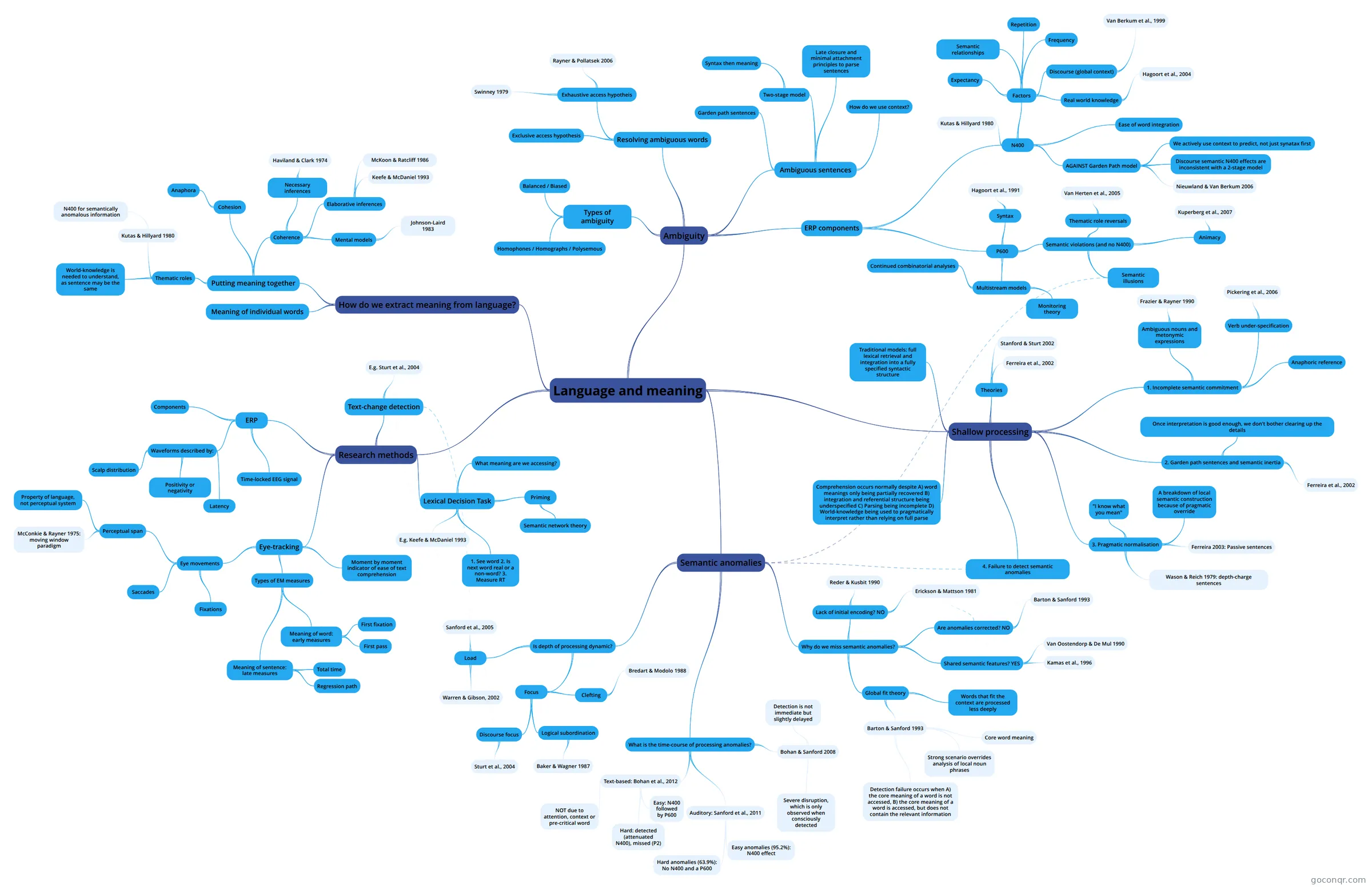
Mind map: Language and meaning
Inhalt der Mindmap
Language and meaning
How do we extract meaning from language?
- Meaning of individual words
- Putting meaning together
- Thematic roles
- Who did what? With or to whom? e.g The boy kissed the girl Need to identity agent, patient and action
- World-knowledge is needed to understand, as sentence may be the same
- Kutas & Hillyard 1980
- - Mary are some tasty rocks - John drank tea with dog When roles don't fit it is easy to detect --> don't fit the context
- N400 for semantically anomalous information
- Cohesion
- Explicit markers linking sentences
- Anaphora
- When pronouns could refer to multiple people/things, we use context and world knowledge to resolve. Resolving is easy
- Coherence
- Model in our heads of what is happening
- Necessary inferences
- Haviland & Clark 1974
- - Sam offered to give Claire a lift. her car had broken down - Sam drove Claire into town, her car had broken down Slower when you require an inference (drive already contains the information car, but give a lift does not)
- Haviland & Clark 1974
- Elaborative inferences
- McKoon & Ratcliff 1986
- Think of 'dead' without it being mentioned. - the director and cameraman were ready to shoot close-ups when suddenly the actress fell from the 14th story
- Keefe & McDaniel 1993
- Think of 'broke' without it being mentioned - No longer able to contain his anger, the husband threw the delicate porcelain vase against the wall
- McKoon & Ratcliff 1986
- Mental models
- Johnson-Laird 1983
- On which side of Claire is Andrew? This depends on the mental model you have created of the scene (e.g. bench vs small round table)
- Johnson-Laird 1983
- Thematic roles
Research methods
- Lexical Decision Task
- Priming
- Semantic network theory
- Concepts are represented as nodes, links represent relationships between concepts --> meaning is accessed through spreading activation
- Semantic network theory
- 1. See word 2. Is next word real or a non-word? 3. Measure RT
- E.g. Keefe & McDaniel 1993
- No longer able to control his anger, the husband threw the delicate porcelain vase against the wall. The sentence primes 'broke', so in a lexical decision task people were faster to say 'broke' was a word than to say that 'greap' was a non-word
- What meaning are we accessing?
- Language is made up of A. mental lexicon and B. grammar LDT accesses the lexicon
- Priming
- Eye-tracking
- Moment by moment indicator of ease of text comprehension
- Types of EM measures
- Meaning of word: early measures
- First fixation
- How long we spend on a word when we first encounter it
- First pass
- When we move away but then return to the same word
- First fixation
- Meaning of sentence: late measures
- Total time
- All fixations on that word
- Regression path
- All the times we look back
- Total time
- Meaning of word: early measures
- Eye movements
- Fixations
- - Meaningful information--> word-based - 100-150ms for next move if processing is advanced enough - 250-500ms -60ms for information on the fixated word to travel from retina to cortex
- Saccades
- - 20-40ms & oculomotor latency of 100-150ms (to plan jump) - no visual information picked up - 90% are progressive -Function words are often skipped
- Perceptual span
- 4 to left, 15 to right
- McConkie & Rayner 1975: moving window paradigm
- Controlled how many X's were replaced by real letters Gwoltiger was a bravo cat who travelled on a barge
- Property of language, not perceptual system
- Direction of reading and level of information per character
- Fixations
- ERP
- Time-locked EEG signal
- Waveforms described by:
- Latency
- Positivity or negativity
- Scalp distribution
- Components
- A component is a predictable and identifiable waveform that covaries in response to experimental manipulations
- Text-change detection
- E.g. Sturt et al., 2004
- Lexical Decision Task
Ambiguity
- Ambiguous sentences
- Garden path sentences
- Two-stage model
- Syntax then meaning
- Late closure and minimal attachment principles to parse sentences
- Late closure = keep working on the same phrase/clause for as long as possible Minimal attachment= build the simplest structure possible
- How do we use context?
- ERP components
- N400
- Kutas & Hillyard 1980
- Proportional to the degree of incongruity
- Factors
- Expectancy
- Cloze probability E.g. the cat is on the mat/fridge
- Semantic relationships
- E.g. doctor/nurse vs dog/boat
- Repetition
- Frequency
- Discourse (global context)
- Van Berkum et al., 1999
- The cat entered the room suddenly, startling a mouse. The mouse quickly/slowly left. - The discourse-dependent semantic anomalies elicited a large N400 effect --> No fundamental distinction between the integration of a word in its local and its global semantic context
- Van Berkum et al., 1999
- Real world knowledge
- Hagoort et al., 2004
- N400 effect for world knowledge and semantic violations Dutch trains
- Hagoort et al., 2004
- Expectancy
- Ease of word integration
- AGAINST Garden Path model
- We actively use context to predict, not just synatax first
- Nieuwland & Van Berkum 2006
- PEANUT: Discourse context can immediately overrule local lexical-semantic violations, and therefore language comprehension does not involve an initially context-free semantic analysis Peanut in love/salted
- Discourse semantic N400 effects are inconsistent with a 2-stage model
- Kutas & Hillyard 1980
- P600
- Syntax
- Hagoort et al., 1991
- The spoilt child throws/throw the toy on the ground (subject-verb agreement)
- Hagoort et al., 1991
- Semantic violations (and no N400)
- Thematic role reversals
- Van Herten et al., 2005
- The fox that hunted the poacher
- Van Herten et al., 2005
- Animacy
- Kuperberg et al., 2007
- Every morning at breakfast the eggs would eat
- Kuperberg et al., 2007
- Semantic illusions
- Thematic role reversals
- Multistream models
- Monitoring theory
- Parallel syntactic and plausibility analyses If there is a conflict, the message is re-analysed resulting in a P600
- Continued combinatorial analyses
- Syntactic, plausibility and thematic streams P600 reflects ongoing effort to integrate the information across the three streams
- Monitoring theory
- Syntax
- N400
- Types of ambiguity
- Homophones / Homographs / Polysemous
- Homophones: same phonology, different spelling Homographs: same spelling, different phonology Polysemous: Same word, multiple meanings
- Balanced / Biased
- Balanced = when we look at the frequency of meanings it is fairly similar Biased= there is a dominant meaning, one is used more often than another
- Homophones / Homographs / Polysemous
- Resolving ambiguous words
- Exclusive access hypothesis
- Choose the appropriate meaning
- Exhaustive access hypotheis
- Access both meanings and resolve further down the line
- Swinney 1979
- Rumour has it that the government building has been plagued with problems. the man was not surprised when he found several bugs* in the cor*ner of the room - Ant/spy/sew as targets in the LDT - RT was the same for ant or spy if immediately after bugs - RT was faster for spy by corner
- Rayner & Pollatsek 2006
- Eye tracking study for biased vs balanced ambiguous words. Balanced: read slowly in neutral contexts (exhaustive checking), but quickly in context Biased: read quickly in neutral contexts and in contexts indicating the dominant meaning, but slowly in instances indicating subordinate meaning
- Exclusive access hypothesis
- Ambiguous sentences
Semantic anomalies
- Why do we miss semantic anomalies?
- Lack of initial encoding? NO
- Erickson & Mattson 1981
- Forewarning does not impact (not correcting)
- Reder & Kusbit 1990
- Self-paced reading: Faster for detected, so not just quickly skipping over when people miss the anomaly
- Erickson & Mattson 1981
- Are anomalies corrected? NO
- Barton & Sanford 1993
- Where were the survivors buried?
- Barton & Sanford 1993
- Shared semantic features? YES
- Van Oostendorp & De Mul 1990
- Moses, Adam, Nixon
- Kamas et al., 1996
- Highlighting differences and similarities (e.g. Who parted the sea vs which religion)
- Van Oostendorp & De Mul 1990
- Global fit theory
- Words that fit the context are processed less deeply
- Barton & Sanford 1993
- Decide where to bury the survivors?
- Core word meaning
- Strong scenario overrides analysis of local noun phrases
- Detection failure occurs when A) the core meaning of a word is not accessed, B) the core meaning of a word is accessed, but does not contain the relevant information
- Lack of initial encoding? NO
- What is the time-course of processing anomalies?
- Bohan & Sanford 2008
- Negotiated/communicated with the hostages: no detection at all or delayed eye movements in detection
- Detection is not immediate but slightly delayed
- Severe disruption, which is only observed when consciously detected
- Auditory: Sanford et al., 2011
- Easy anomalies (95.2%): N400 effect
- Hard anomalies (63.9%): No N400 and a P600
- Text-based: Bohan et al., 2012
- HOSTAGES
- Easy: N400 followed by P600
- Hard: detected (attenuated N400), missed (P2)
- NOT due to attention, context or pre-critical word
- Bohan & Sanford 2008
- Is depth of processing dynamic?
- Focus
- Clefting
- Bredart & Modolo 1988
- Clefting and Moses: it was two animals that Moses took on the ark vs It was Moses who took two animals on the ark
- Bredart & Modolo 1988
- Logical subordination
- Baker & Wagner 1987
- Emerald city & red stone
- Baker & Wagner 1987
- Discourse focus
- Sturt et al., 2004
- What was happening that night/ Which man got into trouble
- Sturt et al., 2004
- Clefting
- Load
- Warren & Gibson, 2002
- Full noun phrases vs pronouns in reading time
- Sanford et al., 2005
- WM load affected detection rates The professor who (the student/I) had recently (met/seen/missed) at the party was famous, but no one could figure out why
- Warren & Gibson, 2002
- Focus
- Why do we miss semantic anomalies?
Shallow processing
- Traditional models: full lexical retrieval and integration into a fully specified syntactic structure
- 1. Incomplete semantic commitment
- Ambiguous nouns and metonymic expressions
- Frazier & Rayner 1990
- Semantic commitments are minimised, occurring only when mutually incompatible choices are presented by the grammar or when forced by the need to maintain consistency between the interpretation of the current phrase and any already processed contextual material
- Frazier & Rayner 1990
- Verb under-specification
- Pickering et al., 2006
- Anaphoric reference
- Ambiguous nouns and metonymic expressions
- 2. Garden path sentences and semantic inertia
- Once interpretation is good enough, we don't bother clearing up the details
- Ferreira et al., 2002
- While Anna dressed the baby played in the crib 100% know the baby played in the crib, but they still think Anna dressed the baby
- 3. Pragmatic normalisation
- "I know what you mean"
- A breakdown of local semantic construction because of pragmatic override
- Ferreira 2003: Passive sentences
- Wason & Reich 1979: depth-charge sentences
- No head injury is too trivial to be ignoredNo missile is too small to be banned
- 4. Failure to detect semantic anomalies
- Comprehension occurs normally despite A) word meanings only being partially recovered B) integration and referential structure being underspecified C) Parsing being incomplete D) World-knowledge being used to pragmatically interpret rather than relying on full parse
- Theories
- Stanford & Sturt 2002
- Ferreira et al., 2002
Informationen
- Beschreibung
- Advanced topics in language (Language and meaning) Mindmap am Language and meaning, erstellt von Isobel Dawson am 03/12/2019.
- Erstellt von
- Isobel Dawson
- Aufrufe
- 1
- Bewertung