
Mindmap
THE WORLD TODAY
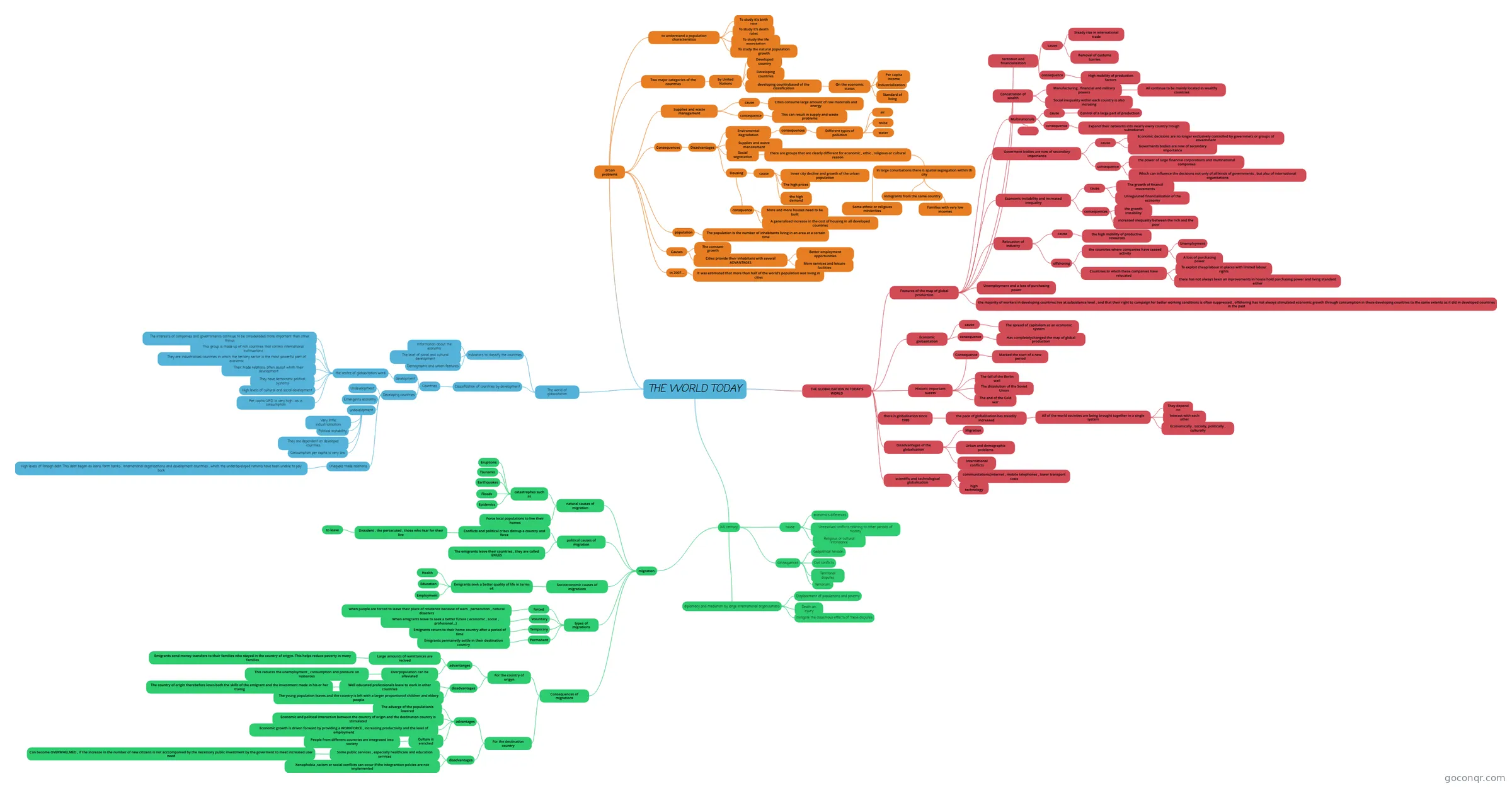
Mind map: The world today
Inhalt der Mindmap
THE WORLD TODAY
Urban problems
- In 2007...
- It was estimated that more than half of the world's population was living in cities
- Causes
- Cities provide their inhabitans with several ADVANTAGES
- Better employment opportunities
- More services and leisure facilities
- The constant growth
- Cities provide their inhabitans with several ADVANTAGES
- Consequences
- Disadvantages
- Enviromental degradation
- consequences
- Different types of pollution
- air
- noise
- water
- Different types of pollution
- consequences
- Supplies and waste management
- Social segretation
- there are groups that are clearly different for economic , ethic , religious or cultural reason
- In large conurbations there is spatial segregation within th city
- Some ethnic or religiuos miniorities
- Inmigrants from the same country
- Families with very low incomes
- In large conurbations there is spatial segregation within th city
- there are groups that are clearly different for economic , ethic , religious or cultural reason
- Housing
- cause
- Inner city decline and growth of the urban population
- The high prices
- the high demand
- consquence
- More and more houses need to be built
- A generalised increase in the cost of housing in all developed countries
- cause
- Enviromental degradation
- Disadvantages
- Supplies and waste management
- consequence
- This can result in supply and waste problems
- cause
- Cities consume large amount of raw materials and energy
- consequence
- population
- The population is the number of inhabitants living in an area at a certain time
- Two major categories of the countries
- by United Nations
- Developed country
- developing countrybased of the classification
- On the economic status
- Per capita income
- Industrialization
- Standard of living
- On the economic status
- Developing countries
- by United Nations
- to understand a population characteristics
- To study it's birth race
- To study it's death rates
- To study the life expectation
- To study the natural population growth
- In 2007...
THE GLOBALISATION IN TODAY'S WORLD
- Historic important sucess
- The fall of the Berlin wall
- The dissolution of the Soviet Union
- The end of the Cold war
- Consequence
- Marked the start of a new period
- Disadvanteges of the globalisation
- Migration
- International conflicts
- Urban and demographic problems
- there is globalisation since 1980
- the pace of globalisation has steadily increased
- All of the world societies are being brought together in a single system
- They depend on
- Interact with each other
- Economically , socially, politically , culturally
- All of the world societies are being brought together in a single system
- the pace of globalisation has steadily increased
- Economic globasitation
- cause
- The spread of capitalism as an economic system
- consequence
- Has completelychanged the map of global production
- cause
- Features of the map of global production
- tertistion and financialisation
- cause
- Steady rise in international trade
- Removal of customs barries
- consequence
- High mobility of production factors
- cause
- Concetration of wealth
- Manufacturing , financial and military powers
- All continue to be mainly located in wealthy countries
- Social inequality within each country is also incrasing
- Manufacturing , financial and military powers
- Multinationals
- cause
- Control of a large part of production
- consequence
- Expand their networks into nearly every country trough subsidiaries
- cause
- Goverment bodies are now of secondary importance
- cause
- Economic decisions are no longer exclusively controlled by governmets or groups of government
- Goverments bodies are now of secondary importance
- consequence
- the power of large financial corporations and multinational companies
- Which can influence the decisions not only of all kinds of governments , but also of international organitations
- cause
- Economic inctability and increased inequality
- cause
- The growth of financil movements
- Unregulated financialisation of the economy
- consequences
- the growth instability
- increased inequality between the rich and the poor
- cause
- Relocation of industry
- cause
- the high mobility of productive resources
- offshoring
- the countries where companies have ceased activity
- Unemployment
- A loss of purchasing power
- Countries to which these companies have relocated
- To exploit cheap labour in places with limited labour rights
- there has not always been an inprovements in house hold purchasing power and living standard either
- the countries where companies have ceased activity
- cause
- Unemployment and a loss of purchasing power
- the majority of workers in developing countries live at subsistence level , and that their right to campaign for better working conditions is often suppressed , offshoring has not always stimulated economic growth through consumption in these developing countries to the same extents as it did in developed countries in the past
- tertistion and financialisation
- scientific and technological globalisation
- communitations(internet , mobile telephones , lower transport costs
- high technology
- Historic important sucess
XXI century
- migration
- natural causes of migration
- catastrophes such as
- Eruptions
- Tsunamis
- Earthquakes
- Floods
- Epidemics
- Force local populations to live their homes
- catastrophes such as
- political causes of migration
- Conflicts and political crises distrup a country and force
- Dissident , the persecuted , those who fear for their live
- to leave
- Dissident , the persecuted , those who fear for their live
- The emigrants leave their countries , they are called EXILES
- Conflicts and political crises distrup a country and force
- Socioeconomic causes of migrations
- Emigrants seek a better quality of life in terms of:
- Health
- Education
- Employment
- Emigrants seek a better quality of life in terms of:
- types of migrations
- forced
- when paople are forced to leave their place of residence because of wars , persecution , natural disasters
- Voluntary
- When emigrants leave to seek a better future ( economic , social , profesional...)
- Temporary
- Emigrants return to their home country after a period of time
- Permanent
- Emigrants permanetly settle in their destination country
- forced
- Consequences of migrations
- For the country of origyn
- advantanges
- Large amounts of remittances are recived
- Emigrants send money transfers to thair families who stayed in the country of origyn. This helps reduce poverty in many families
- Overpopulation can be alleviated
- This reduces the unemployment , consumption and pressure on resources
- Large amounts of remittances are recived
- disadvantages
- Well educated professionals leave to work in other countries
- The country of origin therebefore loses both the skills of the emigrant and the investment made in his or her trainig
- The young population leaves and the country is left with a larger proportionof children and eldery people
- Well educated professionals leave to work in other countries
- advantanges
- For the destination country
- advantages
- The advarge of the populationis lowered
- Economic and political interaction between the country of origin and the destination country is stimulated
- Economic growth is driven forward by providing a WORKFORCE , increasing productivity and the level of employment
- Culture is enriched
- People from different countries are integrated into society
- disadvantages
- Some public services , especially healthcare and education services
- Can become OVERWHELMED , if the increase in the number of new citizens is not acccompanied by the necessary public investment by the goverment to meet increased user need
- Xenophobia ,racism or social conflicts can occur if the integrantion polcies are not implemented
- Some public services , especially healthcare and education services
- advantages
- For the country of origyn
- natural causes of migration
- cause
- economics diferences
- Unresolved conflicts relating to other periods of history
- Religious or cultural intorelance
- consequences
- Geopolitical tension
- Civil conflicts
- Territorial disputes
- terrorism
- diplomacy and mediation by large international organisations
- mitigate the disastrous effects of these disputes
- Displacement of populations and poverty
- Death an injury
- migration
The world of globasitation
- Indicators to classify the countries
- Information about the economic
- The level of social and cultural development
- Demographic and urban features
- Classification of countries by development
- Countries
- development
- the centre of globasitation word
- The interests of companies and govermments continue to be consideraded more important than other things
- This group is made up of rich countries that control international instituations
- They are industralised countries in which the terciary sector is the most powerful part of economic
- Their trade relations often assist whith their development
- They have democratic political systems
- High levels of cultural and social development
- Per capita G.P.D. is very high , as is consumption
- the centre of globasitation word
- Developing countries
- Undevelopment
- Emergents economy
- undevelopment
- Very little industrialisation
- Political instability
- They are dependent on developed countries
- Consumption per capita is very low
- Unequals trade relations
- High levels of foreign debt. This debt began as loans form banks , International organisations and development countries , which the underdeveloped nations have been unable to pay back
- development
- Countries
- Indicators to classify the countries
Informationen
- Beschreibung
- Mindmap am THE WORLD TODAY, erstellt von MANUEL LAZARO MALDONA am 11/12/2019.
- Erstellt von
- MANUEL LAZARO MALDONA
- Aufrufe
- 1
- Bewertung