
Mindmap
P4 - Explaining motion
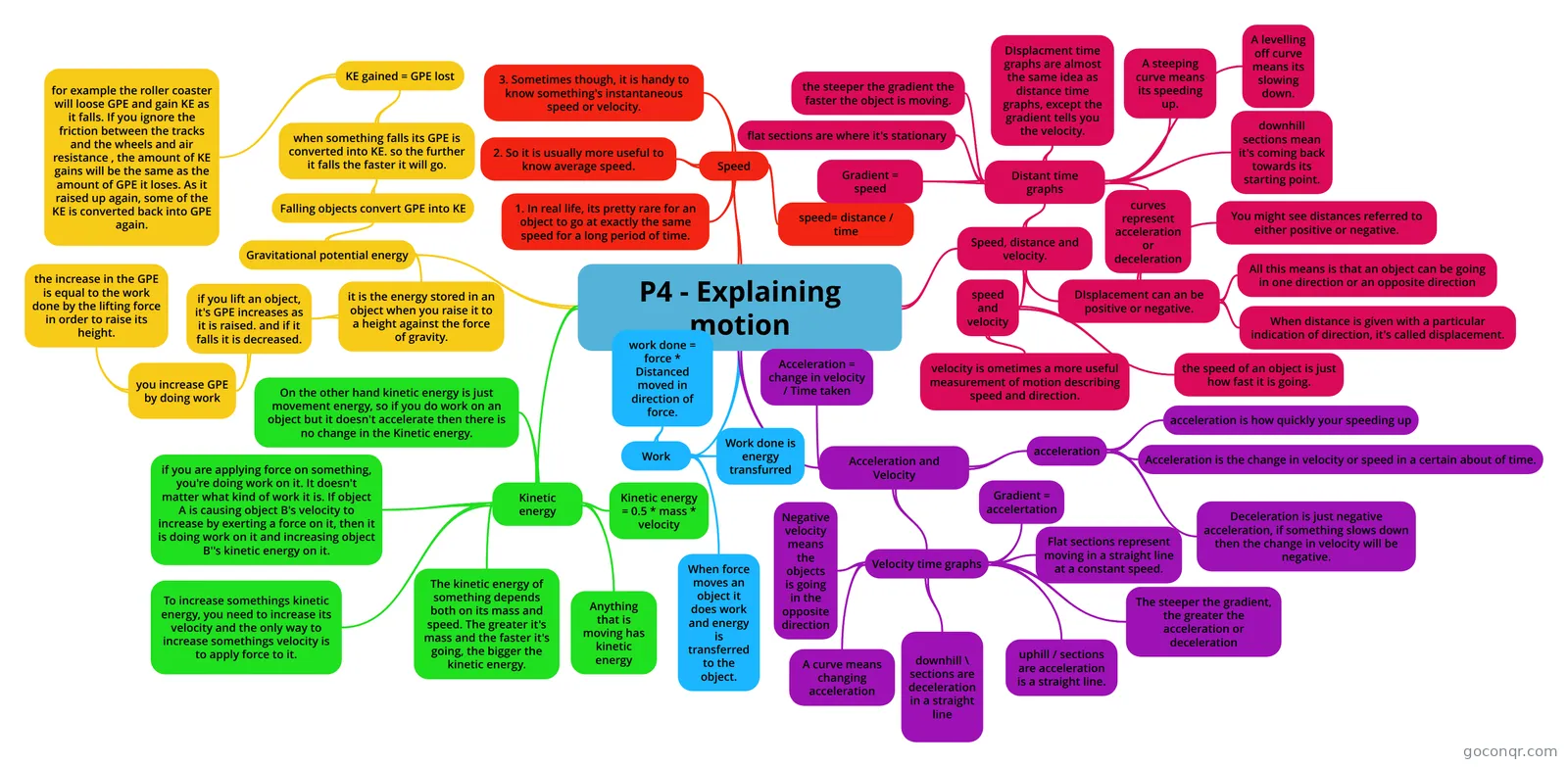
Mind map: Explaining motion
Inhalt der Mindmap
P4 - Explaining motion
Speed
- speed= distance / time
- 1. In real life, its pretty rare for an object to go at exactly the same speed for a long period of time.
- 2. So it is usually more useful to know average speed.
- 3. Sometimes though, it is handy to know something's instantaneous speed or velocity.
Speed, distance and velocity.
- Distant time graphs
- Gradient = speed
- flat sections are where it's stationary
- the steeper the gradient the faster the object is moving.
- downhill sections mean it's coming back towards its starting point.
- curves represent acceleration or deceleration
- A steeping curve means its speeding up.
- A levelling off curve means its slowing down.
- DIsplacment time graphs are almost the same idea as distance time graphs, except the gradient tells you the velocity.
- DIsplacement can an be positive or negative.
- You might see distances referred to either positive or negative.
- All this means is that an object can be going in one direction or an opposite direction
- When distance is given with a particular indication of direction, it's called displacement.
- speed and velocity
- the speed of an object is just how fast it is going.
- velocity is ometimes a more useful measurement of motion describing speed and direction.
- Distant time graphs
Acceleration and Velocity
- acceleration
- acceleration is how quickly your speeding up
- Acceleration is the change in velocity or speed in a certain about of time.
- Deceleration is just negative acceleration, if something slows down then the change in velocity will be negative.
- Velocity time graphs
- Gradient = accelertation
- Flat sections represent moving in a straight line at a constant speed.
- The steeper the gradient, the greater the acceleration or deceleration
- uphill / sections are acceleration is a straight line.
- downhill \ sections are deceleration in a straight line
- A curve means changing acceleration
- Negative velocity means the objects is going in the opposite direction
- Acceleration = change in velocity / Time taken
- acceleration
Work
- Work done is energy transfurred
- When force moves an object it does work and energy is transferred to the object.
- work done = force * Distanced moved in direction of force.
Kinetic energy
- Anything that is moving has kinetic energy
- The kinetic energy of something depends both on its mass and speed. The greater it's mass and the faster it's going, the bigger the kinetic energy.
- Kinetic energy = 0.5 * mass * velocity
- To increase somethings kinetic energy, you need to increase its velocity and the only way to increase somethings velocity is to apply force to it.
- if you are applying force on something, you're doing work on it. It doesn't matter what kind of work it is. If object A is causing object B's velocity to increase by exerting a force on it, then it is doing work on it and increasing object B''s kinetic energy on it.
- On the other hand kinetic energy is just movement energy, so if you do work on an object but it doesn't accelerate then there is no change in the Kinetic energy.
Gravitational potential energy
- it is the energy stored in an object when you raise it to a height against the force of gravity.
- if you lift an object, it's GPE increases as it is raised. and if it falls it is decreased.
- you increase GPE by doing work
- the increase in the GPE is equal to the work done by the lifting force in order to raise its height.
- you increase GPE by doing work
- if you lift an object, it's GPE increases as it is raised. and if it falls it is decreased.
- Falling objects convert GPE into KE
- when something falls its GPE is converted into KE. so the further it falls the faster it will go.
- KE gained = GPE lost
- for example the roller coaster will loose GPE and gain KE as it falls. If you ignore the friction between the tracks and the wheels and air resistance , the amount of KE gains will be the same as the amount of GPE it loses. As it raised up again, some of the KE is converted back into GPE again.
- KE gained = GPE lost
- when something falls its GPE is converted into KE. so the further it falls the faster it will go.
- it is the energy stored in an object when you raise it to a height against the force of gravity.
Informationen
- Beschreibung
- Mindmap am P4 - Explaining motion, erstellt von Emily Snelling am 16/02/2015.
- Erstellt von
- Emily Snelling
- Aufrufe
- 10
- Bewertung