
Motion and Kinematics
1,290 resources created by 1,016 users
This Motion and Kinematics page on GoConqr gathers community-made quizzes, mind maps, flashcards and notes, from speed, distance and time to SUVAT equations, projectile motion and free fall. It's built for school students revising a topic and teachers after ready-made material. There are over 1,100 resources here, including more than 100 quizzes, over 500 mind maps and over 400 flashcards, mostly at secondary level. Pick a quiz to find your gaps, then browse the maps that match.
Top Motion and Kinematics resources
-
10 cardsUNIT 6.1 DISTANCE, SPEED AND ACCELERATION A car travels 2 km in 80 seconds. How fast was it travelling in meters per second? (Remember 1 km = 1,000 m)
-
21 questionsKinematics in Two Dimensions A ball is rolling down one hill and up another. Points A and B are at the same height. How do the velocity ...
-
12 questionsVelocity & Acceleration v Time Graphs for Uniform Acceleration Over the time frame shown, the cart is:
-
35 cardsPhysics and Motion Which scientist was the first to propose the heliocentric model of the universe? A. Aristotle B. Isaac Newt...
-
39 cardsPhysics: Semester 1 Exam A vector is different from a scalar because:
-
22 questionsMastering Physics: Chapter 3
-
12 questionsThe Princeton Review Chapter 5 Kinematics An object that's moving with constant speed travels once around a circular path. Which of the following is/...
-
53 cardsUnit 1 Review - Kinematics Ap Physics 1 Frame of Reference
Quizzes
See all 167 quizzes-
21 questionsKinematics in Two Dimensions A ball is rolling down one hill and up another. Points A and B are at the same height. How do the velocity ...
-
12 questionsVelocity & Acceleration v Time Graphs for Uniform Acceleration Over the time frame shown, the cart is:
-
22 questionsMastering Physics: Chapter 3
-
12 questionsThe Princeton Review Chapter 5 Kinematics An object that's moving with constant speed travels once around a circular path. Which of the following is/...
-
12 questionsAS Level Physics Equations of Motion Quiz Quiz for AS Level Physics Topic 3 Kinematics on Equations of Motion
-
11 questionsKinematics Pretest A ball is thrown upward with an initial velocity of 20m/s. How long will the ball take to reach its maximum...
-
3 questionsAS Level Physics Unit 3 Kinematics Quiz #2 A cart is only able to move along a straight line. A varying net force along the direction of motion is exe...
-
5 questionsKINEMATICS QUIZ A long-distance runner wishes to calculate her average speed for a race. Which calculation should she use?
Mind maps
See all 595 mind maps-
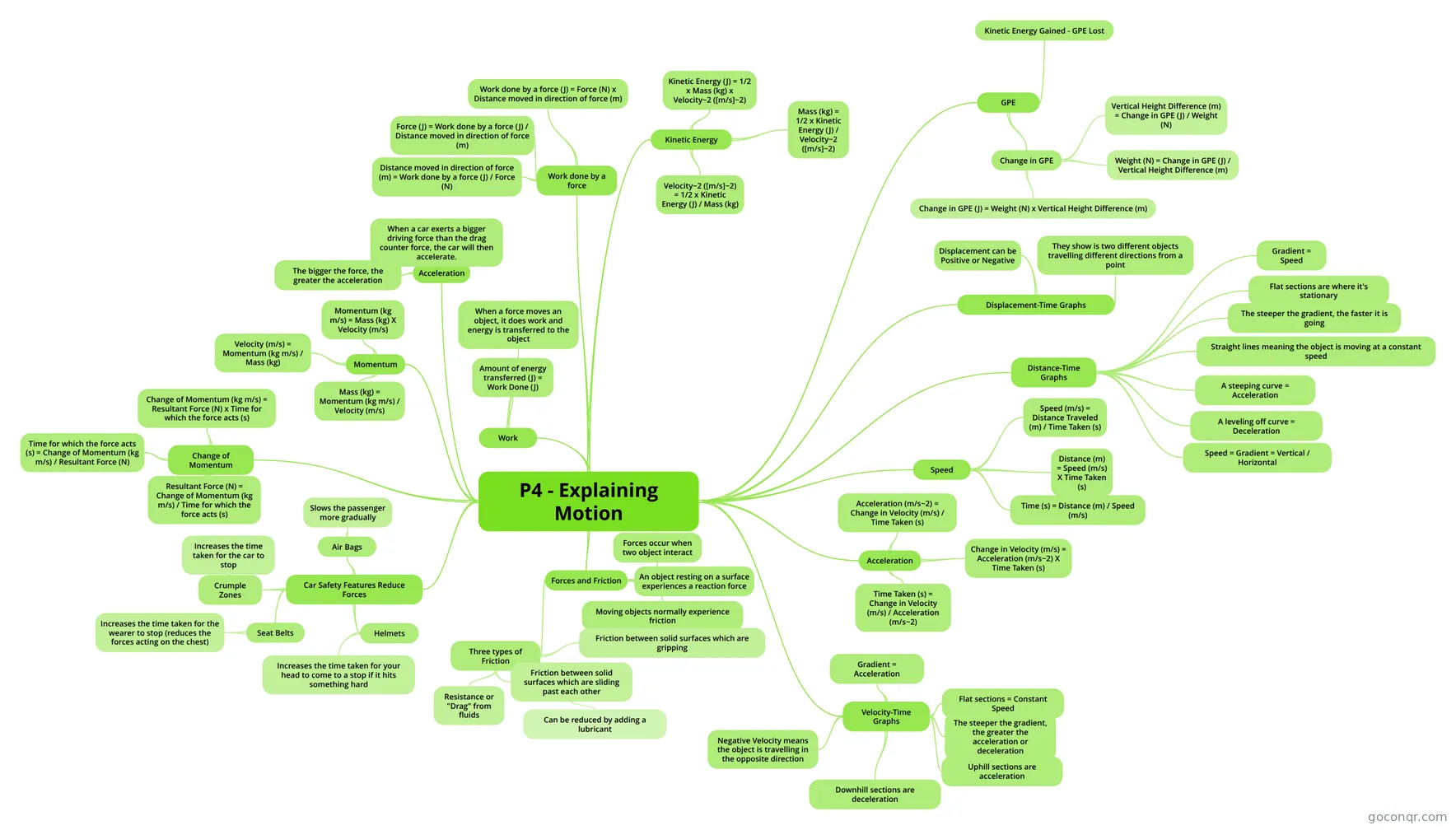 P4 - Explaining Motion
-
Velocity/Acceleration and Distance Time Graphs
-
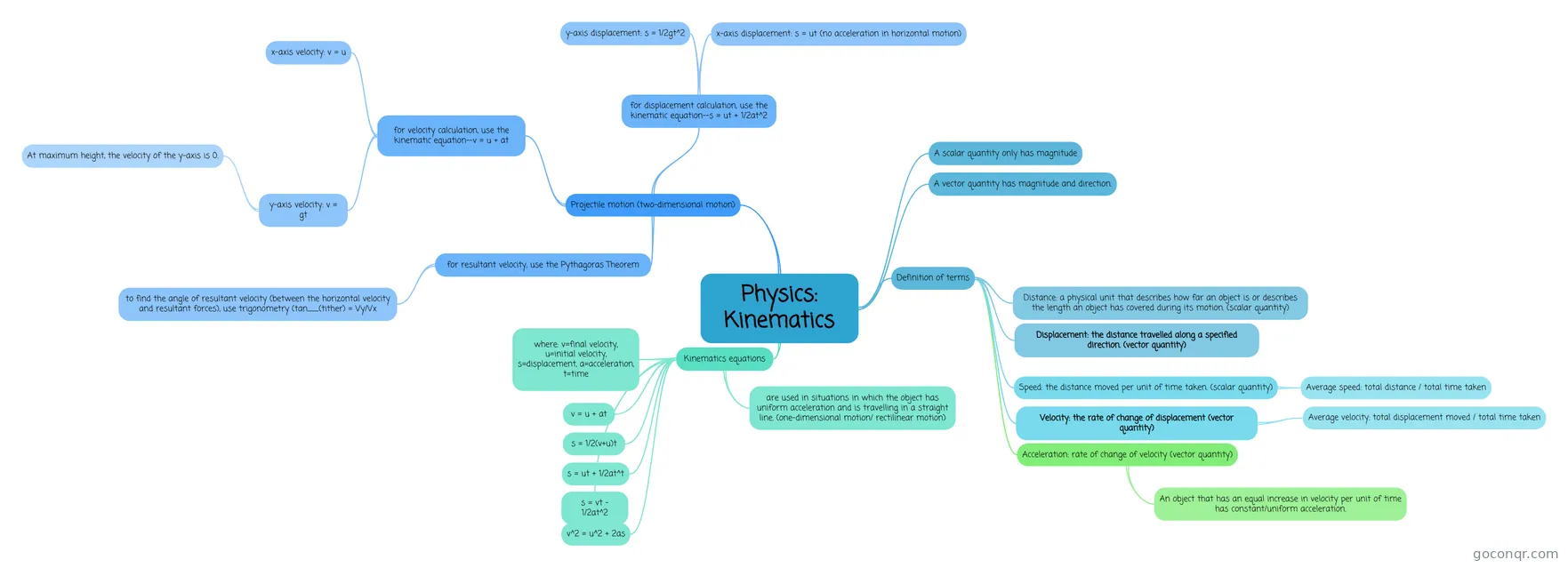 Physics: Kinematics Kinematics! :)
-
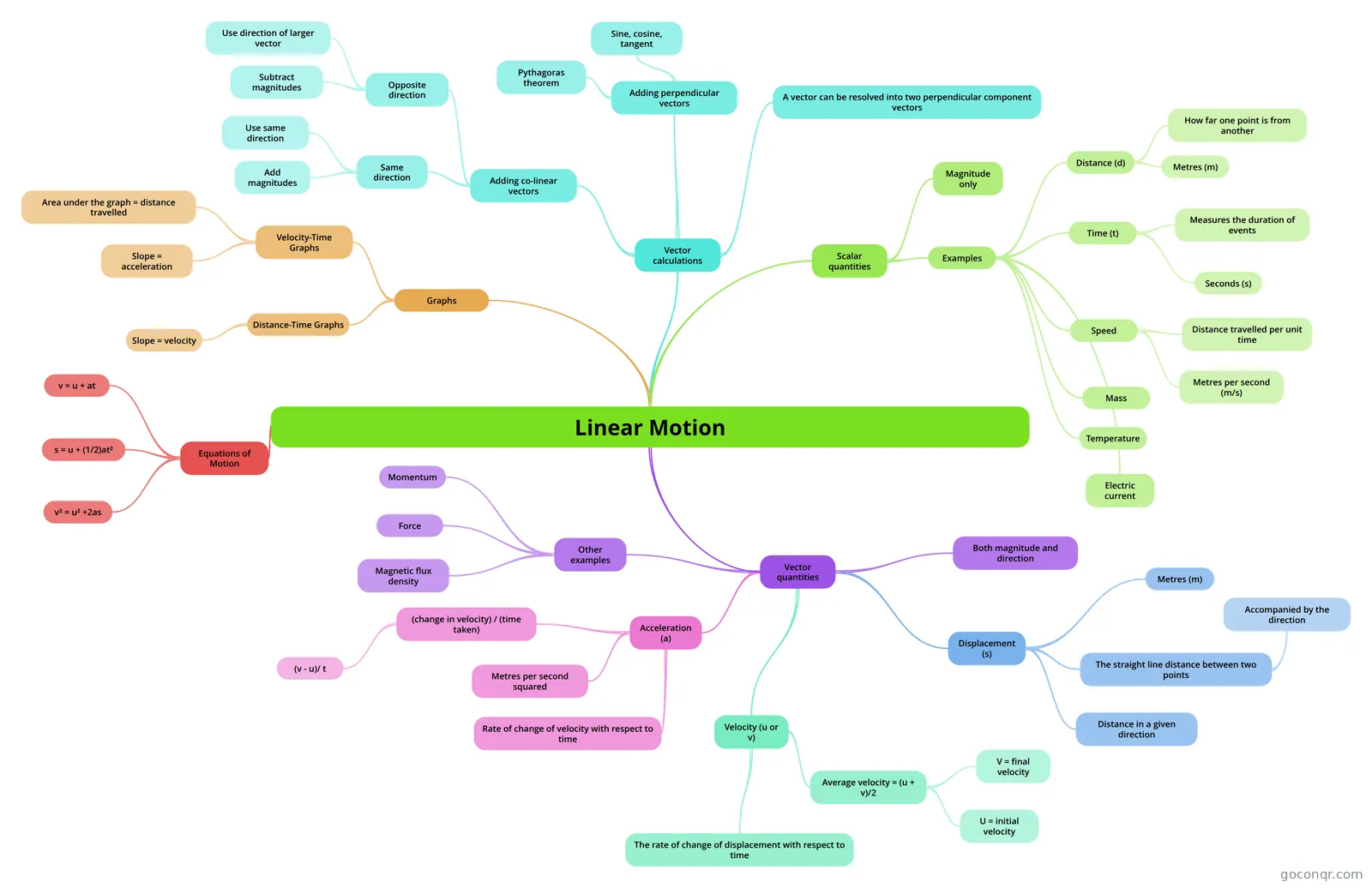 Linear Motion This mind map covers scalar quantities, vectors, distance-time graphs, velocity-time graphs and equations o...
-
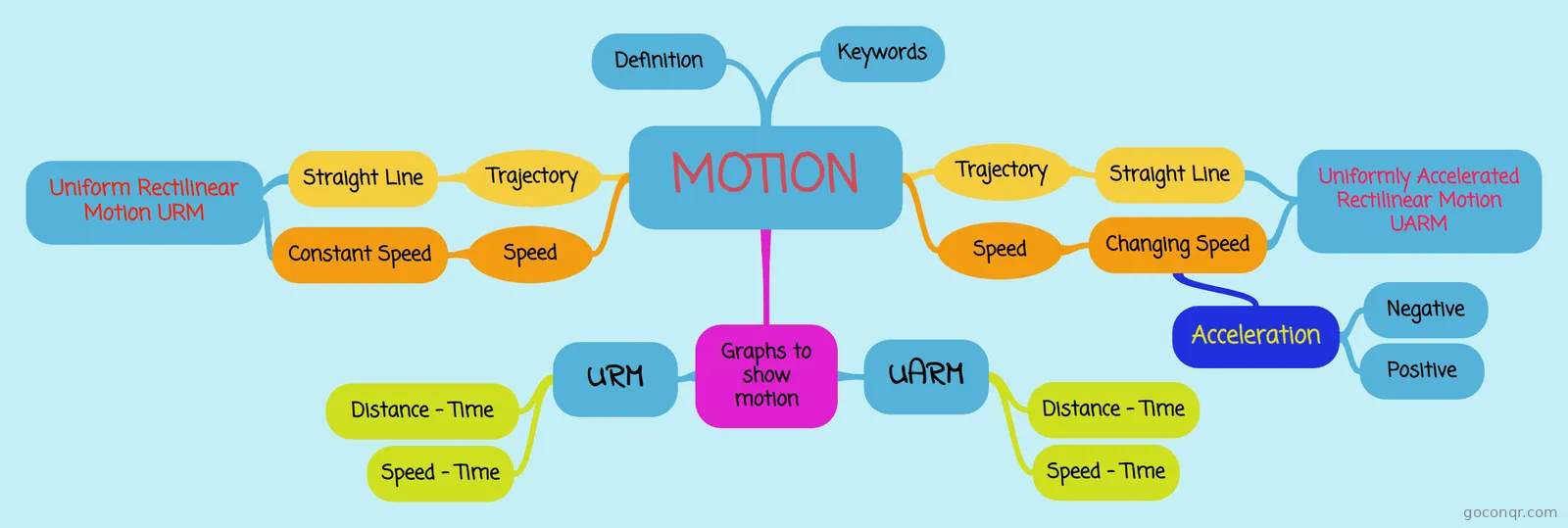 MOTION Movimiento rectilineo uniforme y uniformemente acelerado.
-
P9: Motion
-
Ch.2 Physics: Motion along a straight line
-
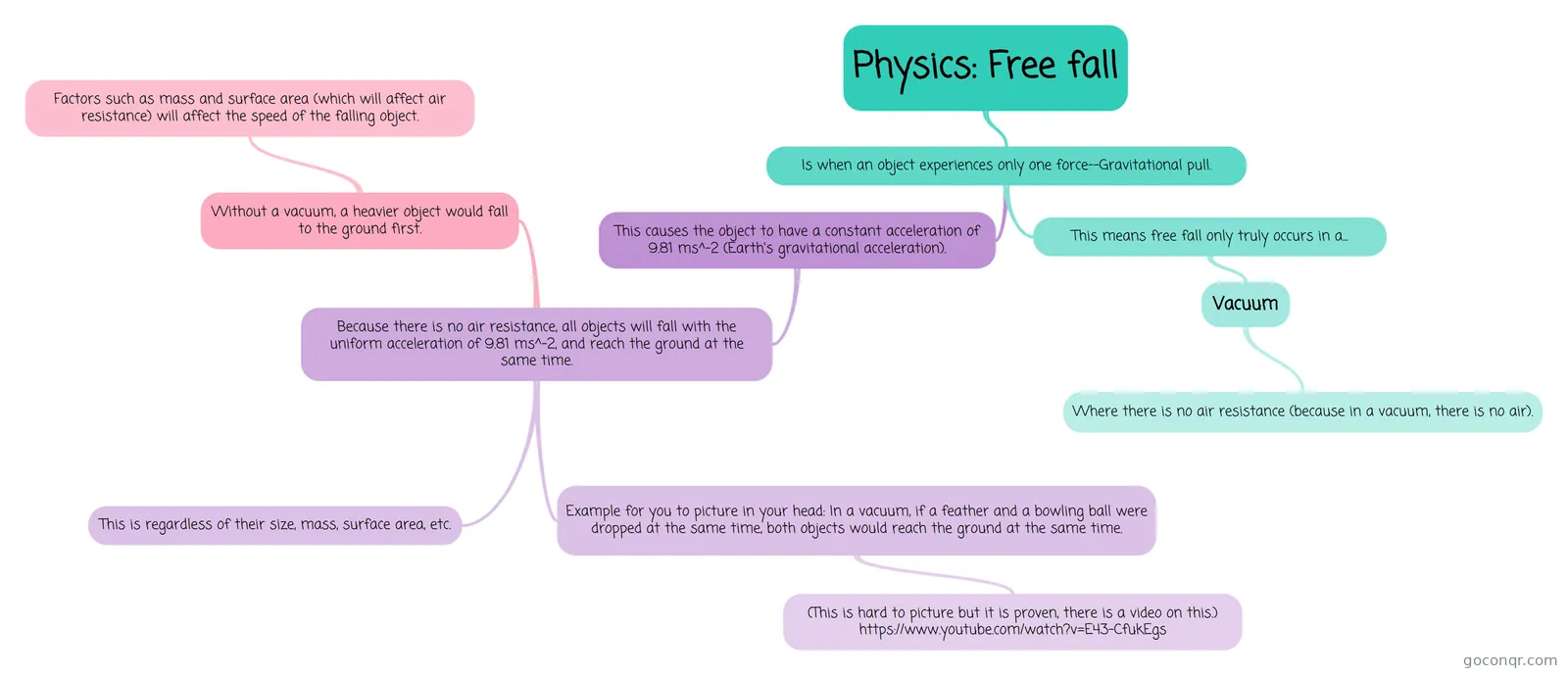 Physics: Free fall Physics--Free Fall. Just a small, simple mindmap on falling objects!
Flashcards
See all 427 flashcards-
10 cardsUNIT 6.1 DISTANCE, SPEED AND ACCELERATION A car travels 2 km in 80 seconds. How fast was it travelling in meters per second? (Remember 1 km = 1,000 m)
-
35 cardsPhysics and Motion Which scientist was the first to propose the heliocentric model of the universe? A. Aristotle B. Isaac Newt...
-
39 cardsPhysics: Semester 1 Exam A vector is different from a scalar because:
-
53 cardsUnit 1 Review - Kinematics Ap Physics 1 Frame of Reference
-
8 cardsPhysics 2a - Motion, Energy and Electricity (Velocity and time distance graphs) What is speed?
-
10 cardsPhysics - Speed, Displacement & Velocity What Is The SI Unit Of Time?
-
4 cardsProjectile Motion Flashcards Air resistance Definition
-
5 cardsOCR Gateway P3a P3a - Speed
Flowcharts
Notes
See all 76 notes-
Linear Motion: Basic Vector Operations
-
Linear Motion: Graphs of Linear Motion Distance-Time GraphsPlotting a graph of distance from a given point against time can be useful in illustrating different types of motion The body starts moving from point A and moves towards point B very quickly The s...
-
iGCSE Physics - Describing Motion Formulaespeed= distance/timeav. speed= total distance/total timeacceleration= final velocity-initial velocity/ time New Page
-
Distance Time Graphs Distance Time Graphs show how far something travels over a certain period of time. The vertical axis shows the distance travelled from the start. The horizontal axis shows the time from the start. When an object is st...
-
2. The Laws of Motion 2. An analysis of the external forces on vehicles helps to understand the effects of acceleration and deceleration2.1 - Relative MotionDescribe the motion of one body relative to another Motion differs depending on th...
-
1D motion 1. Introduction In our dialy life ,we see lots of things moving around for example car passing through from one place to other ,person riding on a bicycle and many more like this. In scientific terms an object is said...
-
Physical Science Lesson 1 A researcher observes a vehicle with an initial velocity of 14 m/s. The vehicle accelerates uniformly with an acceleration of 3 m/s2. After 6 seconds, what is the velocity of the vehicle?v2 = v1 + at v2 = 14 m/s + (3 ...
-
Motion MOTION A Reference Point is used to describe the location of an object. An object can be referred through many reference points. Origin – The reference point that is used to describe the location of an object is calle...
Slides
See all 21 slidesTopics in Motion and Kinematics
More Physics topics
About Motion and Kinematics
GoConqr OriginalWhat the resources cover
This unit page collects material on how things move. The mind map Physics: Kinematics defines the basic terms, such as distance as a scalar quantity and displacement as a vector. The mind map Physics: Free fall looks at motion under gravity alone, and why that only truly happens in a vacuum. Other listed resources cover distance-time graphs, velocity-time graphs, vectors, scalars, terminal velocity and projectile motion.
Where to start
If the vocabulary is new, begin with a mind map. Speed and Velocity and Distance-time graphs are short ways in. Then try the flashcard deck UNIT 6.1 DISTANCE, SPEED AND ACCELERATION, which has worked calculations such as finding a speed in metres per second from a distance in kilometres.
- Read a mind map on speed, velocity and acceleration.
- Practise graphs with a distance-time or velocity-time resource.
- Move on to the SUVAT equations.
- Finish with projectile motion and free fall.
Using quizzes and maps together
Take a quiz first, without notes. The Linear Motion: Quiz asks about scalars, vectors, units of speed and what the slope of a velocity-time graph shows. Note what you got wrong, then open the matching map and read only that branch. Retake the quiz afterwards.
For harder questions, the AS Level Physics Equations of Motion Quiz and the AS Level Physics U3 KInematics - SUVAT Equations Quiz use real situations, such as an insect jumping or a sphere reaching terminal velocity. The Princeton Review chapter quiz tests circular motion, where displacement over one lap is zero.
Where it fits
Motion and Kinematics sits in the Mechanics strand of Physics. The resources mention GCSE, IGCSE, A-level, IB and AP courses, so teachers can find material to set as revision or starter tasks.
Ready to begin? Choose a resource that matches your course and work through it at your own pace.
Frequently asked questions
Which resource should I open first?
Start with the mind map Physics: Kinematics, which sets out terms like distance, displacement, speed and velocity. Then try the Linear Motion: Quiz to see which ideas need more work. If you prefer calculations, the flashcard deck on distance, speed and acceleration gives worked questions.
What do the mind maps cover?
The mind maps cover free fall, kinematics terms, speed and velocity, distance-time graphs, SUVAT, projectile motion and motion in one dimension. Some follow specific courses, such as OCR AS Physics and OCR Gateway topics. There are over 500 of them on this page, so you can compare several explanations.
Are the resources free to use?
Yes. Every resource listed here is free to open, study and take, with no account needed. They were made by GoConqr users, not by GoConqr. If you create a free account, your quiz scores are saved and you can make your own quizzes, mind maps, flashcards and notes.
Which exams and levels do these suit?
Most resources are for secondary school, and the listed material mentions GCSE Physics, IGCSE Physics, AQA GCSE Physics, A-level Physics, OCR AS Physics, IB Physics and AP Physics 1. Edexcel M1, the Leaving Certificate and the MCAT also appear. Check each title to match your course.
Is there material on projectile motion and graphs?
Yes. For projectiles, look at the mind maps P5c: Projectile Motion and Projectile Motion, the Projectile Motion Flashcards and the Vertical Projectile Motion quiz. For graphs, there are distance-time notes, flashcards and a quiz, plus a mind map covering both distance-time and velocity-time graphs.
What can teachers use here?
Teachers can pick ready-made quizzes for starters or revision, mind maps to explain a topic, and flashcard decks for recall practice. The page also lists slide sets such as Distance, Displacement, Speed and Velocity, and Motion graph exam questions. Every item is free to open.