
Mindmap
Patents
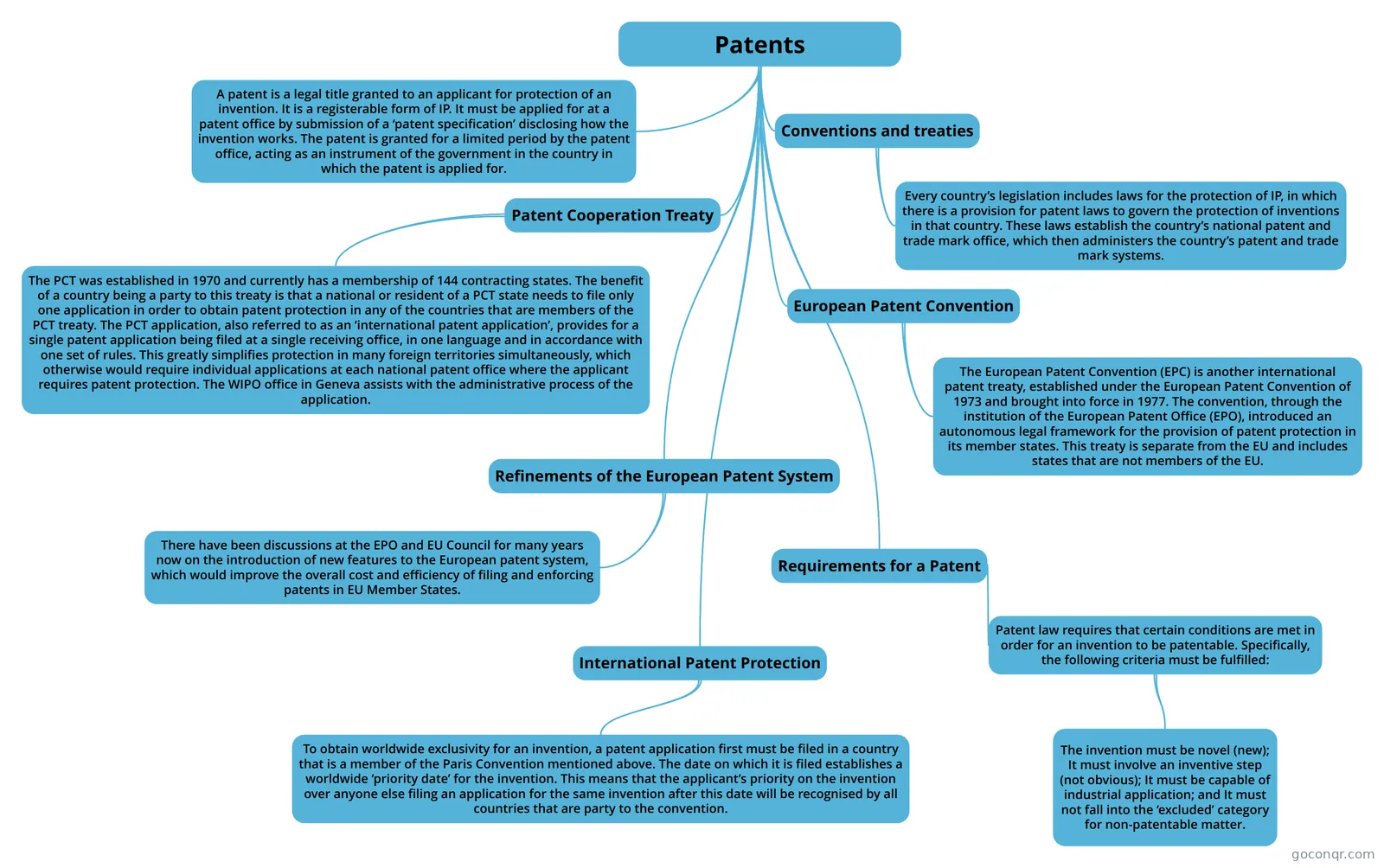
Mind map: Patents
Inhalt der Mindmap
Patents
A patent is a legal title granted to an applicant for protection of an invention. It is a registerable form of IP. It must be applied for at a patent office by submission of a ‘patent specification’ disclosing how the invention works. The patent is granted for a limited period by the patent office, acting as an instrument of the government in the country in which the patent is applied for.
Conventions and treaties
- Every country’s legislation includes laws for the protection of IP, in which there is a provision for patent laws to govern the protection of inventions in that country. These laws establish the country’s national patent and trade mark office, which then administers the country’s patent and trade mark systems.
Patent Cooperation Treaty
- The PCT was established in 1970 and currently has a membership of 144 contracting states. The benefit of a country being a party to this treaty is that a national or resident of a PCT state needs to file only one application in order to obtain patent protection in any of the countries that are members of the PCT treaty. The PCT application, also referred to as an ‘international patent application’, provides for a single patent application being filed at a single receiving office, in one language and in accordance with one set of rules. This greatly simplifies protection in many foreign territories simultaneously, which otherwise would require individual applications at each national patent office where the applicant requires patent protection. The WIPO office in Geneva assists with the administrative process of the application.
European Patent Convention
- The European Patent Convention (EPC) is another international patent treaty, established under the European Patent Convention of 1973 and brought into force in 1977. The convention, through the institution of the European Patent Office (EPO), introduced an autonomous legal framework for the provision of patent protection in its member states. This treaty is separate from the EU and includes states that are not members of the EU.
Refinements of the European Patent System
- There have been discussions at the EPO and EU Council for many years now on the introduction of new features to the European patent system, which would improve the overall cost and efficiency of filing and enforcing patents in EU Member States.
Requirements for a Patent
- Patent law requires that certain conditions are met in order for an invention to be patentable. Specifically, the following criteria must be fulfilled:
- The invention must be novel (new); It must involve an inventive step (not obvious); It must be capable of industrial application; and It must not fall into the ‘excluded’ category for non-patentable matter.
- Patent law requires that certain conditions are met in order for an invention to be patentable. Specifically, the following criteria must be fulfilled:
International Patent Protection
- To obtain worldwide exclusivity for an invention, a patent application first must be filed in a country that is a member of the Paris Convention mentioned above. The date on which it is filed establishes a worldwide ‘priority date’ for the invention. This means that the applicant’s priority on the invention over anyone else filing an application for the same invention after this date will be recognised by all countries that are party to the convention.
Informationen
- Beschreibung
- Mindmap am Patents, erstellt von Jose Angel Meneses Gonzalez am 09/03/2020.
- Erstellt von
- Jose Angel Meneses Gonzalez
- Aufrufe
- 1
- Bewertung