
Intellectual Property: General Principles
438 resources created by 320 users
This Intellectual Property: General Principles page on GoConqr gathers community-made mind maps, flashcards, quizzes, flowcharts and notes on trade marks, passing off, patents, copyright, design rights and the law of confidence. It's built for university students working through the basics and teachers after ready-made material. There are over 400 resources here, including more than 360 mind maps, over 20 flashcards decks and 7 quizzes, mostly at university level. Browse a topic, then test yourself with a quiz.
Top Intellectual Property: General Principles resources
-
43 cardsTM deck 1 Section 30(a) - Identity of Applicant
-
Mind map COPYRIGHT DERECHOS DE AUTOR
-
Mind map Passing off and goodwill
-
47 cardsIntellectual Property
-
Mind map Trade mark subject matter
-
Mind map Trademark [TMA]
-
89 questionsPa-tentan Which three requirements must be met for enforceable trade secrets to exist?
-
Mind map Moral rights
Quizzes
-
89 questionsPa-tentan Which three requirements must be met for enforceable trade secrets to exist?
-
20 questionsBusiness Law Chapter 8 t/f More than two hundred years ago, the Declaration of Independence recognized the importance of protecting cr...
-
20 questionsBusiness Law Chapter 8 multiple choice Savory Bean Company makes and sells a sweet espresso coffee beverage under the name “Sugar Sugar.” Tropic R...
-
20 questionsAMS588 Ch 16 Intellectual Property
-
7 questionsUntitled A distinctive word, symbol, or design that identifies the manufacturer as the source of the goods and disti...
-
8 questionsPOCOSA As an ISO member do you have to sign a specific contract with ISO to start selling ISO products?
-
5 questionsUntitled Which of the following is INcorrect; an idea is patentable only if:
-
1 questionsUntitled
Mind maps
See all 376 mind maps
Flashcards
See all 27 flashcards-
43 cardsTM deck 1 Section 30(a) - Identity of Applicant
-
47 cardsIntellectual Property
-
25 cardsLegal issues and intellectual property, patents What does intellectual property rights?
-
28 cardsLegal protection and intellectual propertly - other topics What makes information confidential?
-
18 cardsIntellectual Property
-
51 cardsExam 2 What are two words to describe patents?
-
16 cardsPassing Off Case Law Passing Off - Perry v Truefit
-
16 cardsUntitled Temple Island Collections Ltd v New English teas [2012]
Flowcharts
See all 14 flowcharts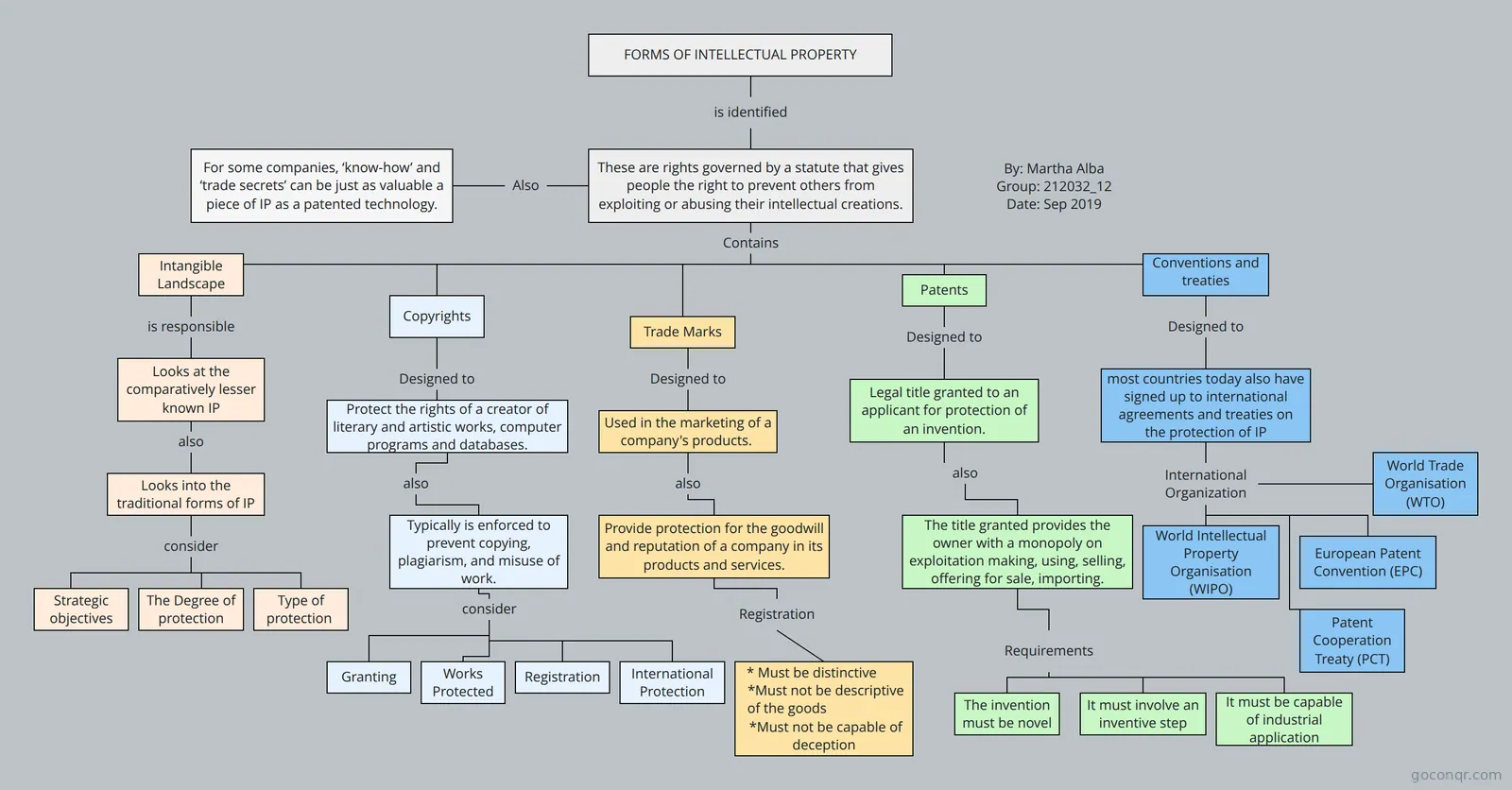
Notes
See all 11 notes-
The Copy Rights Act COPYRIGHTS ACT 1. Explain nature and purpose of copyright. In which type of works it subsists. Who is called the author of copyright ****2. What are the various rights conferred by copyright? **3. Discuss the procedur...
-
FORMS OF INTELLECTUAL PROPERTY - creado desde un Mapa Mental They are rights governed by statutes that give people the right to prevent others from exploiting or abusing their intellectual creations. The most common forms are patents, trademarks, copyrights, design rights, conf...
-
PATENTS - creado desde un Mapa Mental It is a type of traditional Intellectual property (IP). It is a property title granted by the state. It gives the legal right to exclude others from making, using, selling, and importing an invention for a limited tim...
-
Trademarks - creado desde un Mapa Mental A brand is a sign that is apt to distinguish a product or service in the market. Types of brands In Colombia, the entity that regulates trademarks is the superintendence of industry and commerce
-
Introduce el texto aquí - creado desde un Mapa Mental
-
Identify intellectual property as an asset - creado desde un Mapa Mental Designs (Nontraditional) Domain names (Traditional) Circuit layouts (Nontraditional)
-
PATENTS - creado desde un Mapa Mental The exclusive rights patents that your invention will use and exploit and prevent you from using it without your consent A patent is an exclusive right granted by the State for the protection of an invention In order ...
-
Patents - created from Mind Map Object Obligations of the holder rights of the holder
Slides
Topics in Intellectual Property: General Principles
More Commercial and company law topics
About Intellectual Property: General Principles
GoConqr OriginalWhat this unit covers
The unit brings together the core forms of intellectual property. Trade marks are the biggest theme. The Trade mark subject matter mind map starts with the question of what counts as a sign: words, designs, letters, numerals, and the shape of goods or packaging under the Trade Marks Act 1994. The Trademarks mind maps add the advantages of registering, the role of the Registrar and the functions of a mark.
Passing off is the next theme. Passing off and goodwill opens with the classic statement that a man may not sell his own goods as the goods of another. A flashcard deck on passing off covers the Reckitt & Colman v Borden test, false endorsement and merchandising.
Patents, copyright and beyond
Patents appear in several maps, notes and decks. One mind map describes patents as protecting the technical and functional side of products and processes, lasting up to 20 years. You will also find decks on patent registrability, patent infringement and patent case law.
Other rights are here too: copyright ownership, moral rights, design right, trade secrets, the law of confidence and the World Intellectual Property Organization (WIPO). A set of maps on patent licence negotiation covers best practice for dealing with IP as an asset.
Where to start
- Open What is intellectual property? or one of the maps on the forms of intellectual property for the overview.
- Pick one right, such as trade marks, and read its mind map.
- Work through the matching flashcard deck, for example Trade Mark Intro, to fix the key terms and cases.
- Try a quiz, such as Business Law Chapter 8 multiple choice, to see what stuck.
Using maps and quizzes together
Read a map first to see how the ideas connect. Then take a quiz without looking and note the questions you missed. Go back to the relevant branch of the map and fix the gap. Teachers can use the maps as ready-made starting points for a lesson or handout.
Where it fits
This unit sits in the Intellectual Property strand of Commercial and company law. Choose a topic that matches your course, and when you are ready, make a map or deck of your own.
Frequently asked questions
Which resource should I open first?
Start with a broad overview such as the mind map What is intellectual property? or one of the maps on the forms of intellectual property. They set out the main rights side by side. After that, move to the map for the right you are studying, then its flashcards.
What do the trade mark resources cover?
They cover what counts as a sign under the Trade Marks Act 1994, why registering helps, the role of the Registrar, and the functions of a mark. There are mind maps, a flashcard deck called Trade Mark Intro, and a deck touching on likelihood of confusion and opposition deadlines.
Are there resources on passing off?
Yes. Several mind maps cover passing off, including one on passing off and goodwill. Flashcard decks cover the Reckitt & Colman v Borden test, false endorsement and merchandising claims, and a separate deck gathers passing off case law for quick revision.
Are the resources free, and who made them?
Every resource listed here is free to open, study and take, with no account needed. They were made by GoConqr users, not by GoConqr. A free account also saves your quiz scores and lets you create your own quizzes, maps, flashcards and notes.
Which levels is this page suited to?
Most of the material is at university level, so it suits university students studying commercial or company law. Teachers can also draw on it for ready-made maps and decks. A small share of the resources is aimed at other levels.
What if the topic I need is missing?
Try the related topics first, such as the law of confidence, trade secrets or design right, which have their own maps and decks. If nothing fits, you can build your own mind map or flashcards on the topic.