
Mindmap
Hearing
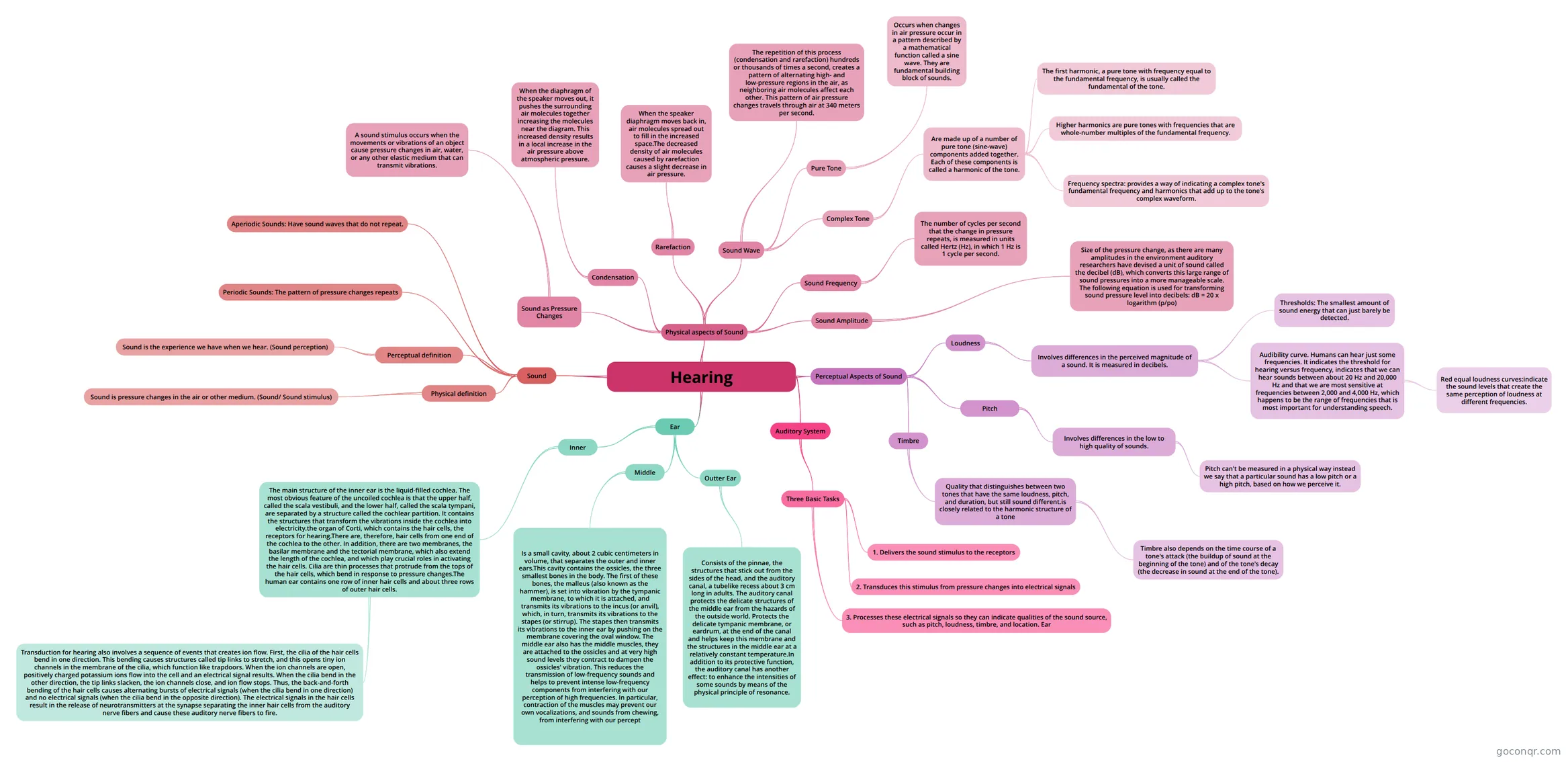
Mind map: hearing
Inhalt der Mindmap
Hearing
Sound
- Perceptual definition
- Sound is the experience we have when we hear. (Sound perception)
- Physical definition
- Sound is pressure changes in the air or other medium. (Sound/ Sound stimulus)
- Aperiodic Sounds: Have sound waves that do not repeat.
- Periodic Sounds: The pattern of pressure changes repeats
- Perceptual definition
Physical aspects of Sound
- Sound as Pressure Changes
- A sound stimulus occurs when the movements or vibrations of an object cause pressure changes in air, water, or any other elastic medium that can transmit vibrations.
- Condensation
- When the diaphragm of the speaker moves out, it pushes the surrounding air molecules together increasing the molecules near the diagram. This increased density results in a local increase in the air pressure above atmospheric pressure.
- Rarefaction
- When the speaker diaphragm moves back in, air molecules spread out to fill in the increased space.The decreased density of air molecules caused by rarefaction causes a slight decrease in air pressure.
- Sound Wave
- The repetition of this process (condensation and rarefaction) hundreds or thousands of times a second, creates a pattern of alternating high- and low-pressure regions in the air, as neighboring air molecules affect each other. This pattern of air pressure changes travels through air at 340 meters per second.
- Pure Tone
- Occurs when changes in air pressure occur in a pattern described by a mathematical function called a sine wave. They are fundamental building block of sounds.
- Complex Tone
- Are made up of a number of pure tone (sine-wave) components added together. Each of these components is called a harmonic of the tone.
- The first harmonic, a pure tone with frequency equal to the fundamental frequency, is usually called the fundamental of the tone.
- Higher harmonics are pure tones with frequencies that are whole-number multiples of the fundamental frequency.
- Frequency spectra: provides a way of indicating a complex tone's fundamental frequency and harmonics that add up to the tone's complex waveform.
- Are made up of a number of pure tone (sine-wave) components added together. Each of these components is called a harmonic of the tone.
- Sound Frequency
- The number of cycles per second that the change in pressure repeats, is measured in units called Hertz (Hz), in which 1 Hz is 1 cycle per second.
- Sound Amplitude
- Size of the pressure change, as there are many amplitudes in the environment auditory researchers have devised a unit of sound called the decibel (dB), which converts this large range of sound pressures into a more manageable scale. The following equation is used for transforming sound pressure level into decibels: dB = 20 x logarithm (p/po)
- Sound as Pressure Changes
Perceptual Aspects of Sound
- Loudness
- Involves differences in the perceived magnitude of a sound. It is measured in decibels.
- Thresholds: The smallest amount of sound energy that can just barely be detected.
- Audibility curve. Humans can hear just some frequencies. It indicates the threshold for hearing versus frequency, indicates that we can hear sounds between about 20 Hz and 20,000 Hz and that we are most sensitive at frequencies between 2,000 and 4,000 Hz, which happens to be the range of frequencies that is most important for understanding speech.
- Red equal loudness curves:indicate the sound levels that create the same perception of loudness at different frequencies.
- Involves differences in the perceived magnitude of a sound. It is measured in decibels.
- Pitch
- Involves differences in the low to high quality of sounds.
- Pitch can't be measured in a physical way instead we say that a particular sound has a low pitch or a high pitch, based on how we perceive it.
- Involves differences in the low to high quality of sounds.
- Timbre
- Quality that distinguishes between two tones that have the same loudness, pitch, and duration, but still sound different.is closely related to the harmonic structure of a tone
- Timbre also depends on the time course of a tone's attack (the buildup of sound at the beginning of the tone) and of the tone's decay (the decrease in sound at the end of the tone).
- Quality that distinguishes between two tones that have the same loudness, pitch, and duration, but still sound different.is closely related to the harmonic structure of a tone
- Loudness
Auditory System
- Three Basic Tasks
- 1. Delivers the sound stimulus to the receptors
- 2. Transduces this stimulus from pressure changes into electrical signals
- 3. Processes these electrical signals so they can indicate qualities of the sound source, such as pitch, loudness, timbre, and location. Ear
- Three Basic Tasks
Ear
- Outter Ear
- Consists of the pinnae, the structures that stick out from the sides of the head, and the auditory canal, a tubelike recess about 3 cm long in adults. The auditory canal protects the delicate structures of the middle ear from the hazards of the outside world. Protects the delicate tympanic membrane, or eardrum, at the end of the canal and helps keep this membrane and the structures in the middle ear at a relatively constant temperature.In addition to its protective function, the auditory canal has another effect: to enhance the intensities of some sounds by means of the physical principle of resonance.
- Middle
- Is a small cavity, about 2 cubic centimeters in volume, that separates the outer and inner ears.This cavity contains the ossicles, the three smallest bones in the body. The first of these bones, the malleus (also known as the hammer), is set into vibration by the tympanic membrane, to which it is attached, and transmits its vibrations to the incus (or anvil), which, in turn, transmits its vibrations to the stapes (or stirrup). The stapes then transmits its vibrations to the inner ear by pushing on the membrane covering the oval window. The middle ear also has the middle muscles, they are attached to the ossicles and at very high sound levels they contract to dampen the ossicles' vibration. This reduces the transmission of low-frequency sounds and helps to prevent intense low-frequency components from interfering with our perception of high frequencies. In particular, contraction of the muscles may prevent our own vocalizations, and sounds from chewing, from interfering with our percept
- Inner
- The main structure of the inner ear is the liquid-filled cochlea. The most obvious feature of the uncoiled cochlea is that the upper half, called the scala vestibuli, and the lower half, called the scala tympani, are separated by a structure called the cochlear partition. It contains the structures that transform the vibrations inside the cochlea into electricity.the organ of Corti, which contains the hair cells, the receptors for hearing.There are, therefore, hair cells from one end of the cochlea to the other. In addition, there are two membranes, the basilar membrane and the tectorial membrane, which also extend the length of the cochlea, and which play crucial roles in activating the hair cells. Cilia are thin processes that protrude from the tops of the hair cells, which bend in response to pressure changes.The human ear contains one row of inner hair cells and about three rows of outer hair cells.
- Transduction for hearing also involves a sequence of events that creates ion flow. First, the cilia of the hair cells bend in one direction. This bending causes structures called tip links to stretch, and this opens tiny ion channels in the membrane of the cilia, which function like trapdoors. When the ion channels are open, positively charged potassium ions flow into the cell and an electrical signal results. When the cilia bend in the other direction, the tip links slacken, the ion channels close, and ion flow stops. Thus, the back-and-forth bending of the hair cells causes alternating bursts of electrical signals (when the cilia bend in one direction) and no electrical signals (when the cilia bend in the opposite direction). The electrical signals in the hair cells result in the release of neurotransmitters at the synapse separating the inner hair cells from the auditory nerve fibers and cause these auditory nerve fibers to fire.
- The main structure of the inner ear is the liquid-filled cochlea. The most obvious feature of the uncoiled cochlea is that the upper half, called the scala vestibuli, and the lower half, called the scala tympani, are separated by a structure called the cochlear partition. It contains the structures that transform the vibrations inside the cochlea into electricity.the organ of Corti, which contains the hair cells, the receptors for hearing.There are, therefore, hair cells from one end of the cochlea to the other. In addition, there are two membranes, the basilar membrane and the tectorial membrane, which also extend the length of the cochlea, and which play crucial roles in activating the hair cells. Cilia are thin processes that protrude from the tops of the hair cells, which bend in response to pressure changes.The human ear contains one row of inner hair cells and about three rows of outer hair cells.
- Outter Ear
Informationen
- Beschreibung
- Mindmap am Hearing, erstellt von Eugenia Rodríguez am 20/03/2020.
- Erstellt von
- Eugenia Rodríguez
- Aufrufe
- 4
- Bewertung
Mehr zu Hearing and Auditory Perception