
Sensation, Perception and Attention
239 resources created by 160 users
This Sensation, Perception and Attention page on GoConqr gathers community-made quizzes, mind maps, flashcards and notes, from psychophysics and the eye and ear to Gestalt laws, depth cues and theories of attention. It's built for university students and professional candidates, school students, and teachers after ready-made material. There are over 1,600 resources here, including more than 280 quizzes, over 650 mind maps and more than 620 flashcards, made by over 960 contributors. Pick a topic, try a quiz to find your gaps, then make your own revision sets.
Top Sensation, Perception and Attention resources
-
81 cardsUnderstanding Psychology: Chap 3 Sensation and Perception
-
149 cardsGCSE Psychology Edexcel Unit 1 - Cue Cards (Unfinished) Cue cards for the whole of unit 1 (topic A and B) psychology
-
60 questionsChapter 4 - part 2: Our Sense of Sight: The Visual System What aspect of perception is affected by the wavelength of light?
-
51 questionsPsychology 134: CHAPTER 4 When Sam listens to his girlfriend Susan in the restaurant and ignores other people's conversations, he is ...
-
41 cardsGibson and Walk What is depth perception?
-
40 questionsChapter 4 - part 3: The Visual System: Perceptual Processes Which of the following concepts helps to explain why three people could look at the same sketch and report ...
-
38 questionsUnderstanding Psychology: Chap 3 If a psychologist wanted to know how much louder a person must speak in order for another person to notice ...
-
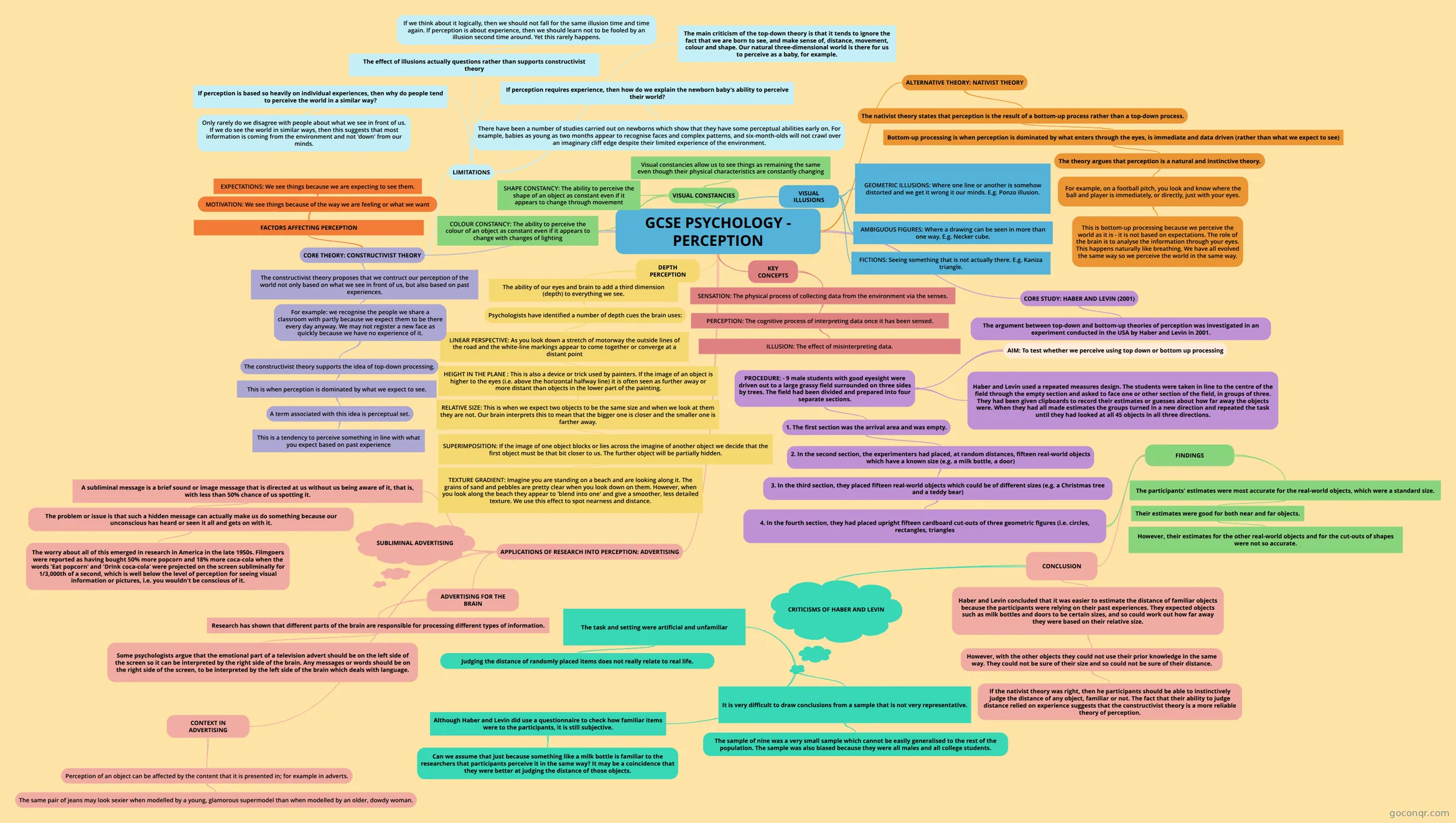 Mind map GCSE PSYCHOLOGY - PERCEPTION
Quizzes
See all 66 quizzes-
60 questionsChapter 4 - part 2: Our Sense of Sight: The Visual System What aspect of perception is affected by the wavelength of light?
-
51 questionsPsychology 134: CHAPTER 4 When Sam listens to his girlfriend Susan in the restaurant and ignores other people's conversations, he is ...
-
40 questionsChapter 4 - part 3: The Visual System: Perceptual Processes Which of the following concepts helps to explain why three people could look at the same sketch and report ...
-
38 questionsUnderstanding Psychology: Chap 3 If a psychologist wanted to know how much louder a person must speak in order for another person to notice ...
-
29 questionsChapter 4 - part 1: Psychophysics: Basic Concepts and Issues Which of the following reflects a distinction between the process of sensation and the process of perception?
-
30 questionsChapter 4 - part 7: Our Other Senses Which sense is important for perception of the positions of the various parts of the body?
-
31 questionsIntroduction to perception - Midterm II Part 2. The voice onset time (VOT) for the sound /da/ is 17 ms, and the VOT for the sound /ta/ is 91 msec. When a c...
-
15 questionsChapter 4 - part 5: Our Chemical Senses: Taste and Smell If you are experiencing gustatory perception, what are you doing?
Mind maps
See all 61 mind maps-
GCSE PSYCHOLOGY - PERCEPTION
-
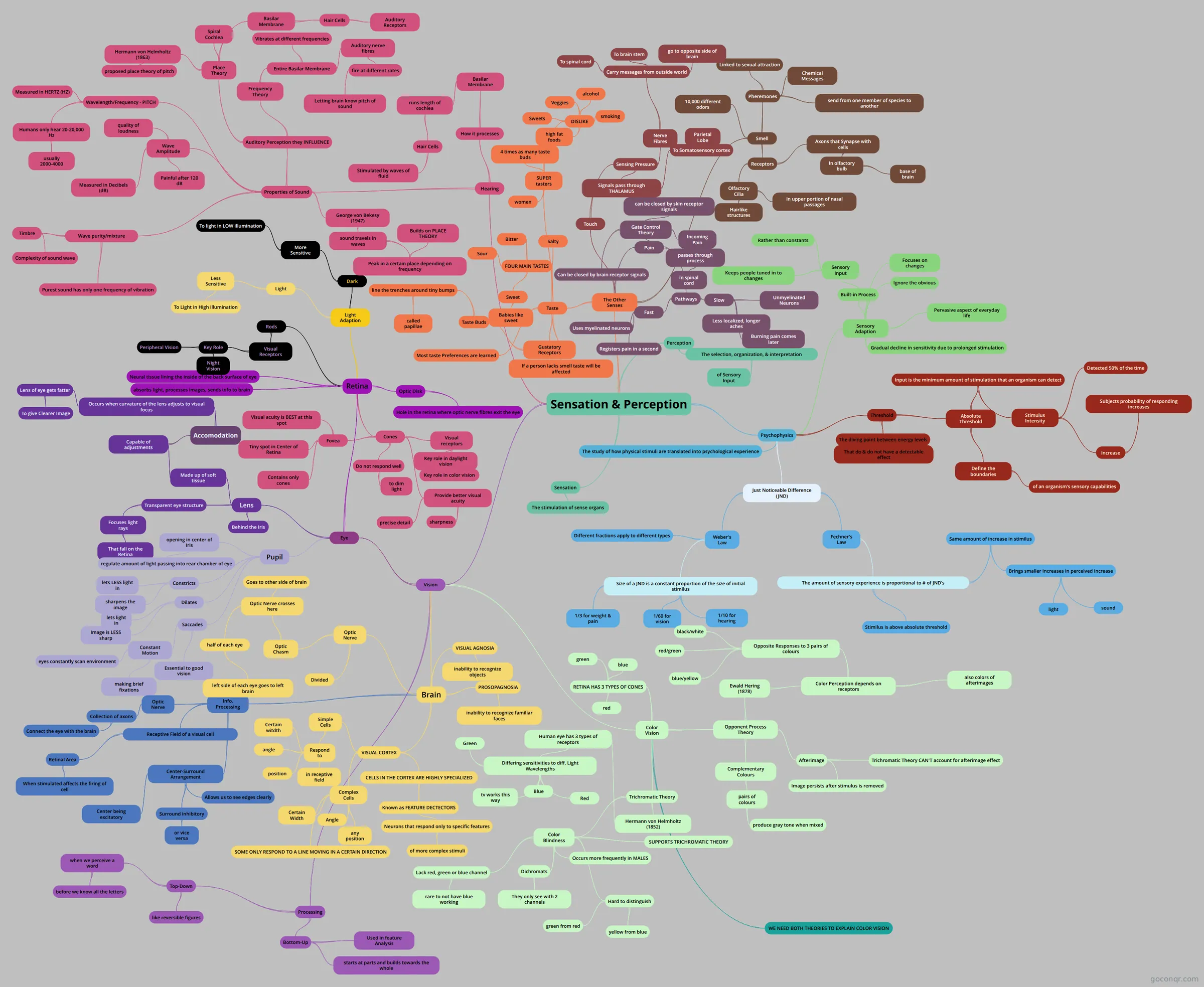 Sensation & Perception Chapter 4 Psychology 104 Concept Map Sensation & Perception
-
Psychology: Illusions (2)
-
 Moray's study of dichotic listening: affective cues and influence of instructions (1959)
-
Chapter 4: Sensation and Perception this is my chap 4 mind map, pay no attention to it:)
-
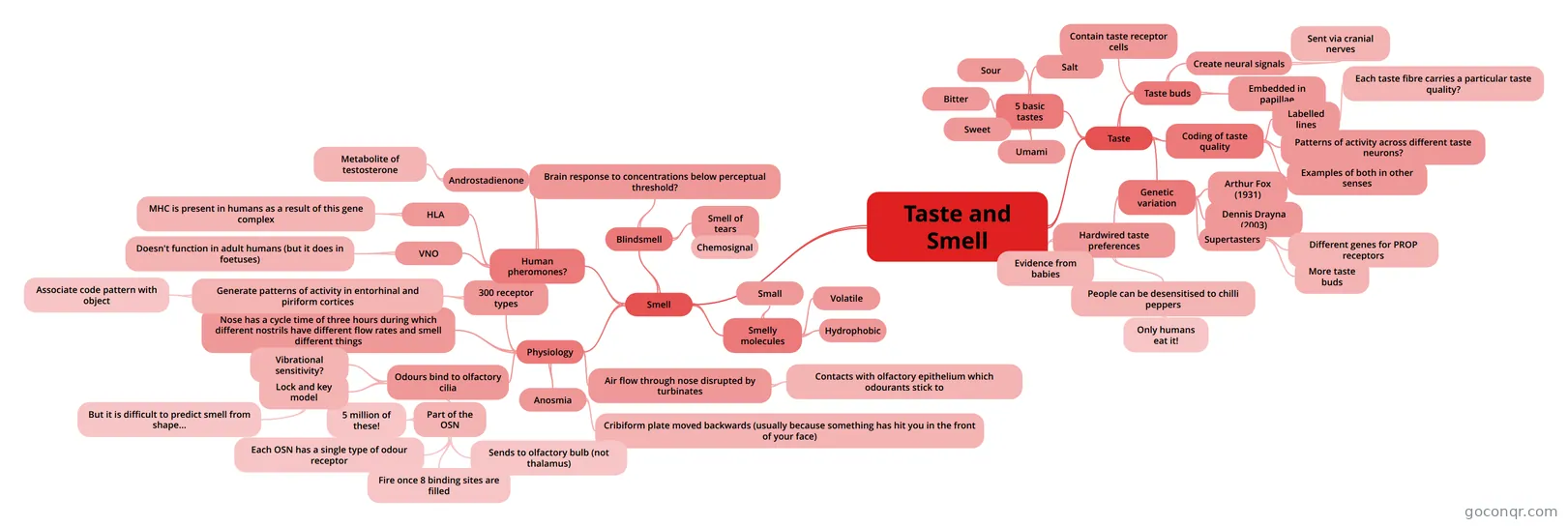 Taste and Smell
-
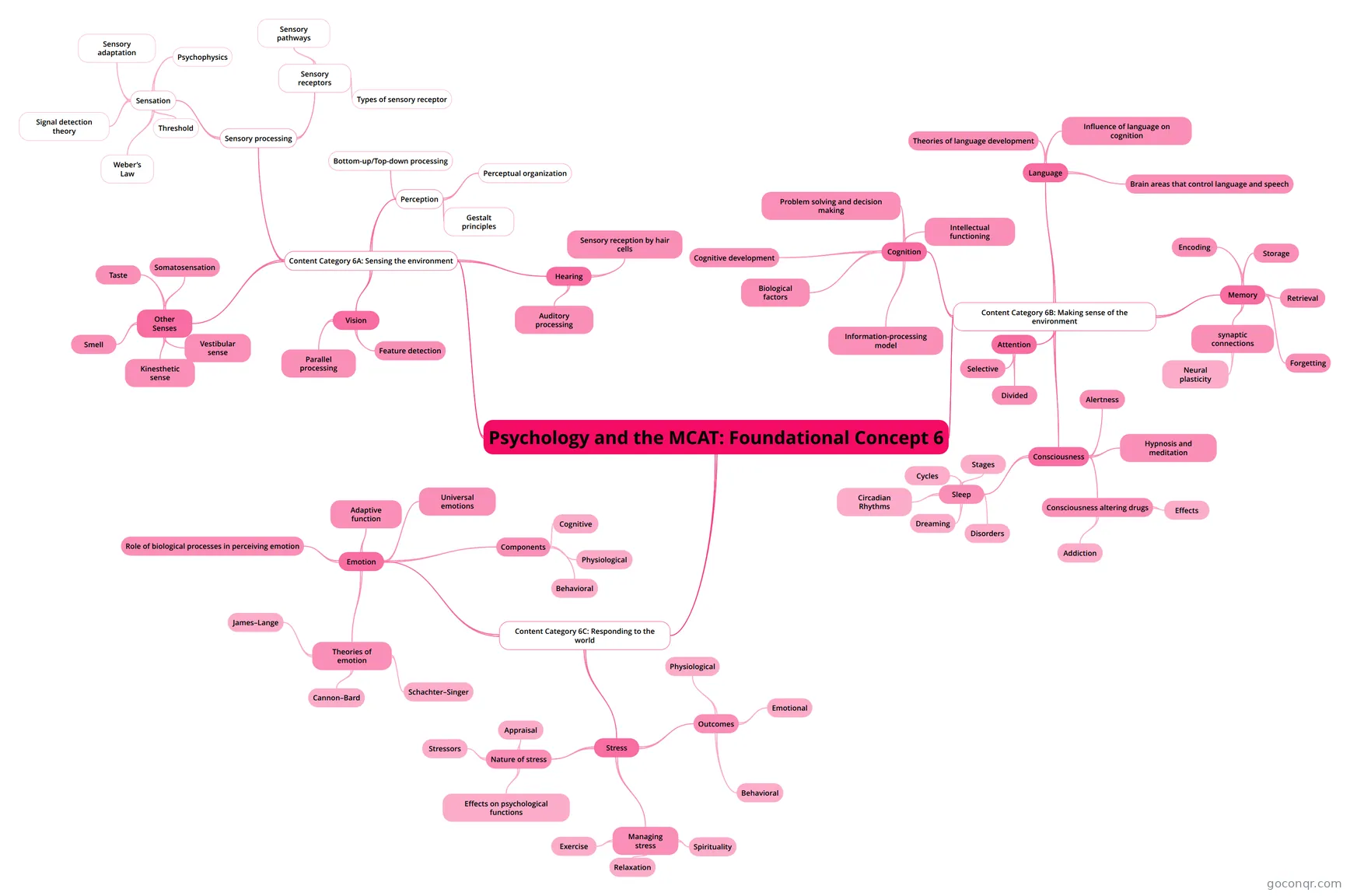 Psychology and the MCAT: Foundational Concept 6 Overview of Psychology concepts required for the new MCAT, per the AAMC (American Association of Medical Co...
-
Chapter 4: Sensation and Perception This is my Mind Map for Psych 104.
Flashcards
See all 92 flashcards-
81 cardsUnderstanding Psychology: Chap 3 Sensation and Perception
-
149 cardsGCSE Psychology Edexcel Unit 1 - Cue Cards (Unfinished) Cue cards for the whole of unit 1 (topic A and B) psychology
-
41 cardsGibson and Walk What is depth perception?
-
88 cardsUnit 4: Terms and Concepts Chapter 4: Sensation and Perception
-
42 cardsCh.6 Object Recognition Principles of object recognition
-
35 cardsUnit 3 - Module 18: Sensation: Vision Unit Three - Module 18 Sensation: Vision
-
25 cardsIntro to Psychology ch. 4
-
29 cardsUnit 3 - Module 22: Perception: Perceptual Organization and Interpretation Unit Three - Module 22 Perception: Perceptual Organization and Interpretation
Flowcharts
Notes
-
Lecture 3 - Colour Chapter 5 Luminance = the black & white information we get from our surroundings (no colour)The visible spectrum is the section of the electromagnetic spectrum that we are able to see (400-700 nm?). The wavelength of ...
-
Lecture 1 - Illusions in Space and Time Chapter 0 Photons (light) enter the eye and are analysed " The camera never lies, because the camera doesn’t have to tell us what it sees—but our visual system does." Vision is active (we have to interpret what we see...
-
Unit 4: Study Questions Define sensation and perception. Distinguish between the two terms. (p. 138) Define psychophysics.(p. 139) Define threshold and absolute threshold. Provide and recognize original examples of each. (p. 139) How is the ...
-
Vision Key notes Describe the different photoreceptor types and their connectionsLight sensitive cells in the retina consist of two types of photo receptors: rods and cones. Rods and cones contain photopigments that break down when ex...
-
29. Minds Wander 30 Percent of the Time 29. Minds Wander 30 Percent of the Time MIND WANDERING IS A VERY COMMON PHENOMENON During everyday activities your minds wander up to 30 percent of the time, and in some cases, such as driving on an uncrowded highway,...
-
5. People Imagine Objects Tilted And At A Slight Angle Above Cups of Coffee Drawn by People Around the World Stephen Palmer (1981) had a simple mission. Travel the world getting people to draw what their minds remembered, and identified, as a cup of coffee. This is what he retu...
-
8. People can miss changes in their visual field Take a look at the video above.Did you miss something? It’s called inattentional blindness.This happens because people often miss large changes in their visual fields. According to Chabris and Simons (2010), this phen...
-
48 Loud Noises Startle and Get Attention The mind will automatically ignore sounds that are made frequently, however introduction of new sounds will grab its attention. People habituate to sound The more powerful the sound the quicker you will get the attent...
Slides
See all 10 slidesMore Psychology topics
About Sensation, Perception and Attention
GoConqr OriginalWhat the resources cover
The unit follows the route from stimulus to experience. The flashcard deck Understanding Psychology: Chap 3 starts with sensation, transduction, absolute and difference thresholds and Weber's Law, then moves through the parts of the eye, from cornea and pupil to rods, cones and bipolar cells. The mind map Visual Pathway traces ganglion cells to the thalamus and the primary visual cortex. Other maps cover The Ear and Gustation and Olfaction.
Perception and attention
Once sensation is clear, the perception material asks how the brain interprets it. Gibson's direct perception argues that the senses supply enough information without extra processing, and there are flashcards on Gregory's Perspective Theory for the contrasting view. You will also find Gestalt laws, illusions, object recognition, speech perception and blindsight. For attention, look at the map on bottleneck theories of attention and the flashcards on Moray (1959), the dichotic listening study.
Where to start
- Begin with a broad map such as Sensation & Perception, which covers psychophysics, the just noticeable difference, Weber's Law and Fechner's Law.
- Work through the sense-by-sense material: vision, hearing, taste and smell, then the body senses.
- Move on to Gestalt, depth and object recognition.
- Finish with attention and the perceptual disorders, such as visual neglect.
Using quizzes and maps together
Read a map first to see how the ideas connect. Then take a quiz on the same topic and note what you missed. The Depth Cues Quiz! asks about monocular cues, linear perspective and size constancy, so it pairs well with the visual perception maps. Return to the map for any gaps, then check yourself with flashcards. Some resources mention exams, including GCSE Psychology, A-level Psychology, AP Psychology and the MCAT, so school students and professional candidates can find matching material.
Where this unit sits
This unit belongs to the Cognition and Learning strand of Psychology. It is a good base for later work on memory and thinking. Choose one resource now, work through it, then add your own maps or flashcards for the topics you find hardest.
Frequently asked questions
Which resource should I open first?
Start with the mind map Sensation & Perception for an overview of psychophysics, thresholds and Weber's Law. Then try the flashcard deck Understanding Psychology: Chap 3, which builds up from sensation and transduction to the structure of the eye. Once those feel familiar, test yourself with a quiz.
What do the mind maps cover?
They cover the visual pathway, the structure of the eye and retina, the ear, taste and smell, Gestalt laws, illusions, object recognition, speech perception, blindsight and attention. There are also maps on Gibson's direct perception and on Moray's study of dichotic listening, so theory and evidence are both covered.
Are the resources free to use?
Yes. Every resource on this page is free to open, study and take, with no account needed. They were made by GoConqr users rather than by GoConqr itself. A free account also saves your quiz scores and lets you make your own quizzes, mind maps, flashcards and notes.
Which levels and exams do these suit?
Most resources are aimed at university students and professional candidates, with a smaller share for school students. Some mention GCSE Psychology, A-level Psychology, AP Psychology or the MCAT. Check each resource's title and content to see whether it fits your course.
Is there anything on attention?
Yes. You can open the maps on bottleneck theories of attention and on Moray's dichotic listening study. There are flashcards combining Moray (1959) with Simons and Chabris (1999), plus decks on visual neglect. A quiz on visual attention and face perception is also listed.
What if I can't find my topic?
Try a nearby term, such as vision, hearing, perception or attention, since many resources use chapter titles. If a topic is still missing, you can build your own flashcards, mind map or quiz and use it for revision.