
Mindmap
Multi-store Model (MSM)
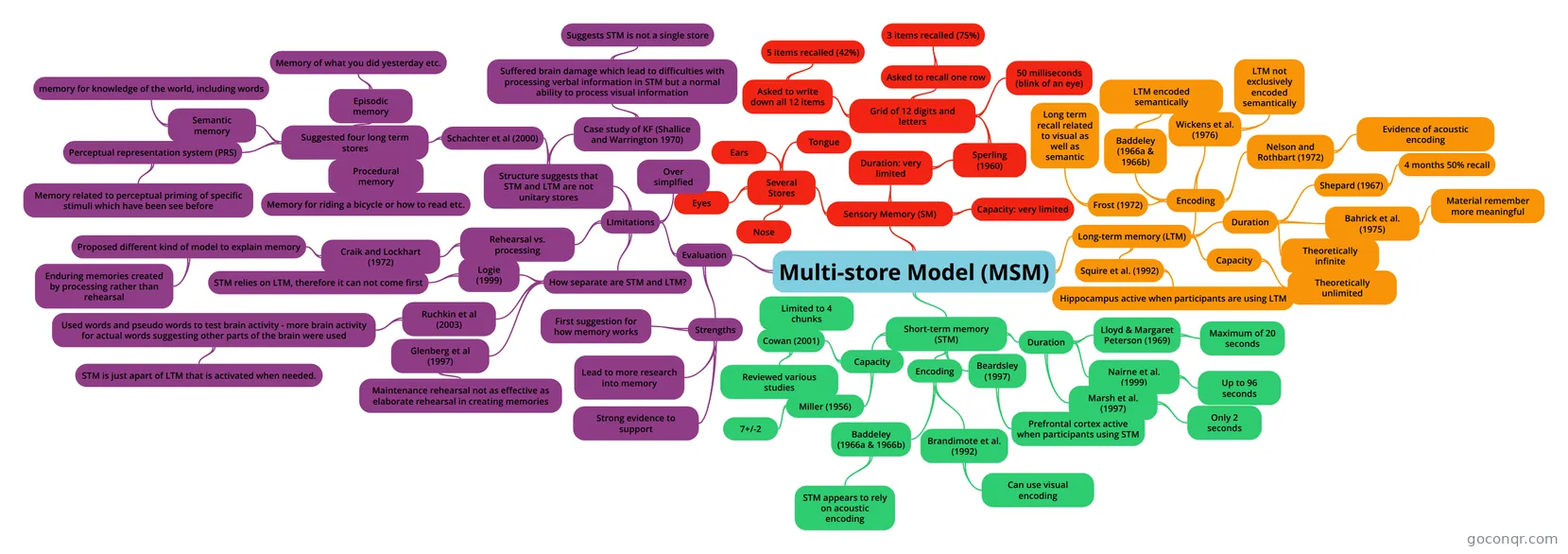
Mind map: Multi-store model of memory
Inhalt der Mindmap
Multi-store Model (MSM)
Short-term memory (STM)
- Beardsley (1997)
- Prefrontal cortex active when participants using STM
- Capacity
- Miller (1956)
- 7+/-2
- Cowan (2001)
- Reviewed various studies
- Limited to 4 chunks
- Miller (1956)
- Duration
- Lloyd & Margaret Peterson (1969)
- Maximum of 20 seconds
- Nairne et al. (1999)
- Up to 96 seconds
- Marsh et al. (1997)
- Only 2 seconds
- Lloyd & Margaret Peterson (1969)
- Encoding
- Baddeley (1966a & 1966b)
- STM appears to rely on acoustic encoding
- Brandimote et al. (1992)
- Can use visual encoding
- Baddeley (1966a & 1966b)
- Beardsley (1997)
Sensory Memory (SM)
- Several Stores
- Eyes
- Ears
- Nose
- Tongue
- Duration: very limited
- Sperling (1960)
- Grid of 12 digits and letters
- 50 milliseconds (blink of an eye)
- Asked to write down all 12 items
- 5 items recalled (42%)
- Asked to recall one row
- 3 items recalled (75%)
- Grid of 12 digits and letters
- Sperling (1960)
- Capacity: very limited
- Several Stores
Long-term memory (LTM)
- Squire et al. (1992)
- Hippocampus active when participants are using LTM
- Capacity
- Theoretically unlimited
- Duration
- Shepard (1967)
- 4 months 50% recall
- Bahrick et al. (1975)
- Material remember more meaningful
- Theoretically infinite
- Shepard (1967)
- Encoding
- Baddeley (1966a & 1966b)
- LTM encoded semantically
- Wickens et al. (1976)
- LTM not exclusively encoded semantically
- Frost (1972)
- Long term recall related to visual as well as semantic
- Nelson and Rothbart (1972)
- Evidence of acoustic encoding
- Baddeley (1966a & 1966b)
- Squire et al. (1992)
Evaluation
- Strengths
- Lead to more research into memory
- Strong evidence to support
- First suggestion for how memory works
- LImitations
- Over simplfied
- Structure suggests that STM and LTM are not unitary stores
- Case study of KF (Shallice and Warrington 1970)
- Suffered brain damage which lead to difficulties with processing verbal information in STM but a normal ability to process visual information
- Suggests STM is not a single store
- Suffered brain damage which lead to difficulties with processing verbal information in STM but a normal ability to process visual information
- Schachter et al (2000)
- Suggested four long term stores
- Episodic memory
- Memory of what you did yesterday etc.
- Perceptual representation system (PRS)
- Memory related to perceptual priming of specific stimuli which have been see before
- Procedural memory
- Memory for riding a bicycle or how to read etc.
- Semantic memory
- memory for knowledge of the world, including words
- Episodic memory
- Suggested four long term stores
- Case study of KF (Shallice and Warrington 1970)
- Rehearsal vs. processing
- Craik and Lockhart (1972)
- Proposed different kind of model to explain memory
- Enduring memories created by processing rather than rehearsal
- Proposed different kind of model to explain memory
- Craik and Lockhart (1972)
- How separate are STM and LTM?
- Logie (1999)
- STM relies on LTM, therefore it can not come first
- Ruchkin et al (2003)
- Used words and pseudo words to test brain activity - more brain activity for actual words suggesting other parts of the brain were used
- STM is just apart of LTM that is activated when needed.
- Used words and pseudo words to test brain activity - more brain activity for actual words suggesting other parts of the brain were used
- Glenberg et al (1997)
- Maintenance rehearsal not as effective as elaborate rehearsal in creating memories
- Logie (1999)
- Strengths
Informationen
- Beschreibung
- Mindmap am Multi-store Model (MSM), erstellt von jamesjordan am 03/03/2015.
- Erstellt von
- jamesjordan
- Aufrufe
- 0
- Bewertung