
Memory
616 resources created by 387 users
This Memory page on GoConqr gathers community-made mind maps, flashcards, quizzes and notes, from the multi-store and working memory models to eyewitness testimony and explanations for forgetting. It's built for school students revising a topic, university students and professional candidates filling gaps, and teachers after ready-made material. There are over 4,400 resources here, including more than 280 quizzes, more than 2,500 mind maps and over 1,200 flashcards, pitched mostly at school level with a solid university share. Pick a topic, try a quiz, then build your own.
Top Memory resources
-
66 cardsMemory full quiz What are the two types of long term memory? E = Tulving 1972 I = Cohen & Squire 1980
-
82 cardsAS Psychology - Memory What is Code, Capacity, Duration & Chuncking?
-
41 cardsLoftus and Palmer What is EWT?
-
66 cardsMemory Shriffin and Atkinson (1969) created what model and what does the model consist of (in order)
-
Mind map cognitive psychology
-
24 cardsDuration, Capacity and Encoding Duration of STM
-
50 cardsEyewitness Testimony
-
24 cardsLoftus and Palmer (1974) What was the aim of Loftus and Palmer experiment 1?
Quizzes
See all 69 quizzes-
143 questionsPsychology 115 Final Exam Review A quiz to help study for an introduction to psychology final exam.
-
63 questionsMemory Quiz- Psychology (AS) Which researcher investigated coding in LTM and STM and when?
-
65 questionsLearning and Memory Quiz Learning and Memory
-
24 questionsAQA-Psychology- Memory Johnshon and scott studied the effects of what on EWT?
-
27 questionsPSY 101-Chapter 8 The three steps in memory information processing are...
-
10 questionsMulti-Store Model of Memory Who created the multi-store model of memory?
-
9 questionsWeek 7 - Semantic Memory In sentence verification tasks, which of the following is a set inclusion type sentence?
-
12 questionsChapter 7: Memory At her school's talent show, Noa answers questions about politics while spinning basketballs on her fingers...
Mind maps
See all 256 mind maps-
cognitive psychology
-
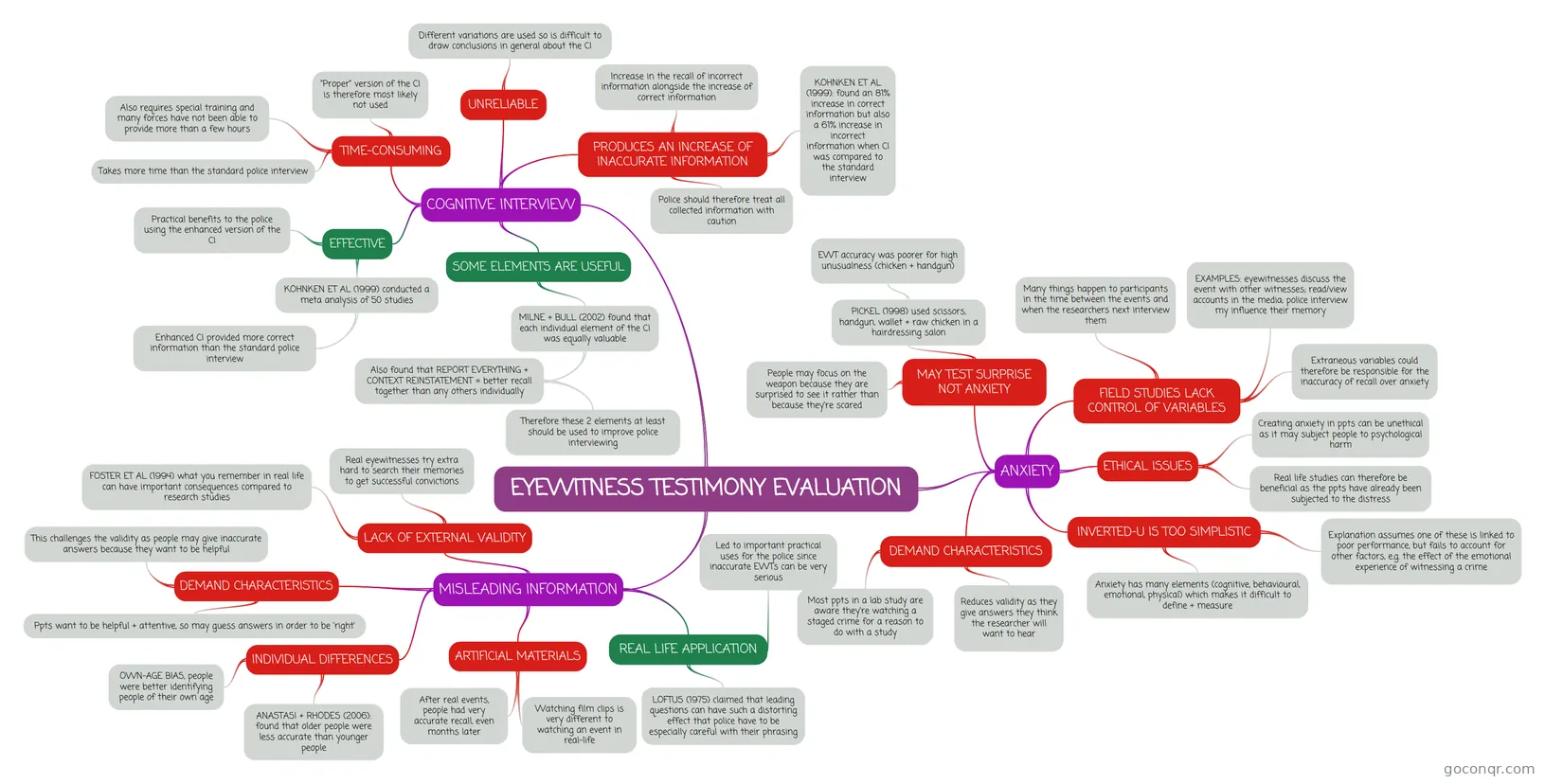 EYEWITNESS TESTIMONY EVALUATION
-
factors affecting eyewitness testimony: anxiety
-
Memory
-
Memory- multi-store model
-
Memory as psychology memory revision
-
Chapter 7: Memory My concept map for Chapter 7:Memory
-
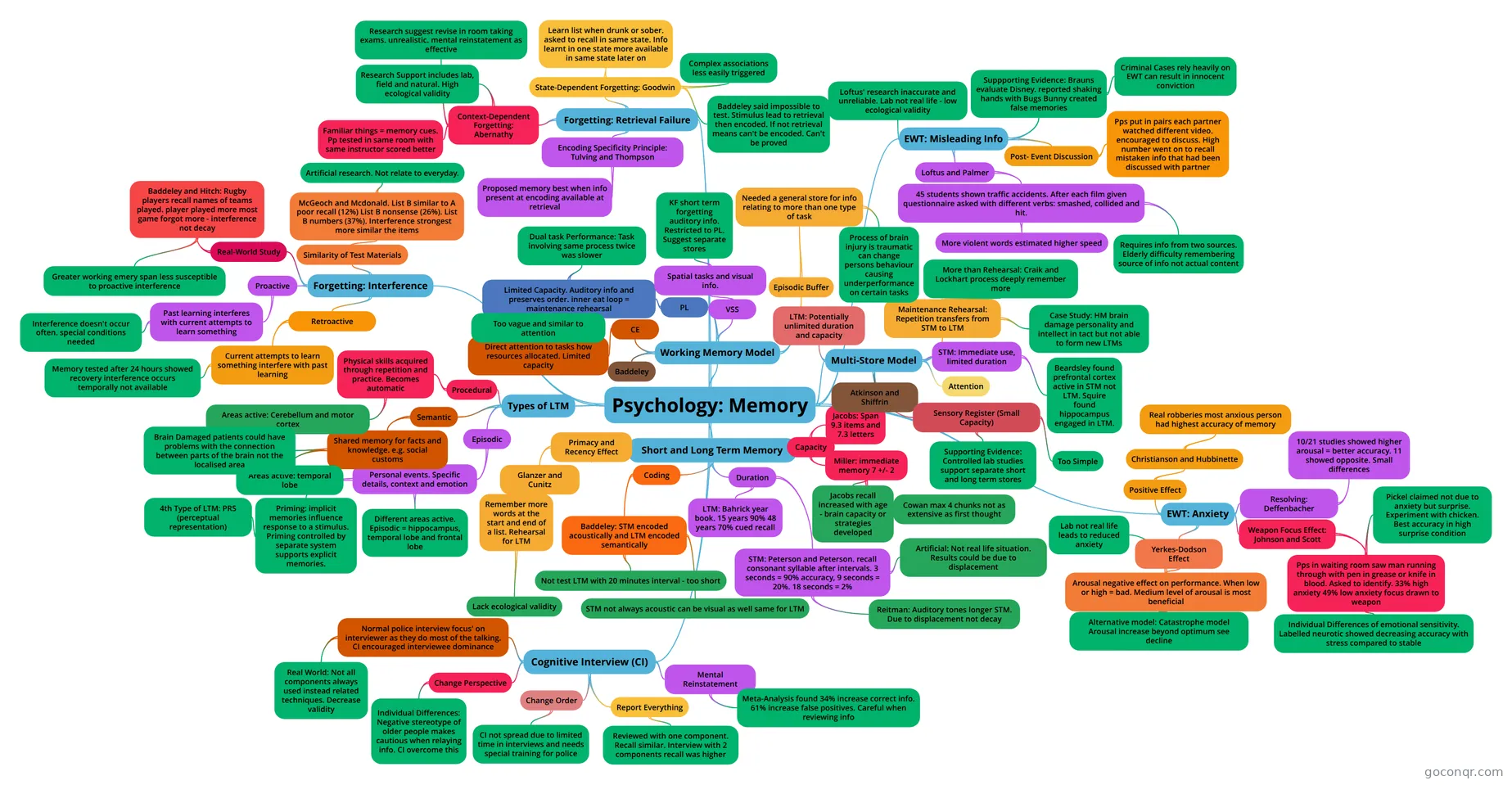 Psychology: Memory Mindmap on the memory content for the AQA AS and A level exam.
Flashcards
See all 217 flashcards-
66 cardsMemory full quiz What are the two types of long term memory? E = Tulving 1972 I = Cohen & Squire 1980
-
82 cardsAS Psychology - Memory What is Code, Capacity, Duration & Chuncking?
-
41 cardsLoftus and Palmer What is EWT?
-
66 cardsMemory Shriffin and Atkinson (1969) created what model and what does the model consist of (in order)
-
24 cardsDuration, Capacity and Encoding Duration of STM
-
50 cardsEyewitness Testimony
-
24 cardsLoftus and Palmer (1974) What was the aim of Loftus and Palmer experiment 1?
-
132 cardsMidterm 2 (Part 2) What is relearning in terms of forgetfulness?
Flowcharts
-
Memory Model describes the path that information takes when it is being encoding to the brain
-
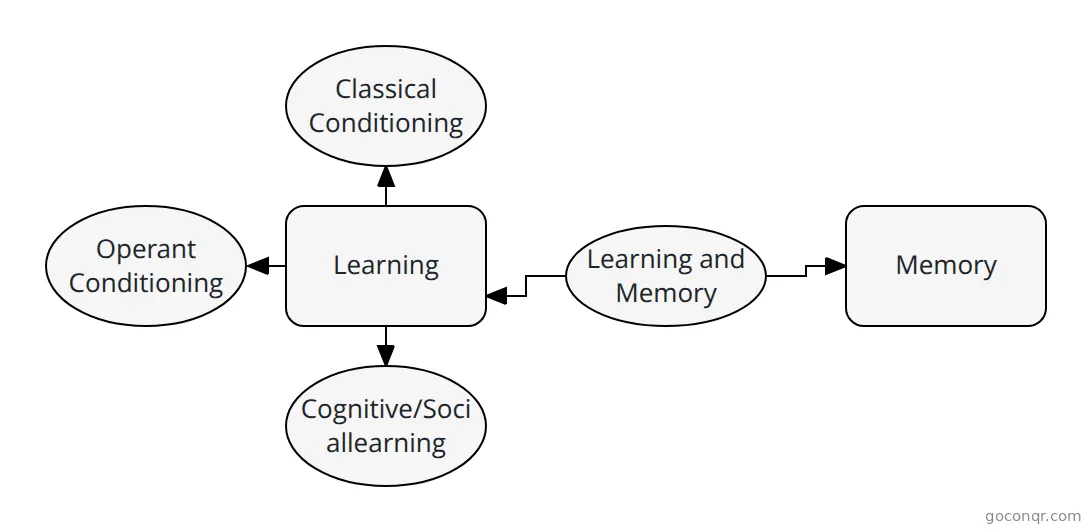 Unit 6: Learning and Memory Flow Chart A flow chart of the learning and memory unit of AP Psychology in high school!
-
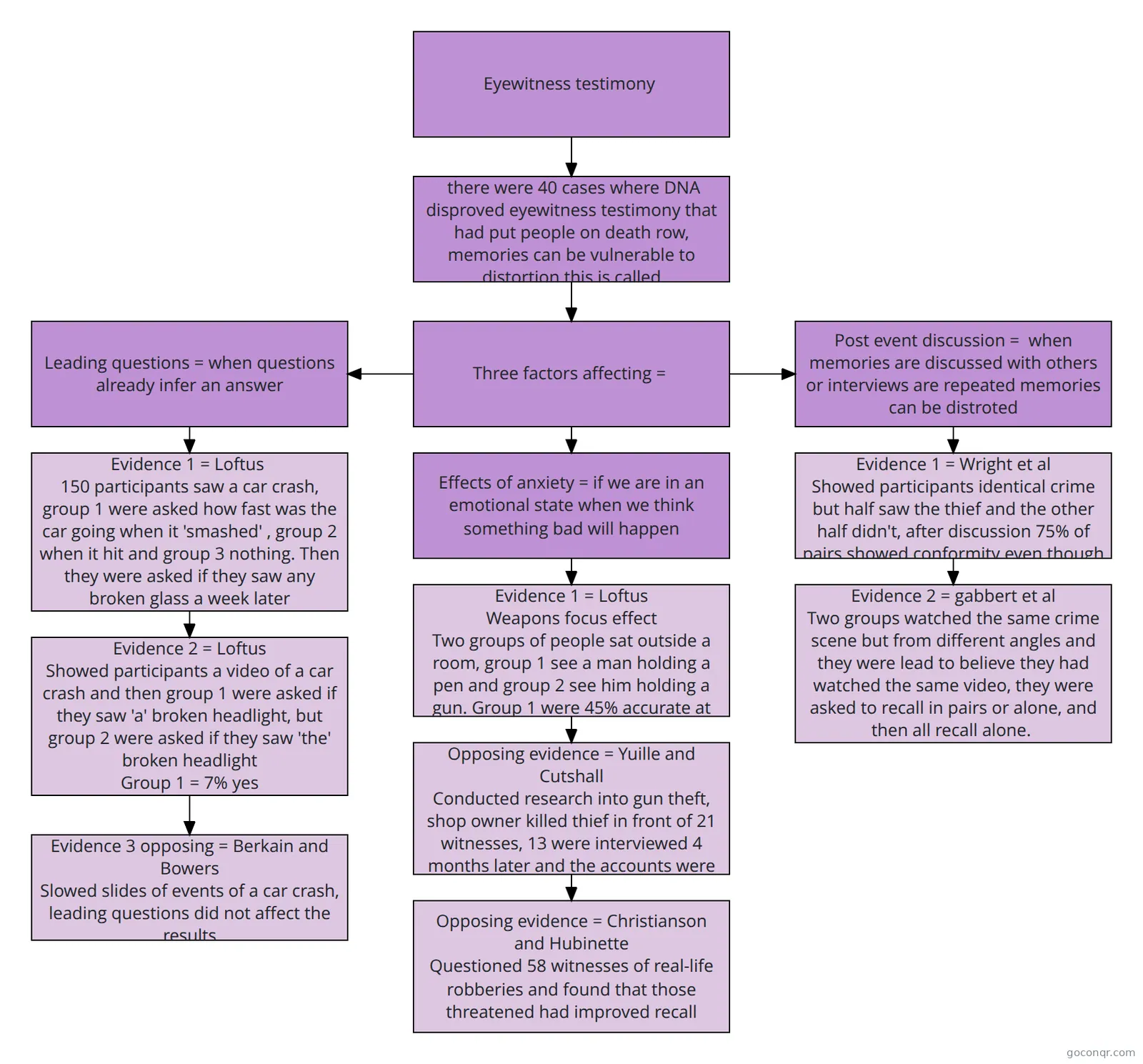 Eyewitness testimony
-
The Working Memory Model - Baddeley & Hitch (1974)
-
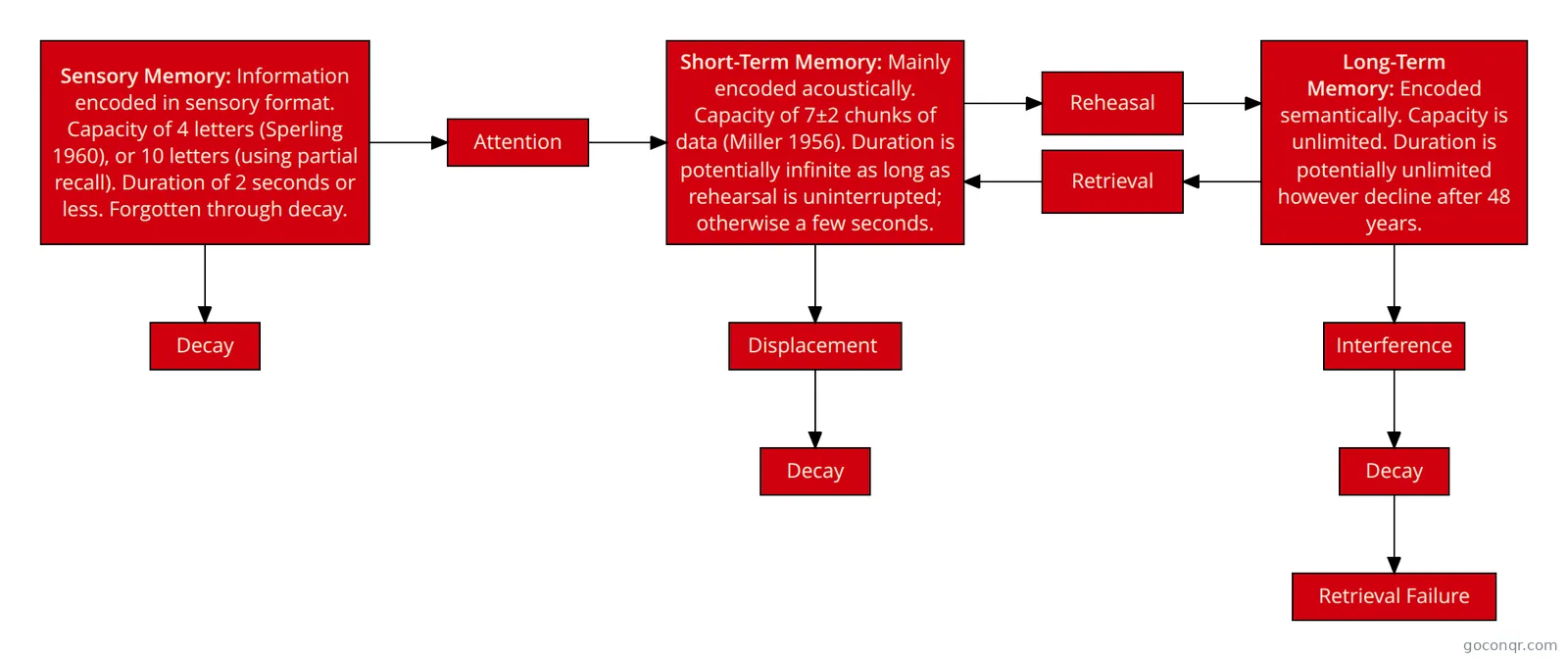 Multi-store Model - Atkinson & Shiffrin (1968/1972) Multi-store Model - Atkinson & Shiffrin (1968/1972)
-
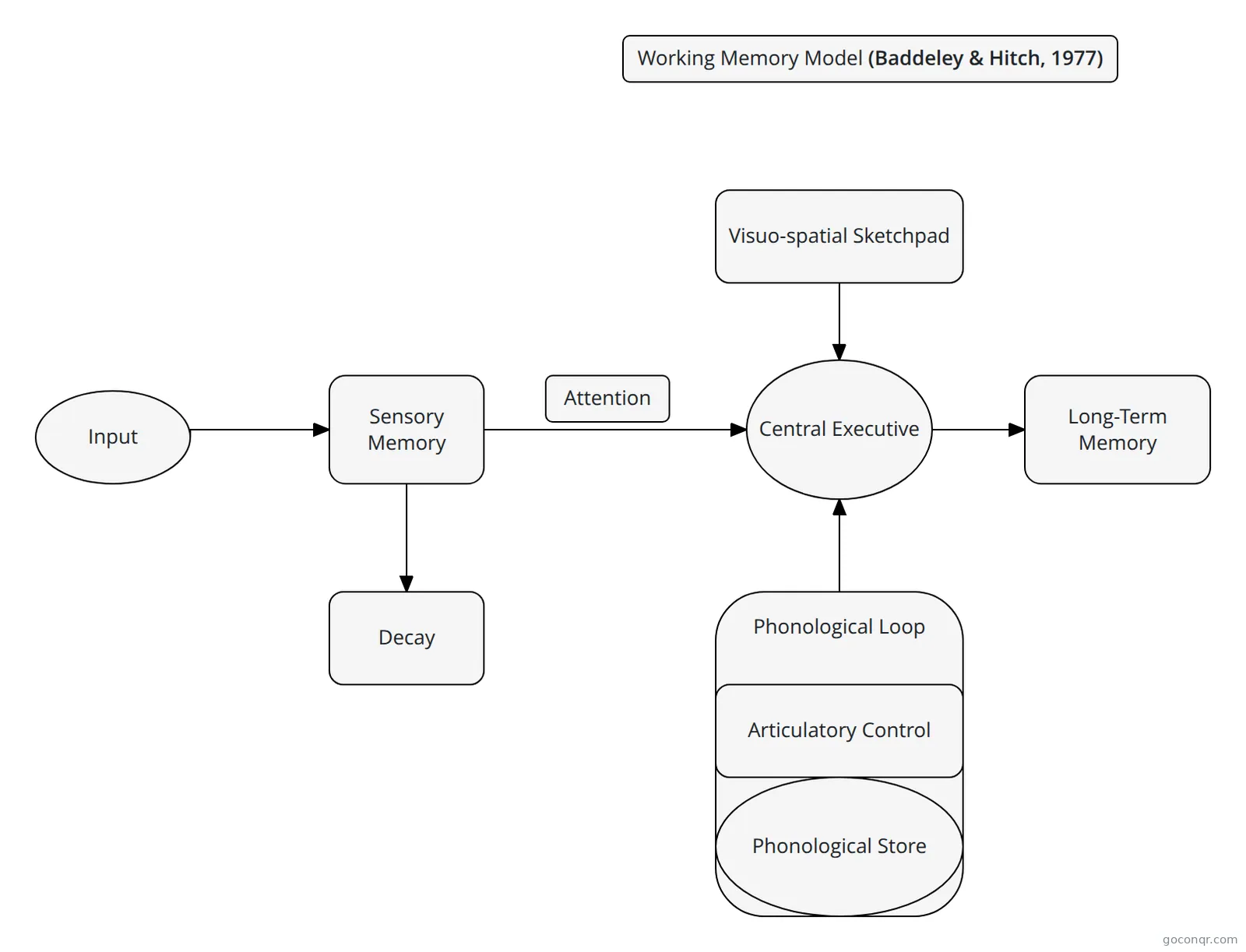 Foundations in Psychology - Semester 1, Lecture 1 Working Memory
-
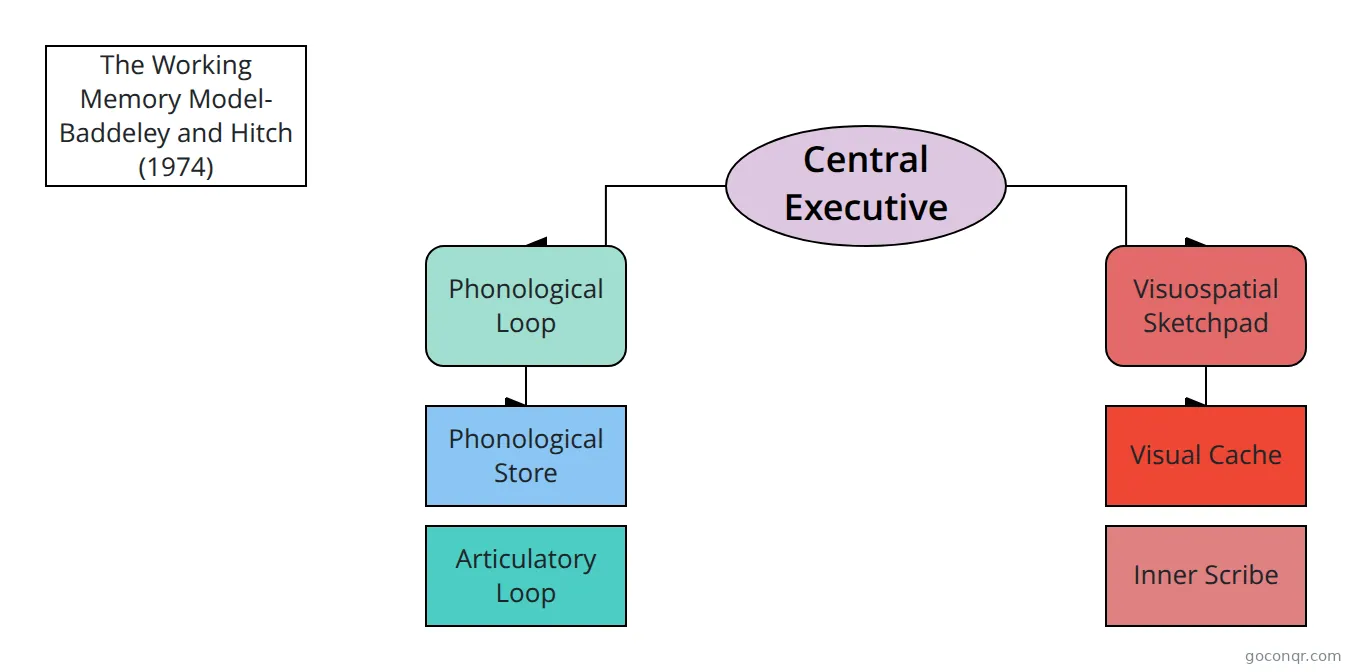 Working Memory Model Working Memory Model- Baddeley and Hitch (1974)
-
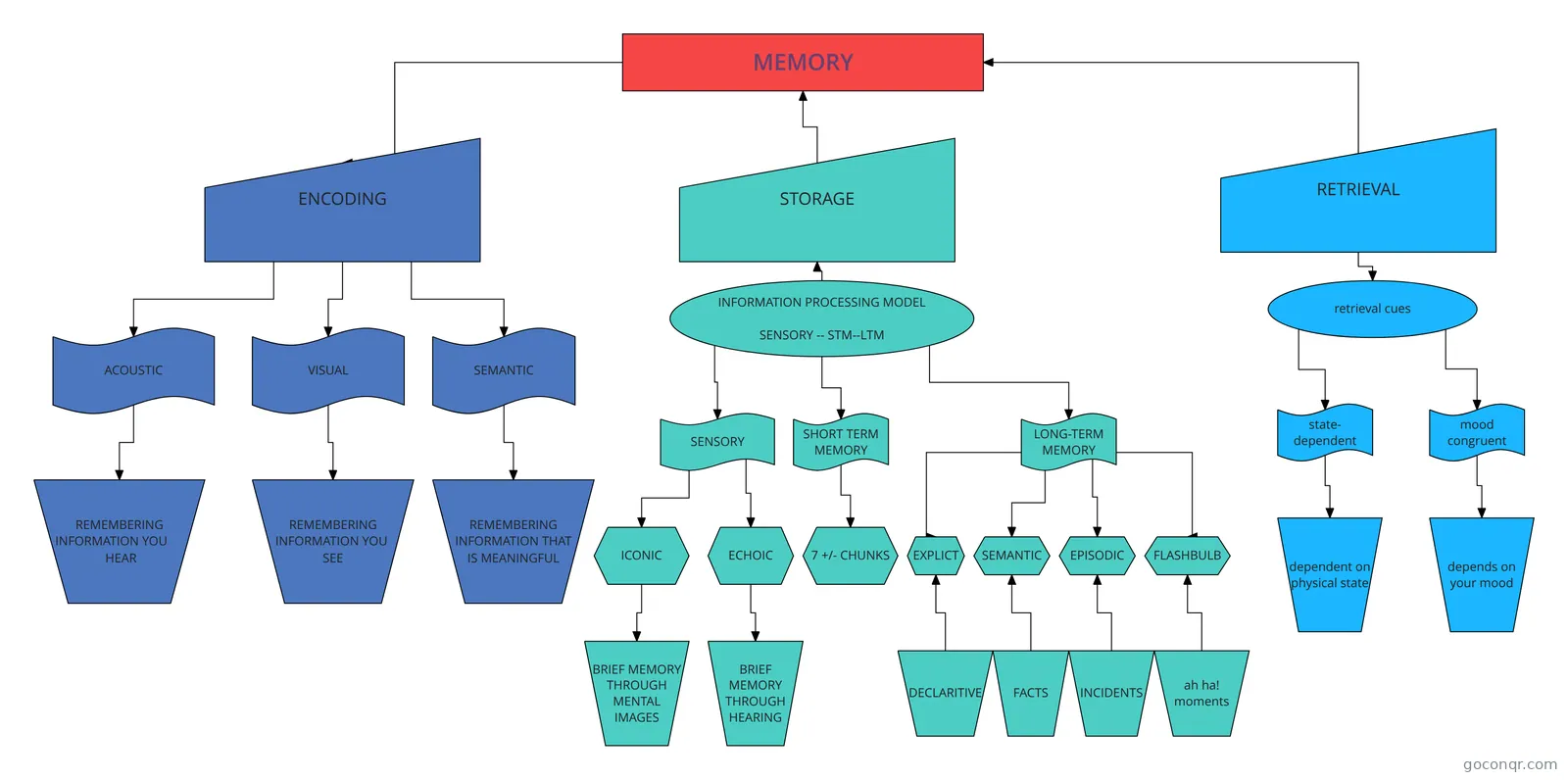 Memory-Psycology Chart covers encoding ,storage, and retrieval in detail.
Notes
See all 44 notes-
Memory 16-marker Plans (AQA A Level Psychology) Coding, capacity and duration Outline Coding- STM= acoustic, LTM= semantic Capacity- STM= 5-9 items, LTM= unlimited Duration- STM= 18-30 seconds, LTM= permanent Discussion Coding- Baddeley, 1966. Four word lists given...
-
Multi Store Memory Model The Multi Store Memory Model (MSM) describes how information flows through the memory system which is made up of 3 stores.The sensory register consists of those received from our 5 senses. The two main parts are the i...
-
The Working Memory Model Atkinson’s and Shiffrin’s (1968) multi-store model was extremely successful in terms of the amount of research it generated. However, as a result of this research, it became apparent that there were a number of proble...
-
the working memory model notes. the working memory model...proposed by Baddeley and hitch the working memory model s a challenge to the MULTI STORE MODEL proposed by Atkinson and shiffrin. They claimed that the short term memory is a unitary store, ...
-
Evaluation of Working Memory Model Strengths KF case study: KF suffered brain damage from a motorcycle accident that damaged his STM. Impairment mainly for verbal info, visual memory intact - evidence of separate stores. Gathercole & Baddeley (1993): p...
-
Working Memory Model The Working Memory Model (WMM) is an explanation of how STM is organised and how it functions. There are four elements. Central executive - monitors incoming data, clearing house, coordinates data. Has a very limited ...
-
Memory- Researchers (AQA A Level Psychology) The following table is comprised of the Memory topics (coding/capacity/duration, MSM, WMM, long term memory, interference, retrieval failure, eyewitness testimony, and cognitive interviews), researchers who investigat...
-
The multi-store model of memory - AS level Psychology
Slides
See all 22 slidesMore Psychology topics
About Memory
GoConqr OriginalWhat this unit covers
The Memory unit sits in the Cognition and Learning strand of Psychology. Most of what is listed follows the classic topics: how memory is coded, how much it holds and how long it lasts, the models that explain it, why we forget, and how reliable eyewitnesses are.
Where to start
Begin with the mind map Memory- multi-store model. It lays out the sensory stores, short-term memory, long-term memory, rehearsal and retrieval on one page. Then open the mind map Human Memory for the three basic processes: encoding, storage and retrieval.
Next, move to the structure of memory itself:
- The flashcard deck Duration, Capacity and Encoding, which covers Peterson and Peterson (1959), Shepard (1967) and Bahrick et al. (1975).
- The mind map Working Memory Model and the notes Evaluation of Working Memory Model.
- The flashcard deck Memory full quiz, which asks about episodic and semantic memory.
Forgetting and eyewitness testimony
Once the models feel familiar, look at forgetting. There are mind maps on interference, retrieval failure and lack of consolidation. For eyewitness testimony, the flashcard decks Eyewitness Testimony and Loftus and Palmer (1974) cover the aims, participants and design of the study. The mind map on anxiety asks whether anxiety makes recall worse or better. The mind map The Cognitive Interview shows how testimony can be improved.
Using quizzes and maps together
Read a mind map first, then close it and take a quiz such as Working memory model or Multi-Store Model of Memory. Wherever you lose marks, go back to the matching map and read that branch again. For longer written answers, the notes Memory 16-marker Plans (AQA A Level Psychology) show how to outline a point and then discuss it.
Make it your own
Pick one topic from the list today, work through its map and quiz, then build a short set of flashcards in your own words to keep it fresh.
Frequently asked questions
Which resource should I open first?
Start with the mind map Memory- multi-store model. It shows the sensory stores, short-term and long-term memory, rehearsal and retrieval together, so you get the overall picture. After that, the flashcard deck Duration, Capacity and Encoding adds the key studies behind the numbers.
What do the mind maps on this page cover?
The mind maps cover the multi-store model, the working memory model, coding, capacity and duration, and forgetting through interference and retrieval failure. They also cover eyewitness testimony, including anxiety and misleading information, plus reconstructive memory and the cognitive interview. There are more than 2,500 in total.
Which exams do these resources suit?
The listed resources mention A-level Psychology, AQA A-level, AQA AS, AQA Psychology, GCSE Psychology, AP Psychology and IB Psychology, and one also mentions the MCAT. Around two thirds are at school level and the rest at university level, so check each title to see what fits you.
Are the resources free to use?
Yes. Every resource listed here is free to open, study and take, with no account needed. They were made by GoConqr users rather than by GoConqr itself, so styles and depth vary. A free account saves your quiz scores and lets you make your own quizzes, maps, flashcards and notes.
Is there anything for writing longer exam answers?
Yes. The notes Memory 16-marker Plans (AQA A Level Psychology) set out outline and discussion points for coding, capacity and duration. The notes Memory- Researchers (AQA A Level Psychology) are a handy companion when you need to name studies in an answer.
What if I can't find my exact topic?
Try a nearby title first. Studies such as Loftus and Palmer, Bower and Springston (1970) or Schmolck et al. (2002) appear in maps, decks and quizzes under several names. If a topic is still missing, you can build your own map or flashcards and fill the gap.