
Mindmap
PERSONALITY APPROACHES
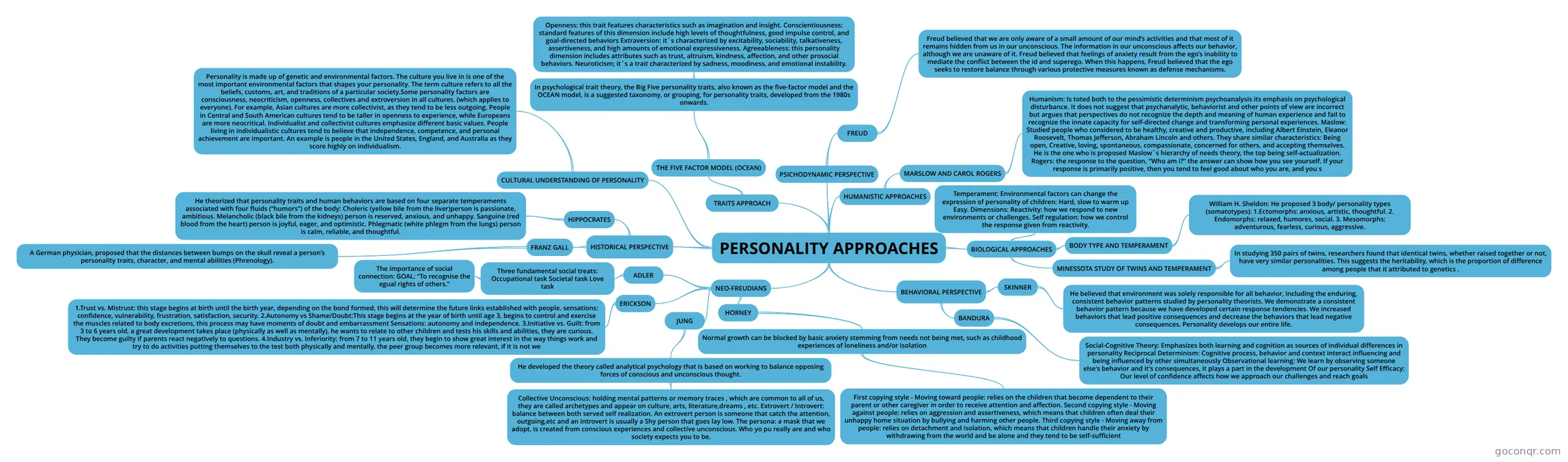
Mind map: Personality approaches
Inhalt der Mindmap
PERSONALITY APPROACHES
HISTORICAL PERSPECTIVE
- HIPPOCRATES
- He theorized that personality traits and human behaviors are based on four separate temperaments associated with four fluids (“humors”) of the body: Choleric (yellow bile from the liver)person is passionate, ambitious. Melancholic (black bile from the kidneys) person is reserved, anxious, and unhappy. Sanguine (red blood from the heart) person is joyful, eager, and optimistic. Phlegmatic (white phlegm from the lungs) person is calm, reliable, and thoughtful.
- FRANZ GALL
- A German physician, proposed that the distances between bumps on the skull reveal a person’s personality traits, character, and mental abilities (Phrenology).
- HIPPOCRATES
NEO-FREUDIANS
- ADLER
- Three fundamental social treats: Occupational task Societal task Love task
- The importance of social connection: GOAL: “To recognise the egual rights of others.”
- Three fundamental social treats: Occupational task Societal task Love task
- ERICKSON
- 1.Trust vs. Mistrust: this stage begins at birth until the birth year, depending on the bond formed, this will determine the future links established with people. sensations: confidence, vulnerability, frustration, satisfaction, security. 2.Autonomy vs Shame/Doubt:This stage begins at the year of birth until age 3, begins to control and exercise the muscles related to body excretions, this process may have moments of doubt and embarrassment Sensations: autonomy and independence. 3.Initiative vs. Guilt: from 3 to 6 years old, a great development takes place (physically as well as mentally), he wants to relate to other children and tests his skills and abilities, they are curious. They become guilty if parents react negatively to questions. 4.Industry vs. Inferiority: from 7 to 11 years old, they begin to show great interest in the way things work and try to do activities putting themselves to the test both physically and mentally, the peer group becomes more relevant, if it is not we
- JUNG
- He developed the theory called analytical psychology that is based on working to balance opposing forces of conscious and unconscious thought.
- Collective Unconscious: holding mental patterns or memory traces , which are common to all of us, they are called archetypes and appear on culture, arts, literature,dreams , etc. Extrovert / Introvert: balance between both served self realization. An extrovert person is someone that catch the attention, outgoing,etc and an introvert is usually a Shy person that goes lay low. The persona: a mask that we adopt, is created from conscious experiences and collective unconscious. Who yo pu really are and who society expects you to be.
- He developed the theory called analytical psychology that is based on working to balance opposing forces of conscious and unconscious thought.
- HORNEY
- Normal growth can be blocked by basic anxiety stemming from needs not being met, such as childhood experiences of loneliness and/or isolation
- First copying style - Moving toward people: relies on the children that become dependent to their parent or other caregiver in order to receive attention and affection. Second copying style - Moving against people: relies on aggression and assertiveness, which means that children often deal their unhappy home situation by bullying and harming other people. Third copying style - Moving away from people: relies on detachment and isolation, which means that children handle their anxiety by withdrawing from the world and be alone and they tend to be self-sufficient
- Normal growth can be blocked by basic anxiety stemming from needs not being met, such as childhood experiences of loneliness and/or isolation
- ADLER
BEHAVIORAL PERSPECTIVE
- SKINNER
- He believed that environment was solely responsible for all behavior, including the enduring, consistent behavior patterns studied by personality theorists. We demonstrate a consistent behavior pattern because we have developed certain response tendencies. We increased behaviors that lead positive consequences and decrease the behaviors that lead negative consequences. Personality develops our entire life.
- BANDURA
- Social-Cognitive Theory: Emphasizes both learning and cognition as sources of individual differences in personality Reciprocal Determinism: Cognitive process, behavior and context interact influencing and being influenced by other simultaneously Observational learning: We learn by observing someone else's behavior and it's consequences, it plays a part in the development Of our personality Self Efficacy: Our level of confidence affects how we approach our challenges and reach goals
- SKINNER
HUMANISTIC APPROACHES
- MARSLOW AND CAROL ROGERS
- Humanism: Is toted both to the pessimistic determinism psychoanalysis its emphasis on psychological disturbance. It does not suggest that psychanalytic, behaviorist and other points of view are incorrect but argues that perspectives do not recognize the depth and meaning of human experience and fail to recognize the innate capacity for self-directed change and transforming personal experiences. Maslow: Studied people who considered to be healthy, creative and productive, including Albert Einstein, Eleanor Roosevelt, Thomas Jefferson, Abraham Lincoln and others. They share similar characteristics: Being open, Creative, loving, spontaneous, compassionate, concerned for others, and accepting themselves. He is the one who is proposed Maslow´s hierarchy of needs theory, the top being self-actualization. Rogers: the response to the question, “Who am i?” the answer can show how you see yourself. If your response is primarily positive, then you tend to feel good about who you are, and you s
- MARSLOW AND CAROL ROGERS
BIOLOGICAL APPROACHES
- MINESSOTA STUDY OF TWINS AND TEMPERAMENT
- In studying 350 pairs of twins, researchers found that identical twins, whether raised together or not, have very similar personalities. This suggests the heritability, which is the proportion of difference among people that it attributed to genetics .
- BODY TYPE AND TEMPERAMENT
- William H. Sheldon: He proposed 3 body/ personality types (somatotypes): 1.Ectomorphs: anxious, artistic, thoughtful. 2. Endomorphs: relaxed, humores, social. 3. Mesomorphs: adventurous, fearless, curious, aggressive.
- Temperament: Environmental factors can change the expression of personality of children: Hard, slow to warm up Easy. Dimensions: Reactivity: how we respond to new environments or challenges. Self regulation: how we control the response given from reactivity.
- MINESSOTA STUDY OF TWINS AND TEMPERAMENT
TRAITS APPROACH
- THE FIVE FACTOR MODEL (OCEAN)
- In psychological trait theory, the Big Five personality traits, also known as the five-factor model and the OCEAN model, is a suggested taxonomy, or grouping, for personality traits, developed from the 1980s onwards.
- Openness: this trait features characteristics such as imagination and insight. Conscientiousness: standard features of this dimension include high levels of thoughtfulness, good impulse control, and goal-directed behaviors Extraversion: it´s characterized by excitability, sociability, talkativeness, assertiveness, and high amounts of emotional expressiveness. Agreeableness: this personality dimension includes attributes such as trust, altruism, kindness, affection, and other prosocial behaviors. Neuroticism; it´s a trait characterized by sadness, moodiness, and emotional instability.
- In psychological trait theory, the Big Five personality traits, also known as the five-factor model and the OCEAN model, is a suggested taxonomy, or grouping, for personality traits, developed from the 1980s onwards.
- THE FIVE FACTOR MODEL (OCEAN)
CULTURAL UNDERSTANDING OF PERSONALITY
- Personality is made up of genetic and environmental factors. The culture you live in is one of the most important environmental factors that shapes your personality. The term culture refers to all the beliefs, customs, art, and traditions of a particular society.Some personality factors are consciousness, neocriticism, openness, collectives and extroversion in all cultures. (which applies to everyone). For example, Asian cultures are more collectivist, as they tend to be less outgoing. People in Central and South American cultures tend to be taller in openness to experience, while Europeans are more neocritical. Individualist and collectivist cultures emphasize different basic values. People living in individualistic cultures tend to believe that independence, competence, and personal achievement are important. An example is people in the United States, England, and Australia as they score highly on individualism.
PSICHODYNAMIC PERSPECTIVE
- FREUD
- Freud believed that we are only aware of a small amount of our mind’s activities and that most of it remains hidden from us in our unconscious. The information in our unconscious affects our behavior, although we are unaware of it. Freud believed that feelings of anxiety result from the ego’s inability to mediate the conflict between the id and superego. When this happens, Freud believed that the ego seeks to restore balance through various protective measures known as defense mechanisms.
- FREUD
Informationen
- Beschreibung
- Psicología Mindmap am PERSONALITY APPROACHES, erstellt von Asis Marañon am 27/04/2020.
- Erstellt von
- Asis Marañon
- Aufrufe
- 0
- Bewertung