
Personality and Individual Differences
1,819 resources created by 1,058 users
This Personality and Individual Differences page on GoConqr gathers community-made quizzes, mind maps, flashcards and notes, from Freud, Jung and Adler to trait theory, Rogers and George Kelly. It's built for university students and professional candidates, and for teachers after ready-made material, with a few resources that suit school students too. There are over 1,700 resources here, including more than 180 quizzes, over 800 mind maps and over 600 flashcards. Pick a theorist, try a quiz to find your gaps, then build your own revision set.
Select topic
- Personality Development15
- Freud and Psychoanalytic Theory106
- Neo-Freudian Theories84
- Humanistic Theories of Personality41
- Trait Theories of Personality166
- Big Five Personality Traits34
- Personality Types and MBTI26
- Biological Bases of Personality29
- Behavioral and Social-Cognitive Theories14
- Cognitive Theories and Personal Constructs35
- Personality Assessment and Research39
- Personality Disorders7
Top Personality and Individual Differences resources
-
 Mind map Freud's Theory of Personality This is just a mind map to help me try and pass AS Psychology
-
 Mind map Alfred Adler
-
50 cardsGordon Allport: Trait Theory Allport's theory & definition of Personality
-
102 questionsPersonality & Individual Differences Weeks 7-12 Tom and Sally have been dating for two years. Sally breaks up with Tom because he cheated on her with Betty...
-
86 questionsCHAPTER 2 The goal of the dissertation in the process of scientific education is to demonstrate that the future scien...
-
74 questionsCHAPTER 3
-
43 questionsPersonality (PPP2014) questions: 1 Clare foolishly believes Tom when he tells her that the chewing gum she just swallowed will take seven year...
-
46 questionsPersonality (PPP2014) questions: 4 A mix of weeks 7-12 blackboard MCQs for practice. 2.20% for correct answers, -0.73 for incorrect answers.
Quizzes
See all 193 quizzes-
102 questionsPersonality & Individual Differences Weeks 7-12 Tom and Sally have been dating for two years. Sally breaks up with Tom because he cheated on her with Betty...
-
86 questionsCHAPTER 2 The goal of the dissertation in the process of scientific education is to demonstrate that the future scien...
-
74 questionsCHAPTER 3
-
43 questionsPersonality (PPP2014) questions: 1 Clare foolishly believes Tom when he tells her that the chewing gum she just swallowed will take seven year...
-
46 questionsPersonality (PPP2014) questions: 4 A mix of weeks 7-12 blackboard MCQs for practice. 2.20% for correct answers, -0.73 for incorrect answers.
-
34 questionsUnderstanding Psychology: Chapter 10 An angry parent imagines hitting a child for misbehaving, but decide instead to discuss the misbehavior wit...
-
40 questionsPersonality (PPP2014) questions; 2 An Individual with a schizotypal personality disorder will usually exhibit which of the following character...
-
11 questionsGeorge Kelly's Personal Construct Theory - 11 Corollaries We anticipate future events according to our interpretations of recurrent themes.
Mind maps
See all 835 mind maps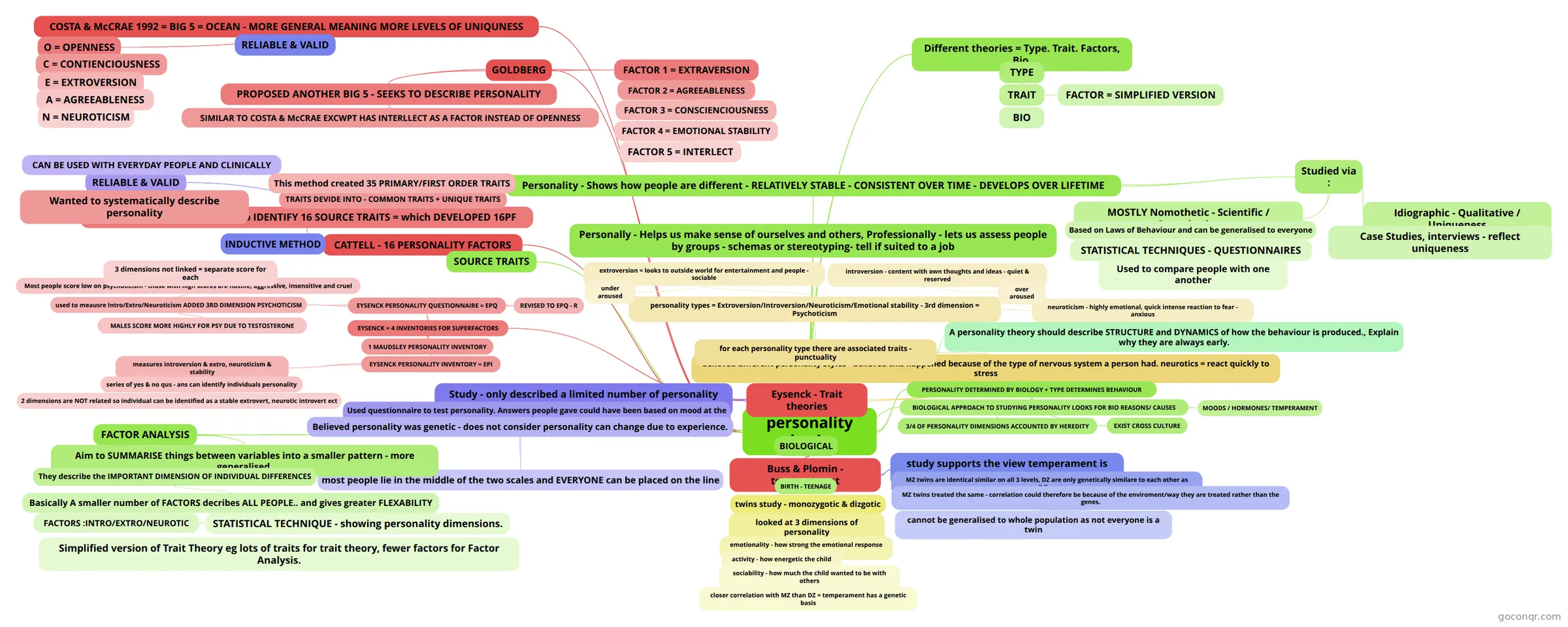
Flashcards
See all 701 flashcards-
50 cardsGordon Allport: Trait Theory Allport's theory & definition of Personality
-
34 cardsThe Individual Differences Approach What was the aim of Rosenhan's study?
-
72 cardsPersonality Traits How is factor analysis used to test the lexical hypothesis?
-
61 cardsPersonality Chapter 8 Evolution Macewan University Psychology 233 Personality Psychology : Domains of knowledge about human nature 5th edit...
-
65 cardsUnit 6 Terms and Concepts Chapter 12: Personality: Theory, Research, and Assessment
-
57 cardsPersonality Psychology Chapter 7 Personality Psychology: Domains of knowledge about Human Nature by R.J. Larsen/D.M. Buss MacEwan University
-
46 cardsPersonaliy psychology Chapter 6 Personality Psychology: Domains of knowledge about Human Nature by R.J. Larsen/D.M. Buss MacEwan University
-
43 cardsChapter 1 Introduction: Evaluating Personality Theories
Flowcharts
See all 19 flowcharts-
Humanistic Theory - Rogers & Maslow
-
Alfred Adler - Psychoanalytic Theory
-
Major Approaches To Personality
-
Untitled
-
Untitled
-
Perspectives & Paradigms
-
THE 4 PERSONALITY TYPES WEEK-7 The conceptual map about the first video "the 4 personality types" - Translation &Interpretation. In...
-
Escuelas Psicodinámicas
Notes
See all 47 notes-
Week 5: DE100 Investigating Psychology - Chapter 1 Chapter 1, Jean McAvoy, Exposing the authoritarian personality, pp19-54 McAvoy, J. (2012) 'Exposing the Authoritarian Personality' in Brace, N. and Byford, J. (eds.) Investigating Psychology, Oxford, Oxford University...
-
Personality final Chapter 1 Definitions of Personality "An individual's characteristic patterns of thought, emotion, and behavior, together with the psychological mechanisms----hidden or not----behind those patterns." An individual's u...
-
Major Theories of Personality - created from Mind Map Psychodynamic Perspective The Phenomenological - Humanistic Approach Trait Approach
-
PSY391 Revision Notes Session 1: Understanding Personality Personality is a facet within a broader set of concepts referred to as individual differences (E.g., General / emotional intelligence, coping styles, self-efficacy, etc.) Personali...
-
Personality and Abnormal Psychology William Sheldon's: early theory of personality associated physique, personality, and delinquency. Sheldon became convinced that the psychological makeup of humans had biological foundations. He ...
-
Unit 6 Study Questions Define the construct of personality in terms of consistency and distinctiveness. (p. 548) Personality is used to describe both the consistency of how one acts among various situations, as well as the distinctive set o...
-
Psychology of Personality Ch 4,5,6 Describe our motivation to strive from a felt minus to a felt plus "According to Adler, the basic human motivation is to strive "from a felt minus situation towards a plus situation, from a feeling of inferiorit...
-
Individual Differences lecture 1 What is Individual Differences Psychology? In what ways are we different from each other? How much are we different from each other? Why are we different from each other? What are the consequences...
Slides
See all 24 slidesTopics in Personality and Individual Differences
More Psychology topics
About Personality and Individual Differences
GoConqr OriginalWhat the resources cover
The page spans the main families of personality theory. The Freud's Theory of Personality mind map walks through the id, the ego and the pleasure principle. Further maps cover Alfred Adler and his types of people based on social interest, Jung and psychic energy, and Person Centred Theory from Carl Rogers. There are also comparison maps such as Adler vs. Horney.
Trait and construct approaches
The flashcard deck on Gordon Allport's trait theory covers his definition of personality, temperament, character and the criteria for an adequate theory. The Gordon Allport mind map shows how he began by listing trait words from a dictionary. For a different angle, the quiz on George Kelly's Personal Construct Theory and its 11 corollaries tests how people construe events. The page also lists a slide set on Eysenck and a mind map on Gray's RST and the FFM.
Where to start
- Open a broad mind map such as Personality or Theories of Personality to see the whole field.
- Move to one theorist at a time, using the single-theory maps and flashcard decks.
- Take a quiz, such as the one on personality assessment in CHAPTER 3, to see what you recall.
- Return to the maps for any topic you missed.
Using quizzes and maps together
Maps give you the structure: who argued what, and how the ideas connect. Quizzes then check the detail. Try reading a map, covering it, and writing down what you remember before you take a quiz. Flashcards suit short definitions, like terms from Allport or Kelly. Teachers can pick a map or quiz to set alongside a lesson.
Where this unit sits
Personality and Individual Differences belongs to the Individual Differences strand of Psychology. Most of the material here is at university level, and a small share is aimed at school study.
Choose a theorist that you find hardest, open its map and see what the quizzes make of it.
Frequently asked questions
Which resource should I open first?
Start with a general mind map such as Personality or Theories of Personality to get the overall picture. Then pick one theorist, for example the Freud's Theory of Personality mind map or the Gordon Allport flashcard deck, and work through that before comparing it with others.
What do the mind maps cover?
They cover psychodynamic ideas from Freud, Jung and Adler, humanistic ideas from Carl Rogers, and trait approaches from Allport. Some compare thinkers directly, such as Adler vs. Horney and Freud vs. Erikson. Others look at topics like Locus of Control and whether personality is a result of genetics.
Are the resources free to use?
Yes. Every resource listed here is free to open, study and take, with no account needed. They were made by GoConqr users, not by GoConqr itself, so styles and depth vary from one resource to the next.
Who are these resources for?
Most suit university students and professional candidates, who can use them for revision and for checking gaps in theory. Teachers can use them as ready-made material. A smaller share suits school students, such as the AQA GCSE Psychology Personality flashcards.
Is there a quiz on personality assessment?
Yes. The quiz called CHAPTER 3 asks what personality assessment refers to and which constructs it applies to, including personality inventories. There are also quizzes such as Personality Test and Lecture 8 Personality if you want more practice.
What if my topic is not listed?
Look at the broader maps and flashcard decks first, as many cover several theories at once. If you still find a gap, a free account lets you make your own quizzes, mind maps, flashcards and notes for it.