
Mindmap
RESEARCH METHODOLOGY
Inhalt der Mindmap
RESEARCH METHODOLOGY
1. Selecting the theme
- The first thing that interests us is knowing, knowing, what will be investigated: Why, for what, what is the value or importance of the fact or phenomenon to be investigated. If the research to be carried out has criteria of priority, novelty, opportunity, conformity or behavior
- 2. Delimitation of the topic
- intended to indicate where, what, how and when, clearly and succinctly indicates the place to which the data refers, the phenomenon that occurs, the interrelated variables, and the date to which the information refers.
- 3. Problem formulation.
- To formulate a problem is to characterize it, define it, frame it theoretically, suggest proposals for solutions to be demonstrated, establish sources of information and methods to collect and process said information. The characterization or definition of the problem leads us to give it a title, in which in the clearest and most denoting way we indicate the elements that are essential to it.
- 4. Research framework (theoretical, referential or conceptual)
- What is the research framework? It is a set of references that a researcher has (synthesis of the results previously achieved and of the literature review on the subject) to adopt a scientific position or current that allows him to support and justify the problem of the research carried out. The theoretical framework answers the question: what antecedents on the subject of your research project exist? Therefore, its purpose is to give research a coordinated and coherent system of concepts, propositions and postulates, which allows obtaining a complete vision of the theoretical system and of the scientific knowledge on the subject.
- 5. Justification of the investigation
- Once the research topic has been selected, defined by the problem statement and the objectives established, the motivations that lead the researcher to develop the project must be indicated. For this, the question of: WHY IS THE INVESTIGATION?
- 6. Limitations
- It is pertinent to give the problem a logical, adequate formulation, to specify its limits, its scope, for this it is necessary to take into account the following factors: Feasibility: the important thing is that the researcher must verify the possibility of obtaining data sources for the development of their study, whether they are of the primary or secondary degree. Place or space where the investigation will be carried out. Time, if the assigned one gives me the coverage of the study or I must have one in case of unforeseen events. Financing, if I am going to implement something that amount of money I have for it or if it will only be a feasibility study.
- 7. Hypothesis development
- It is an affirmative proposition stated to tentatively respond to a problem. It is posed in order to explain facts or phenomena that characterize or identify the object of knowledge. Hypothesis of the first degree: it describes facts or situations of the object of knowledge, which although they are known by popular knowledge, can be tested. Second degree hypothesis: they establish a cause-effect relationship (yes X then Y). This affirmation is demonstrated and verified by its connection with a theoretical model. Third degree hypothesis: the presence of existing relationships between complex variables is affirmed. It suggests explanations among phenomena of greater extension. Null hypothesis: that by which we indicate that the information to be obtained is contrary to the working hypothesis.
- Variable identification
- Independent variable: The truth value that is given to a hypothesis in relation to the cause, is called the independent variable. Dependent variable: We call hypotheses this way when their truth value refers no longer to the cause, but to the effect. Intervening variable: It will be the one whose content refers to a factor that is no longer cause, nor effect, but does modify the conditions of the investigated problem.
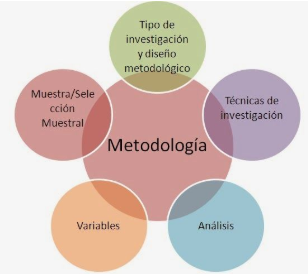
- Methodology
- Design and information gathering techniques.
- Here you must condense all the information related to how you will do your job object of study, what parameters will they use if it will be based on statistical data, which will evaluate of all the information REMEMBER THAT ALL INFORMATION is not always useful for your job. You must select which serves as a interview, from a magazine article, from a comment whether it be radial, textual or other.
- Population and sample.
- Population or universe is any set of units or elements like people, farms, municipalities, companies, etc., clearly defined for which estimates are calculated or information is sought. They must be defined the units, their content and length.
- Analysis techniques.
- In order to define the analysis techniques, a tentative plan or project of the different correlations must be drawn up, based on the general and working hypotheses, specifying: Coding and tabulation system. They will be the statistical techniques to evaluate the quality of the data. Check the hypotheses or obtain conclusions.
- Tentative analytical index of the project.
- It is advisable to prepare a tentative analytical index that gives an overview of the parts or chapters that will contain the work to be done.
- Field work guide.
- In some research projects it is necessary to present a field work guide, for its preparation the following steps can be followed: Previous study or survey. Sample design. Preparation of data collection materials. Necessary work equipment: recorders, cameras, camcorders, etc. Selection and training of personnel. Magazine and experimental test of the previous stages. Collection of data, either primary or secondary. Preparation of the report of the field work. Estimate of necessary personnel and costs.
- Administrative aspects
- Human Resources.
- Budget
- Budget
- Budget
- Human Resources.
- Administrative aspects
- In some research projects it is necessary to present a field work guide, for its preparation the following steps can be followed: Previous study or survey. Sample design. Preparation of data collection materials. Necessary work equipment: recorders, cameras, camcorders, etc. Selection and training of personnel. Magazine and experimental test of the previous stages. Collection of data, either primary or secondary. Preparation of the report of the field work. Estimate of necessary personnel and costs.
- Design and information gathering techniques.
- Methodology
- Independent variable: The truth value that is given to a hypothesis in relation to the cause, is called the independent variable. Dependent variable: We call hypotheses this way when their truth value refers no longer to the cause, but to the effect. Intervening variable: It will be the one whose content refers to a factor that is no longer cause, nor effect, but does modify the conditions of the investigated problem.
- Variable identification
- It is an affirmative proposition stated to tentatively respond to a problem. It is posed in order to explain facts or phenomena that characterize or identify the object of knowledge. Hypothesis of the first degree: it describes facts or situations of the object of knowledge, which although they are known by popular knowledge, can be tested. Second degree hypothesis: they establish a cause-effect relationship (yes X then Y). This affirmation is demonstrated and verified by its connection with a theoretical model. Third degree hypothesis: the presence of existing relationships between complex variables is affirmed. It suggests explanations among phenomena of greater extension. Null hypothesis: that by which we indicate that the information to be obtained is contrary to the working hypothesis.
- 7. Hypothesis development
- It is pertinent to give the problem a logical, adequate formulation, to specify its limits, its scope, for this it is necessary to take into account the following factors: Feasibility: the important thing is that the researcher must verify the possibility of obtaining data sources for the development of their study, whether they are of the primary or secondary degree. Place or space where the investigation will be carried out. Time, if the assigned one gives me the coverage of the study or I must have one in case of unforeseen events. Financing, if I am going to implement something that amount of money I have for it or if it will only be a feasibility study.
- 6. Limitations
- Once the research topic has been selected, defined by the problem statement and the objectives established, the motivations that lead the researcher to develop the project must be indicated. For this, the question of: WHY IS THE INVESTIGATION?
- 5. Justification of the investigation
- What is the research framework? It is a set of references that a researcher has (synthesis of the results previously achieved and of the literature review on the subject) to adopt a scientific position or current that allows him to support and justify the problem of the research carried out. The theoretical framework answers the question: what antecedents on the subject of your research project exist? Therefore, its purpose is to give research a coordinated and coherent system of concepts, propositions and postulates, which allows obtaining a complete vision of the theoretical system and of the scientific knowledge on the subject.
- 4. Research framework (theoretical, referential or conceptual)
- To formulate a problem is to characterize it, define it, frame it theoretically, suggest proposals for solutions to be demonstrated, establish sources of information and methods to collect and process said information. The characterization or definition of the problem leads us to give it a title, in which in the clearest and most denoting way we indicate the elements that are essential to it.
- 3. Problem formulation.
- intended to indicate where, what, how and when, clearly and succinctly indicates the place to which the data refers, the phenomenon that occurs, the interrelated variables, and the date to which the information refers.
- 2. Delimitation of the topic
- The first thing that interests us is knowing, knowing, what will be investigated: Why, for what, what is the value or importance of the fact or phenomenon to be investigated. If the research to be carried out has criteria of priority, novelty, opportunity, conformity or behavior
Bilder und Dateien der Mindmap


Informationen
- Beschreibung
- Mindmap am RESEARCH METHODOLOGY, erstellt von YEISON GOMEZ am 01/05/2020.
- Erstellt von
- YEISON GOMEZ
- Aufrufe
- 0
- Bewertung