
Mindmap
Problem-Based Learning
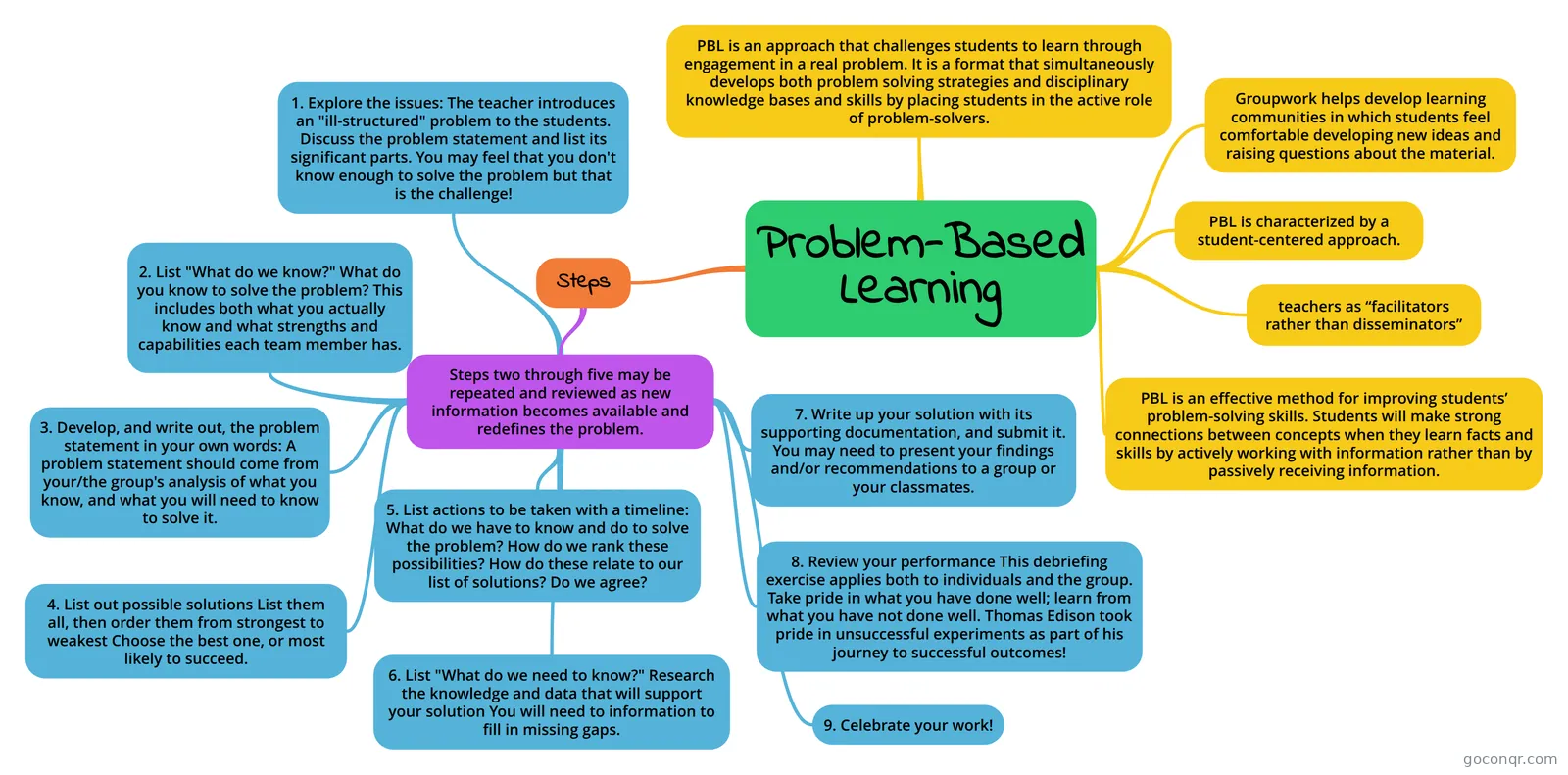
Mind map: Problem-Based Learning
Inhalt der Mindmap
Problem-Based Learning
PBL is an approach that challenges students to learn through engagement in a real problem. It is a format that simultaneously develops both problem solving strategies and disciplinary knowledge bases and skills by placing students in the active role of problem-solvers.
Groupwork helps develop learning communities in which students feel comfortable developing new ideas and raising questions about the material.
PBL is characterized by a student-centered approach.
teachers as “facilitators rather than disseminators”
PBL is an effective method for improving students’ problem-solving skills. Students will make strong connections between concepts when they learn facts and skills by actively working with information rather than by passively receiving information.
Steps
- Steps two through five may be repeated and reviewed as new information becomes available and redefines the problem.
- 1. Explore the issues: The teacher introduces an "ill-structured" problem to the students. Discuss the problem statement and list its significant parts. You may feel that you don't know enough to solve the problem but that is the challenge!
- 2. List "What do we know?" What do you know to solve the problem? This includes both what you actually know and what strengths and capabilities each team member has.
- 3. Develop, and write out, the problem statement in your own words: A problem statement should come from your/the group's analysis of what you know, and what you will need to know to solve it.
- 4. List out possible solutions List them all, then order them from strongest to weakest Choose the best one, or most likely to succeed.
- 5. List actions to be taken with a timeline: What do we have to know and do to solve the problem? How do we rank these possibilities? How do these relate to our list of solutions? Do we agree?
- 6. List "What do we need to know?" Research the knowledge and data that will support your solution You will need to information to fill in missing gaps.
- 7. Write up your solution with its supporting documentation, and submit it. You may need to present your findings and/or recommendations to a group or your classmates.
- 8. Review your performance This debriefing exercise applies both to individuals and the group. Take pride in what you have done well; learn from what you have not done well. Thomas Edison took pride in unsuccessful experiments as part of his journey to successful outcomes!
- 9. Celebrate your work!
- Steps two through five may be repeated and reviewed as new information becomes available and redefines the problem.
Informationen
- Beschreibung
- The following cmap contains important information about Problem-based Learning
- Erstellt von
- mimigo92
- Aufrufe
- 73
- Tags
- Bewertung
Mehr zu Problem-Based Learning