
Mindmap
UNDERSTANDING THE PROBLEM AND THE DEVELOPMENT OF ENGINEERING SPECIFICATIONS
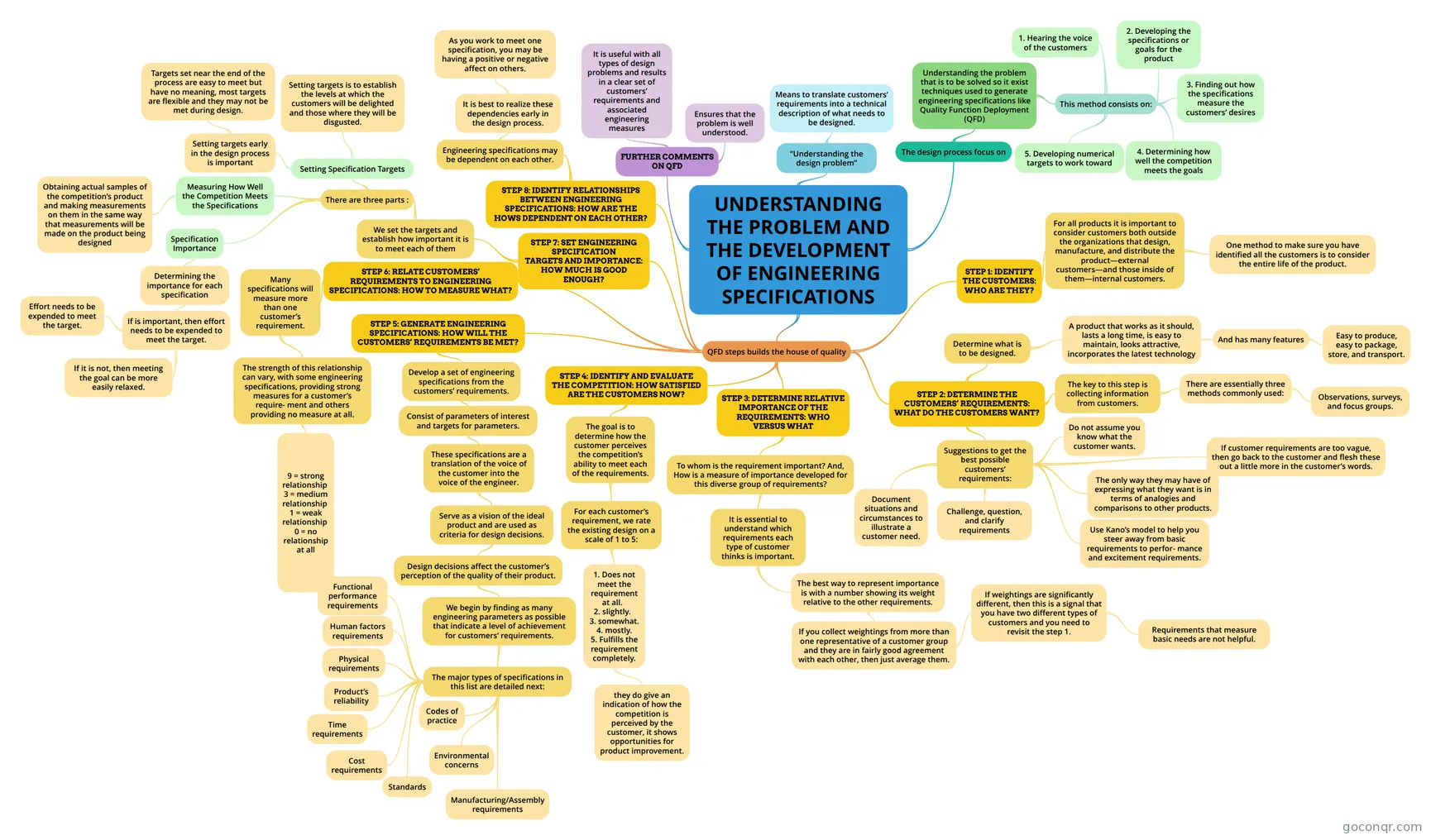
Mind map: Engineering specifications and QFD steps
Inhalt der Mindmap
UNDERSTANDING THE PROBLEM AND THE DEVELOPMENT OF ENGINEERING SPECIFICATIONS
“Understanding the design problem”
- Means to translate customers’ requirements into a technical description of what needs to be designed.
The design process focus on
- Understanding the problem that is to be solved so it exist techniques used to generate engineering specifications like Quality Function Deployment (QFD)
- This method consists on:
- 1. Hearing the voice of the customers
- 2. Developing the specifications or goals for the product
- 3. Finding out how the specifications measure the customers’ desires
- 4. Determining how well the competition meets the goals
- 5. Developing numerical targets to work toward
- This method consists on:
- Understanding the problem that is to be solved so it exist techniques used to generate engineering specifications like Quality Function Deployment (QFD)
QFD steps builds the house of quality
- STEP 1: IDENTIFY THE CUSTOMERS: WHO ARE THEY?
- For all products it is important to consider customers both outside the organizations that design, manufacture, and distribute the product—external customers—and those inside of them—internal customers.
- One method to make sure you have identified all the customers is to consider the entire life of the product.
- For all products it is important to consider customers both outside the organizations that design, manufacture, and distribute the product—external customers—and those inside of them—internal customers.
- STEP 2: DETERMINE THE CUSTOMERS’ REQUIREMENTS: WHAT DO THE CUSTOMERS WANT?
- Determine what is to be designed.
- A product that works as it should, lasts a long time, is easy to maintain, looks attractive, incorporates the latest technology
- And has many features
- Easy to produce, easy to package, store, and transport.
- And has many features
- A product that works as it should, lasts a long time, is easy to maintain, looks attractive, incorporates the latest technology
- The key to this step is collecting information from customers.
- There are essentially three methods commonly used:
- Observations, surveys, and focus groups.
- There are essentially three methods commonly used:
- Suggestions to get the best possible customers’ requirements:
- Do not assume you know what the customer wants.
- If customer requirements are too vague, then go back to the customer and flesh these out a little more in the customer’s words.
- The only way they may have of expressing what they want is in terms of analogies and comparisons to other products.
- Use Kano’s model to help you steer away from basic requirements to perfor- mance and excitement requirements.
- Challenge, question, and clarify requirements
- Document situations and circumstances to illustrate a customer need.
- Determine what is to be designed.
- STEP 3: DETERMINE RELATIVE IMPORTANCE OF THE REQUIREMENTS: WHO VERSUS WHAT
- To whom is the requirement important? And, How is a measure of importance developed for this diverse group of requirements?
- It is essential to understand which requirements each type of customer thinks is important.
- The best way to represent importance is with a number showing its weight relative to the other requirements.
- If you collect weightings from more than one representative of a customer group and they are in fairly good agreement with each other, then just average them.
- If weightings are significantly different, then this is a signal that you have two different types of customers and you need to revisit the step 1.
- Requirements that measure basic needs are not helpful.
- If weightings are significantly different, then this is a signal that you have two different types of customers and you need to revisit the step 1.
- If you collect weightings from more than one representative of a customer group and they are in fairly good agreement with each other, then just average them.
- The best way to represent importance is with a number showing its weight relative to the other requirements.
- It is essential to understand which requirements each type of customer thinks is important.
- To whom is the requirement important? And, How is a measure of importance developed for this diverse group of requirements?
- STEP 4: IDENTIFY AND EVALUATE THE COMPETITION: HOW SATISFIED ARE THE CUSTOMERS NOW?
- The goal is to determine how the customer perceives the competition’s ability to meet each of the requirements.
- For each customer’s requirement, we rate the existing design on a scale of 1 to 5:
- 1. Does not meet the requirement at all.
2. slightly.
3. somewhat.
4. mostly.
5. Fulfills the requirement completely.
- they do give an indication of how the competition is perceived by the customer, it shows opportunities for product improvement.
- 1. Does not meet the requirement at all.
2. slightly.
3. somewhat.
4. mostly.
5. Fulfills the requirement completely.
- For each customer’s requirement, we rate the existing design on a scale of 1 to 5:
- The goal is to determine how the customer perceives the competition’s ability to meet each of the requirements.
- STEP 5: GENERATE ENGINEERING SPECIFICATIONS: HOW WILL THE CUSTOMERS’ REQUIREMENTS BE MET?
- Develop a set of engineering specifications from the customers’ requirements.
- Consist of parameters of interest and targets for parameters.
- These specifications are a translation of the voice of the customer into the voice of the engineer.
- Serve as a vision of the ideal product and are used as criteria for design decisions.
- Design decisions affect the customer’s perception of the quality of their product.
- We begin by finding as many engineering parameters as possible that indicate a level of achievement for customers’ requirements.
- The major types of specifications in this list are detailed next:
- Functional performance requirements
- Human factors requirements
- Physical requirements
- Product’s reliability
- Time requirements
- Cost requirements
- Standards
- Codes of practice
- Environmental concerns
- Manufacturing/Assembly requirements
- The major types of specifications in this list are detailed next:
- We begin by finding as many engineering parameters as possible that indicate a level of achievement for customers’ requirements.
- Design decisions affect the customer’s perception of the quality of their product.
- Serve as a vision of the ideal product and are used as criteria for design decisions.
- These specifications are a translation of the voice of the customer into the voice of the engineer.
- Consist of parameters of interest and targets for parameters.
- Develop a set of engineering specifications from the customers’ requirements.
- STEP 6: RELATE CUSTOMERS’ REQUIREMENTS TO ENGINEERING SPECIFICATIONS: HOW TO MEASURE WHAT?
- Many specifications will measure more than one customer’s requirement.
- The strength of this relationship can vary, with some engineering specifications, providing strong measures for a customer’s require- ment and others providing no measure at all.
- 9 = strong relationship 3 = medium relationship 1 = weak relationship 0 = no relationship at all
- The strength of this relationship can vary, with some engineering specifications, providing strong measures for a customer’s require- ment and others providing no measure at all.
- Many specifications will measure more than one customer’s requirement.
- STEP 7: SET ENGINEERING SPECIFICATION TARGETS
AND IMPORTANCE: HOW MUCH IS GOOD ENOUGH?
- We set the targets and establish how important it is to meet each of them
- There are three parts :
- Specification Importance
- Determining the importance for each specification
- If is important, then effort needs to be expended to meet the target.
- Effort needs to be expended to meet the target.
- If it is not, then meeting the goal can be more easily relaxed.
- If is important, then effort needs to be expended to meet the target.
- Determining the importance for each specification
- Measuring How Well the Competition Meets the Specifications
- Obtaining actual samples of the competition’s product and making measurements on them in the same way that measurements will be made on the product being designed
- Setting Specification Targets
- Setting targets early in the design process is important
- Targets set near the end of the process are easy to meet but have no meaning, most targets are flexible and they may not be met during design.
- Setting targets is to establish the levels at which the customers will be delighted and those where they will be disgusted.
- Setting targets early in the design process is important
- Specification Importance
- There are three parts :
- We set the targets and establish how important it is to meet each of them
- STEP 8: IDENTIFY RELATIONSHIPS BETWEEN ENGINEERING SPECIFICATIONS: HOW ARE THE HOWS DEPENDENT ON EACH OTHER?
- Engineering specifications may be dependent on each other.
- It is best to realize these dependencies early in the design process.
- As you work to meet one specification, you may be having a positive or negative affect on others.
- It is best to realize these dependencies early in the design process.
- Engineering specifications may be dependent on each other.
- STEP 1: IDENTIFY THE CUSTOMERS: WHO ARE THEY?
FURTHER COMMENTS ON QFD
- Ensures that the problem is well understood.
- It is useful with all types of design problems and results in a clear set of customers’ requirements and associated engineering measures
Informationen
- Beschreibung
- Medicina Mindmap am UNDERSTANDING THE PROBLEM AND THE DEVELOPMENT OF ENGINEERING SPECIFICATIONS, erstellt von Manuela Wilches am 21/07/2020.
- Erstellt von
- Manuela Wilches
- Aufrufe
- 0
- Bewertung