
Mindmap
Edexcel Additional Science Biology Topic 1
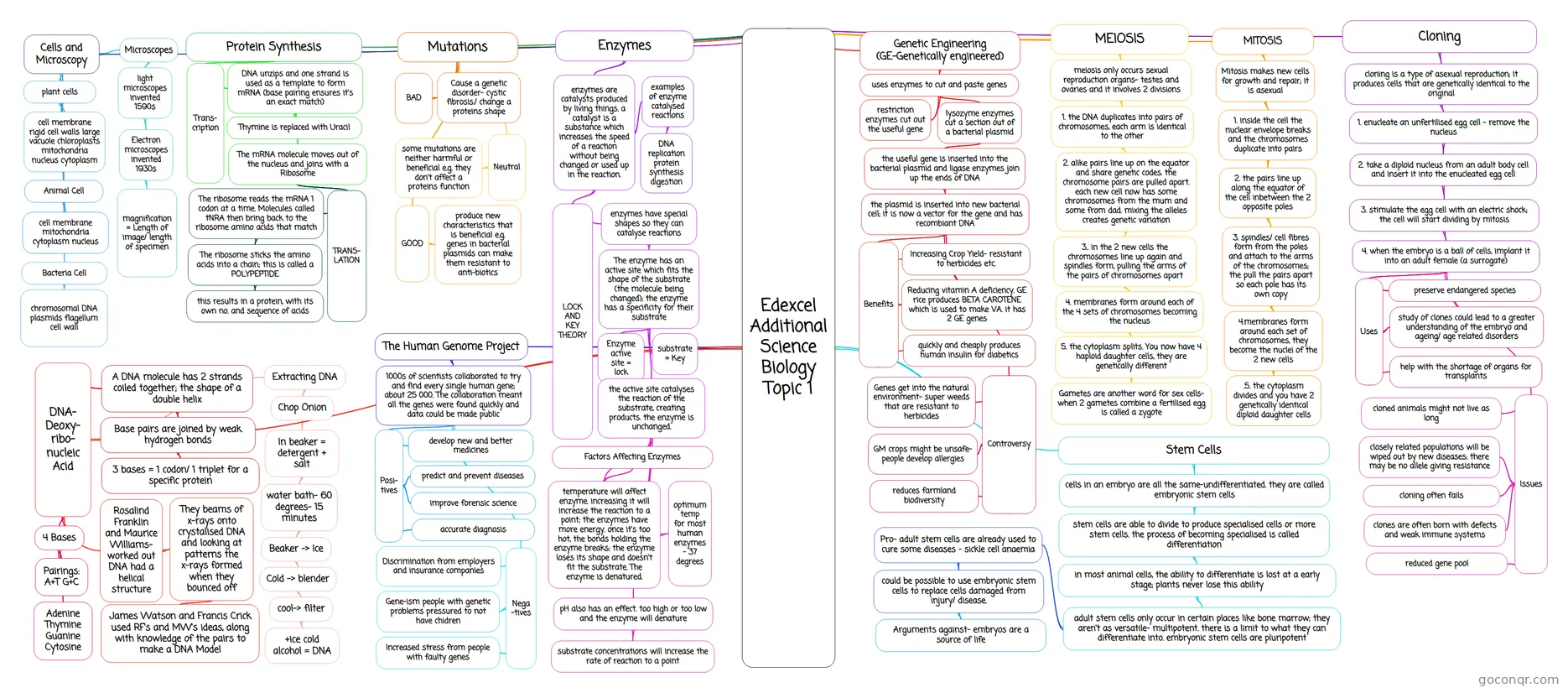
Mind map: Edexcel Additional Science Biology Topic 1
Inhalt der Mindmap
Edexcel Additional Science Biology Topic 1
Cells and Microscopy
- plant cells
- cell membrane rigid cell walls large vacuole chloroplasts mitochondria nucleus cytoplasm
- Animal Cell
- cell membrane mitochondria cytoplasm nucleus
- Bacteria Cell
- chromosomal DNA plasmids flagellum cell wall
- Microscopes
- light microscopes invented 1590s
- Electron microscopes invented 1930s
- magnification = Length of image/ length of specimen
- Electron microscopes invented 1930s
- light microscopes invented 1590s
- plant cells
DNA- Deoxy- ribo- nucleic Acid
- 4 Bases
- Adenine Thymine Guanine Cytosine
- Pairings: A+T G+C
- A DNA molecule has 2 strands coiled together; the shape of a double helix
- Base pairs are joined by weak hydrogen bonds
- 3 bases = 1 codon/ 1 triplet for a specific protein
- Base pairs are joined by weak hydrogen bonds
- Rosalind Franklin and Maurice Williams- worked out DNA had a helical structure
- They beams of x-rays onto crystalised DNA and looking at patterns the x-rays formed when they bounced off
- James Watson and Francis Crick used RF's and MW's ideas, along with knowledge of the pairs to make a DNA Model
- They beams of x-rays onto crystalised DNA and looking at patterns the x-rays formed when they bounced off
- Extracting DNA
- Chop Onion
- In beaker = detergent + salt
- water bath- 60 degrees- 15 minutes
- Beaker -> Ice
- Cold -> blender
- cool-> filter
- +ice cold alcohol = DNA
- cool-> filter
- Cold -> blender
- Beaker -> Ice
- water bath- 60 degrees- 15 minutes
- In beaker = detergent + salt
- Chop Onion
- 4 Bases
Protein Synthesis
- Trans- cription
- DNA unzips and one strand is used as a template to form mRNA (base pairing ensures it's an exact match)
- Thymine is replaced with Uracil
- The mRNA molecule moves out of the nucleus and joins with a Ribosome
- TRANS- LATION
- The ribosome reads the mRNA 1 codon at a time. Molecules called tNRA then bring back to the ribosome amino acids that match
- The ribosome sticks the amino acids into a chain; this is called a POLYPEPTIDE
- this results in a protein, with its own no. and sequence of acids
- The ribosome sticks the amino acids into a chain; this is called a POLYPEPTIDE
- The ribosome reads the mRNA 1 codon at a time. Molecules called tNRA then bring back to the ribosome amino acids that match
- TRANS- LATION
- DNA unzips and one strand is used as a template to form mRNA (base pairing ensures it's an exact match)
- Trans- cription
Mutations
- BAD
- Cause a genetic disorder- cystic fibrosis./ change a proteins shape
- GOOD
- produce new characteristics that is beneficial e.g. genes in bacterial plasmids can make them resistant to anti-biotics
- Neutral
- some mutations are neither harmful or beneficial e.g. they don't affect a proteins function
- BAD
Enzymes
- enzymes are catalysts produced by living things. a catalyst is a substance which increases the speed of a reaction without being changed or used up in the reaction.
- examples of enzyme catalysed reactions
- DNA replication protein synthesis digestion
- LOCK AND KEY THEORY
- enzymes have special shapes so they can catalyse reactions
- The enzyme has an active site which fits the shape of the substrate (the molecule being changed); the enzyme has a specificity for their substrate
- Enzyme active site = lock
- substrate = Key
- the active site catalyses the reaction of the substrate, creating products. the enzyme is unchanged.
- temperature will affect enzyme. increasing it will increase the reaction to a point; the enzymes have more energy. once it's too hot, the bonds holding the enzyme breaks; the enzyme loses its shape and doesn't fit the substrate. The enzyme is denatured.
- optimum temp for most human enzymes - 37 degrees
- Factors Affecting Enzymes
- pH also has an effect. too high or too low and the enzyme will denature
- substrate concentrations will increase the rate of reaction to a point
- temperature will affect enzyme. increasing it will increase the reaction to a point; the enzymes have more energy. once it's too hot, the bonds holding the enzyme breaks; the enzyme loses its shape and doesn't fit the substrate. The enzyme is denatured.
- The enzyme has an active site which fits the shape of the substrate (the molecule being changed); the enzyme has a specificity for their substrate
- enzymes have special shapes so they can catalyse reactions
- examples of enzyme catalysed reactions
- enzymes are catalysts produced by living things. a catalyst is a substance which increases the speed of a reaction without being changed or used up in the reaction.
The Human Genome Project
- 1000s of scientists collaborated to try and find every single human gene; about 25 000. The collaboration meant all the genes were found quickly and data could be made public
- Posi- tives
- predict and prevent diseases
- develop new and better medicines
- accurate diagnosis
- improve forensic science
- Nega -tives
- Increased stress from people with faulty genes
- Gene-ism people with genetic problems pressured to not have chidren
- Discrimination from employers and insurance companies
- Posi- tives
- 1000s of scientists collaborated to try and find every single human gene; about 25 000. The collaboration meant all the genes were found quickly and data could be made public
Genetic Engineering (GE-Genetically engineered)
- uses enzymes to cut and paste genes
- restriction enzymes cut out the useful gene
- lysozyme enzymes cut a section out of a bacterial plasmid
- the useful gene is inserted into the bacterial plasmid and ligase enzymes join up the ends of DNA
- the plasmid is inserted into new bacterial cell; it is now a vector for the gene and has recombiant DNA
- Benefits
- Reducing vitamin A deficiency. GE rice produces BETA CAROTENE which is used to make VA. it has 2 GE genes
- quickly and cheaply produces human insulin for diabetics
- Increasing Crop Yield- resistant to herbicides etc.
- Controversy
- reduces farmland biodiversity
- GM crops might be unsafe- people develop allergies
- Genes get into the natural environment- super weeds that are resistant to herbicides
- Benefits
- the plasmid is inserted into new bacterial cell; it is now a vector for the gene and has recombiant DNA
- the useful gene is inserted into the bacterial plasmid and ligase enzymes join up the ends of DNA
- uses enzymes to cut and paste genes
MITOSIS
- Mitosis makes new cells for growth and repair; it is asexual
- 1. inside the cell the nuclear envelope breaks and the chromosomes duplicate into pairs
- 2. the pairs line up along the equator of the cell inbetween the 2 opposite poles
- 3. spindles/ cell fibres form from the poles and attach to the arms of the chromosomes; the pull the pairs apart so each pole has its own copy
- 4.membranes form around each set of chromosomes, they become the nuclei of the 2 new cells
- .5. the cytoplasm divides and you have 2 genetically identical diploid daughter cells
- 4.membranes form around each set of chromosomes, they become the nuclei of the 2 new cells
- 3. spindles/ cell fibres form from the poles and attach to the arms of the chromosomes; the pull the pairs apart so each pole has its own copy
- 2. the pairs line up along the equator of the cell inbetween the 2 opposite poles
- 1. inside the cell the nuclear envelope breaks and the chromosomes duplicate into pairs
- Mitosis makes new cells for growth and repair; it is asexual
MEIOSIS
- meiosis only occurs sexual reproduction organs- testes and ovaries and it involves 2 divisions
- 1. the DNA duplicates into pairs of chromosomes, each arm is identical to the other
- 2. alike pairs line up on the equator and share genetic codes. the chromosome pairs are pulled apart. each new cell now has some chromosomes from the mum and some from dad. mixing the alleles creates genetic variation
- 3.. in the 2 new cells the chromosomes line up again and spindles form, pulling the arms of the pairs of chromosomes apart
- 4. membranes form around each of the 4 sets of chromosomes becoming the nucleus
- 5. the cytoplasm splits. You now have 4 haploid daughter cells, they are genetically different
- Gametes are another word for sex cells- when 2 gametes combine a fertilised egg is called a zygote
- 5. the cytoplasm splits. You now have 4 haploid daughter cells, they are genetically different
- 4. membranes form around each of the 4 sets of chromosomes becoming the nucleus
- 3.. in the 2 new cells the chromosomes line up again and spindles form, pulling the arms of the pairs of chromosomes apart
- 2. alike pairs line up on the equator and share genetic codes. the chromosome pairs are pulled apart. each new cell now has some chromosomes from the mum and some from dad. mixing the alleles creates genetic variation
- 1. the DNA duplicates into pairs of chromosomes, each arm is identical to the other
- meiosis only occurs sexual reproduction organs- testes and ovaries and it involves 2 divisions
Cloning
- cloning is a type of asexual reproduction; it produces cells that are genetically identical to the original
- 1. enucleate an unfertilised egg cell - remove the nucleus
- 2. take a diploid nucleus from an adult body cell and insert it into the enucleated egg cell
- 3. stimulate the egg cell with an electric shock; the cell will start dividing by mitosis
- 4. when the embryo is a ball of cells, implant it into an adult female (a surrogate)
- Uses
- help with the shortage of organs for transplants
- study of clones could lead to a greater understanding of the embryo and ageing/ age related disorders
- preserve endangered species
- Issues
- closely related populations will be wiped out by new diseases; there may be no allele giving resistance
- cloned animals might not live as long
- cloning often fails
- clones are often born with defects and weak immune systems
- reduced gene pool
- Uses
- 4. when the embryo is a ball of cells, implant it into an adult female (a surrogate)
- 3. stimulate the egg cell with an electric shock; the cell will start dividing by mitosis
- 2. take a diploid nucleus from an adult body cell and insert it into the enucleated egg cell
- 1. enucleate an unfertilised egg cell - remove the nucleus
- cloning is a type of asexual reproduction; it produces cells that are genetically identical to the original
Stem Cells
- cells in an embryo are all the same-undifferentiated. they are called embryonic stem cells
- stem cells are able to divide to produce specialised cells or more stem cells. the process of becoming specialised is called differentiation
- in most animal cells, the ability to differentiate is lost at a early stage; plants never lose this ability
- adult stem cells only occur in certain places like bone marrow; they aren't as versatile- multipotent. there is a limit to what they can differentiate into. embryonic stem cells are pluripotent
- Pro- adult stem cells are already used to cure some diseases - sickle cell anaemia
- could be possible to use embryonic stem cells to replace cells damaged from injury/ disease.
- Arguments against- embryos are a source of life
- could be possible to use embryonic stem cells to replace cells damaged from injury/ disease.
- Pro- adult stem cells are already used to cure some diseases - sickle cell anaemia
- adult stem cells only occur in certain places like bone marrow; they aren't as versatile- multipotent. there is a limit to what they can differentiate into. embryonic stem cells are pluripotent
- in most animal cells, the ability to differentiate is lost at a early stage; plants never lose this ability
- stem cells are able to divide to produce specialised cells or more stem cells. the process of becoming specialised is called differentiation
- cells in an embryo are all the same-undifferentiated. they are called embryonic stem cells
Informationen
- Beschreibung
- Mind Map summarizing key points from B2 Topic 1; Genes and Enymes
- Erstellt von
- hchen8nrd
- Aufrufe
- 1.587
- Tags
- Bewertung