
Mindmap
Biology 150
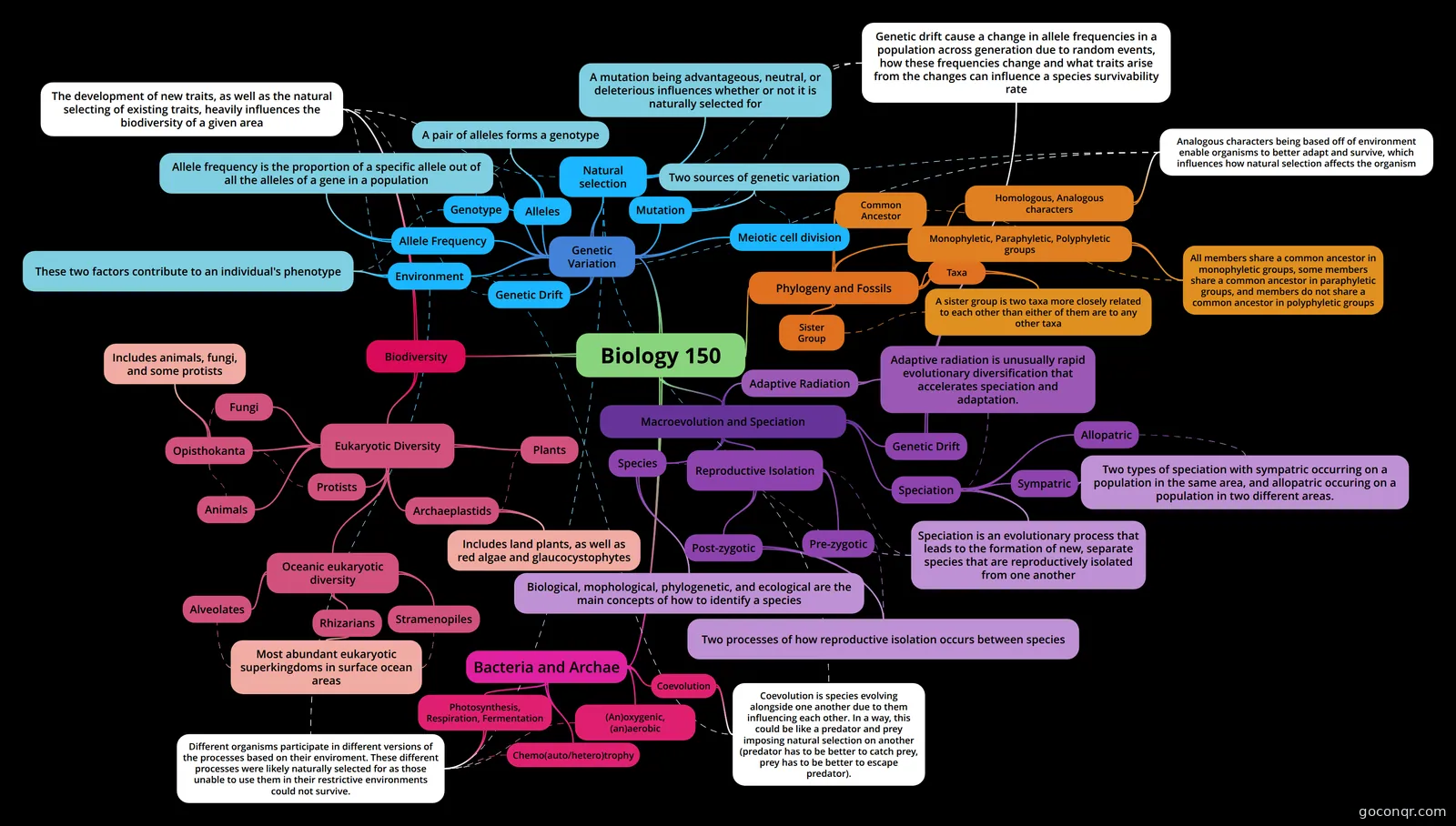
Mind map: Biology 150 evolution and biodiversity
Inhalt der Mindmap
Biology 150
Biodiversity
- Eukaryotic Diversity
- Oceanic eukaryotic diversity
- Rhizarians
- Most abundant eukaryotic superkingdoms in surface ocean areas
- Alveolates
- Stramenopiles
- Rhizarians
- Archaeplastids
- Includes land plants, as well as red algae and glaucocystophytes
- Opisthokanta
- Includes animals, fungi, and some protists
- Protists
- Fungi
- Animals
- Plants
- Oceanic eukaryotic diversity
- The development of new traits, as well as the natural selecting of existing traits, heavily influences the biodiversity of a given area
- Eukaryotic Diversity
Genetic Variation
- Environment
- These two factors contribute to an individual's phenotype
- Genotype
- Alleles
- A pair of alleles forms a genotype
- Mutation
- Two sources of genetic variation
- Meiotic cell division
- Natural selection
- A mutation being advantageous, neutral, or deleterious influences whether or not it is naturally selected for
- Allele Frequency
- Allele frequency is the proportion of a specific allele out of all the alleles of a gene in a population
- Genetic Drift
- Environment
Macroevolution and Speciation
- Species
- Biological, mophological, phylogenetic, and ecological are the main concepts of how to identify a species
- Reproductive Isolation
- Pre-zygotic
- Post-zygotic
- Two processes of how reproductive isolation occurs between species
- Genetic Drift
- Genetic drift cause a change in allele frequencies in a population across generation due to random events, how these frequencies change and what traits arise from the changes can influence a species survivability rate
- Speciation
- Speciation is an evolutionary process that leads to the formation of new, separate species that are reproductively isolated from one another
- Allopatric
- Sympatric
- Two types of speciation with sympatric occurring on a population in the same area, and allopatric occuring on a population in two different areas.
- Adaptive Radiation
- Adaptive radiation is unusually rapid evolutionary diversification that accelerates speciation and adaptation.
- Species
Phylogeny and Fossils
- Sister Group
- Taxa
- A sister group is two taxa more closely related to each other than either of them are to any other taxa
- Monophyletic, Paraphyletic, Polyphyletic groups
- All members share a common ancestor in monophyletic groups, some members share a common ancestor in paraphyletic groups, and members do not share a common ancestor in polyphyletic groups
- Homologous, Analogous characters
- Analogous characters being based off of environment enable organisms to better adapt and survive, which influences how natural selection affects the organism
- Common Ancestor
Bacteria and Archae
- Photosynthesis, Respiration, Fermentation
- Different organisms participate in different versions of the processes based on their enviroment. These different processes were likely naturally selected for as those unable to use them in their restrictive environments could not survive.
- (An)oxygenic, (an)aerobic
- Chemo(auto/hetero)trophy
- Coevolution
- Coevolution is species evolving alongside one another due to them influencing each other. In a way, this could be like a predator and prey imposing natural selection on another (predator has to be better to catch prey, prey has to be better to escape predator).
- Photosynthesis, Respiration, Fermentation
Informationen
- Beschreibung
- Mindmap am Biology 150, erstellt von Dakari Audain-El am 28/08/2020.
- Erstellt von
- Dakari Audain-El
- Aufrufe
- 0
- Bewertung