
Mindmap
First Relationships
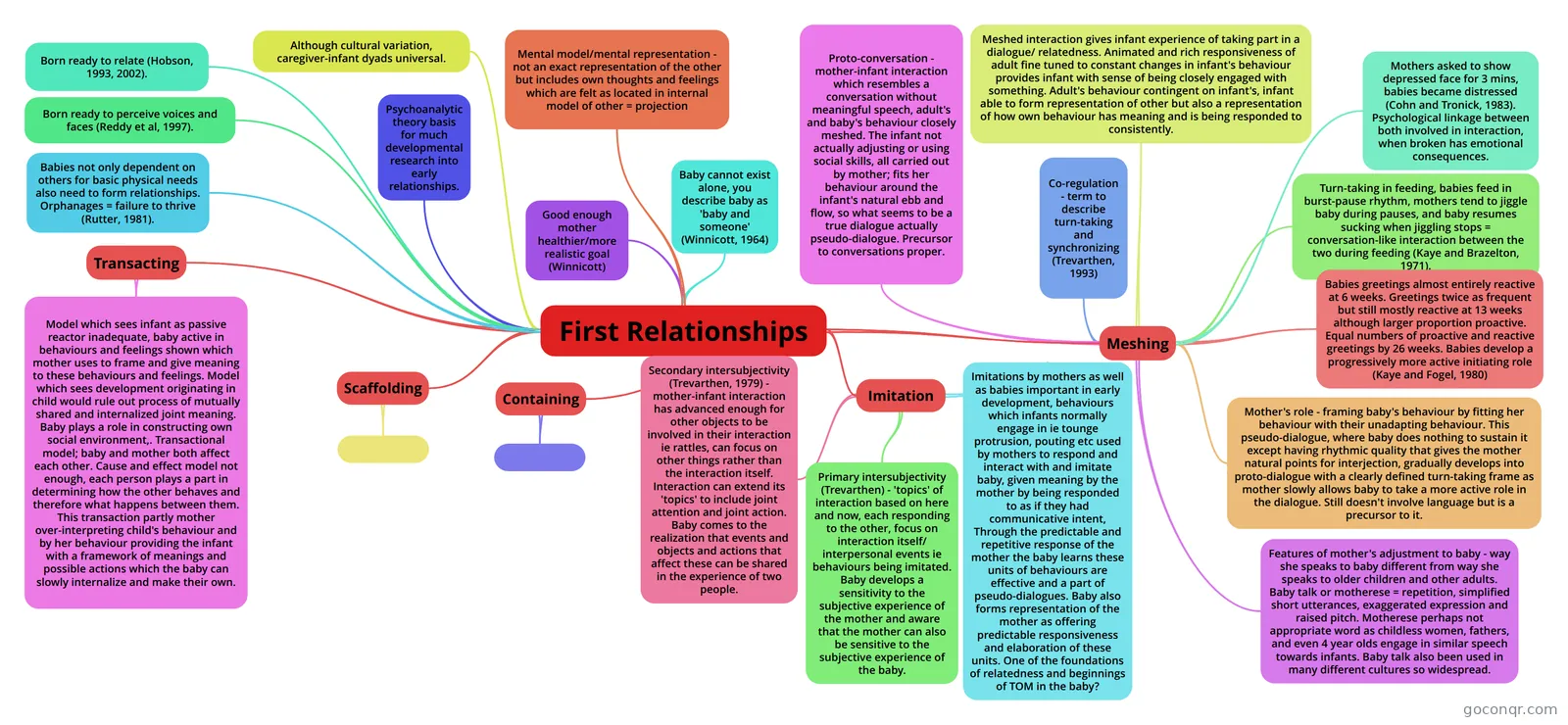
Mind map: First relationships in infant development
Inhalt der Mindmap
First Relationships
Babies not only dependent on others for basic physical needs also need to form relationships. Orphanages = failure to thrive (Rutter, 1981).
Born ready to perceive voices and faces (Reddy et al, 1997).
Born ready to relate (Hobson, 1993, 2002).
Although cultural variation, caregiver-infant dyads universal.
Psychoanalytic theory basis for much developmental research into early relationships.
Mental model/mental representation - not an exact representation of the other but includes own thoughts and feelings which are felt as located in internal model of other = projection
Baby cannot exist alone, you describe baby as 'baby and someone' (Winnicott, 1964)
Good enough mother healthier/more realistic goal (Winnicott)
Meshing
- Proto-conversation - mother-infant interaction which resembles a conversation without meaningful speech, adult's and baby's behaviour closely meshed. The infant not actually adjusting or using social skills, all carried out by mother; fits her behaviour around the infant's natural ebb and flow, so what seems to be a true dialogue actually pseudo-dialogue. Precursor to conversations proper.
- Meshed interaction gives infant experience of taking part in a dialogue/ relatedness. Animated and rich responsiveness of adult fine tuned to constant changes in infant's behaviour provides infant with sense of being closely engaged with something. Adult's behaviour contingent on infant's, infant able to form representation of other but also a representation of how own behaviour has meaning and is being responded to consistently.
- Co-regulation - term to describe turn-taking and synchronizing (Trevarthen, 1993)
- Mothers asked to show depressed face for 3 mins, babies became distressed (Cohn and Tronick, 1983). Psychological linkage between both involved in interaction, when broken has emotional consequences.
- Turn-taking in feeding, babies feed in burst-pause rhythm, mothers tend to jiggle baby during pauses, and baby resumes sucking when jiggling stops = conversation-like interaction between the two during feeding (Kaye and Brazelton, 1971).
- Babies greetings almost entirely reactive at 6 weeks. Greetings twice as frequent but still mostly reactive at 13 weeks although larger proportion proactive. Equal numbers of proactive and reactive greetings by 26 weeks. Babies develop a progressively more active initiating role (Kaye and Fogel, 1980)
- Mother's role - framing baby's behaviour by fitting her behaviour with their unadapting behaviour. This pseudo-dialogue, where baby does nothing to sustain it except having rhythmic quality that gives the mother natural points for interjection, gradually develops into proto-dialogue with a clearly defined turn-taking frame as mother slowly allows baby to take a more active role in the dialogue. Still doesn't involve language but is a precursor to it.
- Features of mother's adjustment to baby - way she speaks to baby different from way she speaks to older children and other adults. Baby talk or motherese = repetition, simplified short utterances, exaggerated expression and raised pitch. Motherese perhaps not appropriate word as childless women, fathers, and even 4 year olds engage in similar speech towards infants. Baby talk also been used in many different cultures so widespread.
Imitation
- Imitations by mothers as well as babies important in early development, behaviours which infants normally engage in ie tounge protrusion, pouting etc used by mothers to respond and interact with and imitate baby, given meaning by the mother by being responded to as if they had communicative intent, Through the predictable and repetitive response of the mother the baby learns these units of behaviours are effective and a part of pseudo-dialogues. Baby also forms representation of the mother as offering predictable responsiveness and elaboration of these units. One of the foundations of relatedness and beginnings of TOM in the baby?
- Primary intersubjectivity (Trevarthen) - 'topics' of interaction based on here and now, each responding to the other, focus on interaction itself/ interpersonal events ie behaviours being imitated. Baby develops a sensitivity to the subjective experience of the mother and aware that the mother can also be sensitive to the subjective experience of the baby.
- Secondary intersubjectivity (Trevarthen, 1979) - mother-infant interaction has advanced enough for other objects to be involved in their interaction ie rattles, can focus on other things rather than the interaction itself. Interaction can extend its 'topics' to include joint attention and joint action. Baby comes to the realization that events and objects and actions that affect these can be shared in the experience of two people.
Scaffolding
Containing
Transacting
- Model which sees infant as passive reactor inadequate, baby active in behaviours and feelings shown which mother uses to frame and give meaning to these behaviours and feelings. Model which sees development originating in child would rule out process of mutually shared and internalized joint meaning. Baby plays a role in constructing own social environment,. Transactional model; baby and mother both affect each other. Cause and effect model not enough, each person plays a part in determining how the other behaves and therefore what happens between them. This transaction partly mother over-interpreting child's behaviour and by her behaviour providing the infant with a framework of meanings and possible actions which the baby can slowly internalize and make their own.
Informationen
- Beschreibung
- Mindmap am First Relationships, erstellt von Cariad57 am 06/10/2013.
- Erstellt von
- Cariad57
- Aufrufe
- 17
- Verlauf
-
- Erstellt von Cariad57 · 6 Okt 2013
- Kopiert von Cariad57 · 6 Okt 2013
- Bewertung