
Attachment
248 resources created by 152 users
This Attachment page on GoConqr gathers community-made quizzes, mind maps, flashcards and notes, from Bowlby's theory and the learning theory to the Strange Situation and the Romanian orphan studies. It's built for school students revising for A-level or GCSE Psychology, and for teachers after ready-made material. There are over 1,900 resources here, including more than 80 quizzes, over 1,200 mind maps and over 500 flashcards, made by more than 900 contributors. Pick a topic, try a quiz to find your gaps, then make your own revision aids.
Top Attachment resources
-
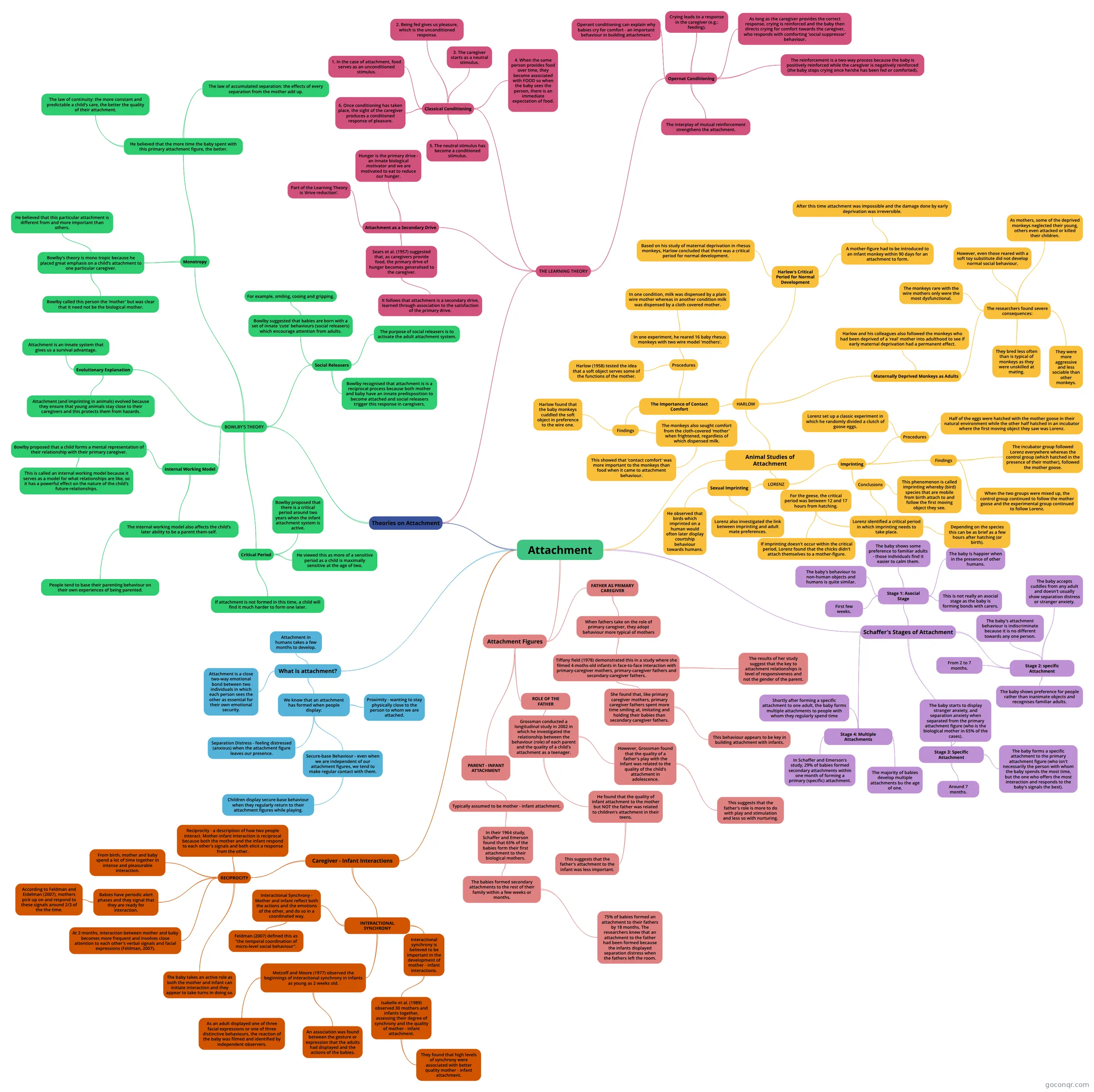 Mind map Attachment This is the third topic from the first paper of AS AQA Psychology (new specification).
-
61 cardsPsychology: Attachment What is attachment?
-
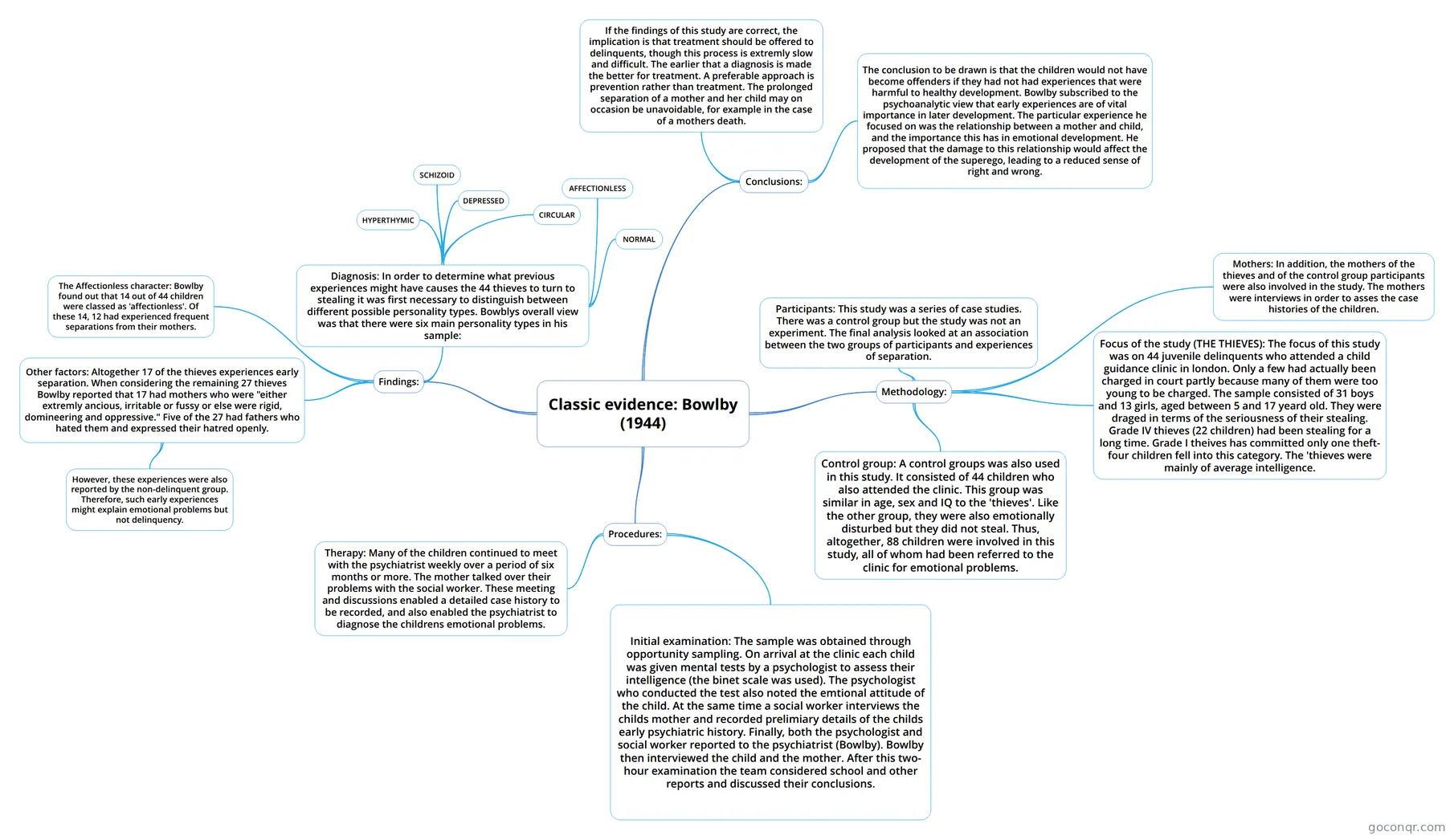 Mind map Classic evidence: Bowlby (1944)
-
 Mind map Takahashi (1990): Cross-cultural variations
-
Mind map van IJzendoorn and Kroonenberg (1988): Cross-cultural variations
-
Mind map Attachment
-
13 questionsPSYA1 - attachment, AQA psychology The learning theory states that:
-
9 cardsattachment ;)
Quizzes
See all 19 quizzes-
13 questionsPSYA1 - attachment, AQA psychology The learning theory states that:
-
12 questionsBowlby's Evolutionary theory of Attachment John Bowlby is a Behavioural Psychologist
-
12 questionsSchaffer and Emerson & Ainsworth Schaffer and Emerson (1964) studied 60 babies from?
-
6 questionsAttachment - Psychology Which two researchers conducted an experiment on the development of attachment
-
4 questionsThe role of the father in psychology
-
3 questionsAttachment Revision: ERA - Effects of Institutionalisation
-
12 questionsThe strange situation What kind of experiment was this
-
3 questionsPsychology - Attachment What was Guiton's 1966 Experiment?
Mind maps
See all 123 mind maps-
Attachment This is the third topic from the first paper of AS AQA Psychology (new specification).
-
Classic evidence: Bowlby (1944)
-
Takahashi (1990): Cross-cultural variations
-
van IJzendoorn and Kroonenberg (1988): Cross-cultural variations
-
Attachment
-
Mary Ainsworth et al (1978) Types of attachment
-
Mary Ainsworth(1978)-The Strange Situation
-
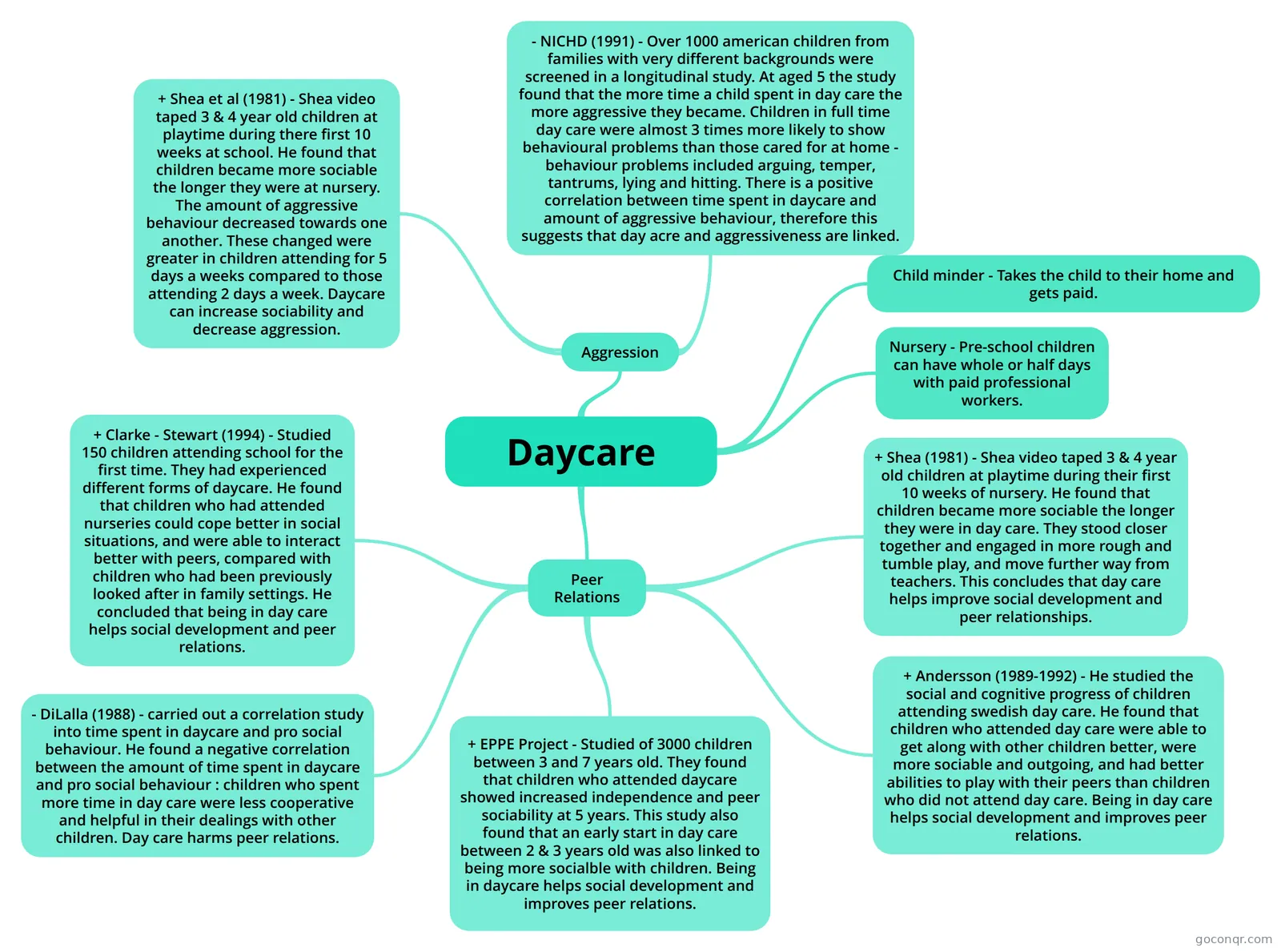 Daycare
Flashcards
See all 74 flashcards-
61 cardsPsychology: Attachment What is attachment?
-
9 cardsattachment ;)
-
16 cardsA-level psychology Attachment
-
19 cardsAttachment keywords Define attachment (Schaffer 1996)
-
20 cardsClassic Research: Bowlby 1944 Methodology & Procedures with Conclusions Bowlby 1944 Methodology
-
11 cardsEvaluation of Bowlby's theory of attachment Evaluation point 1 for John Bowlby's theory for attachment
-
15 cardsAnimal studies of attachment What two psychologists did animal studies to measure attachment?
-
10 cardsCultural variations in attachment How many studies did Van ijzendoorn use?
Flowcharts
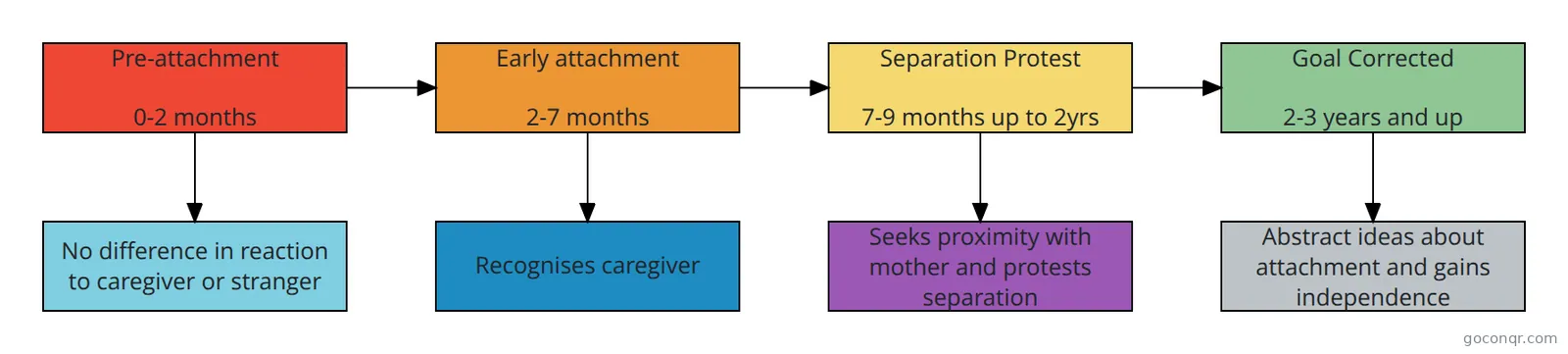
Notes
See all 24 notes-
Attachment 16-marker Plans (AQA A Level Psychology) Caregiver-infant interactions Outline Social interactions between a caregiver and infant affects the development of the attachment Reciprocity From birth: babies and caregiver spend time having intense ple...
-
Outline the learning theory explanation of attachment (6 marks) AO1 Only Learning theory, which is also known as behaviourist theory, suggests that attachment is a by-product of feeding infants and that behaviour is not innate but learned. This learning can be an outcome of an ass...
-
Bowlby (1944) Forty-four juvenile thieves: their characters and home-life. Bowlby (1944) Forty-four juvenile thieves: their characters and home-life.Example exam questions: Describe the methodology and procedures [of the study] (10 marks) Describe the findings + conclusions [of the study] (1...
-
Cultural Variations of Attachment Ijzendoorn and Kroonenberg: They conducted a study to look at the proportions of secure, insecure-resistant and insecure-avoidant attachments across a range of countries. They also looked at the differences within the...
-
Outline and Evaluate the Learning Theory as an Explanation for Attachment Outline and Evaluate the Learning Theory of Attachment The learning theory, firstly proposed by Dolland Miller (1950) argues that attachment is a form of nurture and so is learnt. Behaviourists came up with the idea t...
-
Outline and evaluate the learning theory of attachment (12 marks) Outline and Evaluate the learning theory of attachment (12 marks)The learning theory of attachment suggests that attachment is learnt. This can happen through classical conditioning or operant conditioning. In classic...
-
Attachment- Researchers (AQA A Level Psychology) The following table is comprised of the Attachment topics (caregiver interactions, attachment figures, stages of attachment, animal studies, the learning theory, Bowlby's theory for attachment, the Strange Situation, ...
-
Attachment - PSYA1 ATTACHMENT 1. Outline Bowlby’s theory of attachment Bowlby suggests that attachment is innate and caregiving traits are passed down through evolution. Children give out ‘social releasers’ such as smiling, crying and l...
Slides
More Psychology topics
About Attachment
GoConqr OriginalWhat the resources cover
This unit sits in Developmental Psychology, part of Psychology. The listed material follows the shape of an AQA attachment topic. You will find caregiver-infant interactions, Schaffer's stages of attachment, animal studies, explanations of attachment, Ainsworth's work, cultural variations, and the effects of institutionalisation.
- Theories: mind maps on Bowlby's theory, the learning theory, and Dollard and Miller, plus notes on the evolutionary theory.
- Classic studies: maps on Harlow, Lorenz, and Schaffer and Emerson's Glasgow study, and the flashcards on Bowlby 1944.
- Later research: maps on Hodges and Tizard, and on the role of the father.
Where to start
Begin with a broad overview. The mind map called Attachment defines the term as a close two-way emotional bond. Then open the flashcard deck Attachment keywords to fix the vocabulary.
- Work through Bowlby's theory and the learning theory.
- Move to Schaffer and Emerson, then Ainsworth and the Strange Situation.
- Finish with cultural variations, deprivation and institutionalisation.
Cross-cultural variations
Two maps help here. One covers Takahashi (1990) and asks whether the Strange Situation suits Japanese children. The other covers van IJzendoorn and Kroonenberg (1988), a meta-analysis of 32 studies from 8 countries. Read them side by side, then compare their evaluation points.
Using quizzes and maps together
Read a map first, then test yourself. The quiz Schaffer and Emerson & Ainsworth checks details such as the Glasgow babies. The quiz The strange situation does the same for Ainsworth. Where you lose marks, go back to the map and note the gap.
Practising longer answers
For extended writing, look at the notes on outlining the learning theory for 6 marks, and the 12-mark evaluation notes. The 16-marker plans for AQA A Level Psychology show how to structure an essay. Teachers can use these as ready-made starting points for class. Choose one subtopic today and try its quiz.
Frequently asked questions
Which resource should I open first?
Start with the mind map called Attachment, which defines attachment as a close two-way emotional bond. Then try the flashcard deck Attachment keywords for the terms. Once those feel familiar, move on to the mind maps on Bowlby's theory and Schaffer's stages of attachment.
Which exams do these resources suit?
The listed resources mention A-level Psychology, GCSE Psychology, AQA Psychology and AQA A-level Psychology. Most of the material is aimed at school students, with a small share at university level. Check your own specification, as resources were made by different contributors.
What do the mind maps cover?
They cover Bowlby's theory and maternal deprivation, the learning theory, Ainsworth's Strange Situation, Harlow's monkeys, Lorenz, and Hodges and Tizard. There are also maps on cultural variations, including Takahashi (1990) and van IJzendoorn and Kroonenberg (1988), plus daycare and the role of the father.
Are there quizzes for exam-style practice?
Yes. The page lists more than 80 quizzes, including PSYA1 - attachment, AQA psychology, which has mark-based questions. There are also quizzes on Bowlby's evolutionary theory, learning theory, the strange situation and the effects of institutionalisation. Notes with 6-mark and 12-mark plans support longer answers.
Are these resources free, and who made them?
Every resource listed here is free to open, study and take, with no account needed. They were made by GoConqr users, not by GoConqr itself. A free account saves your quiz scores and lets you make your own quizzes, mind maps, flashcards and notes.
What if I can't find the topic I need?
Look at related titles first. For example, the flashcards on Romanian orphan studies and the notes on privation and institutionalisation both touch on early deprivation. If a gap remains, you could build your own flashcards or a mind map and fill it yourself.