
Mindmap
Neoplasia
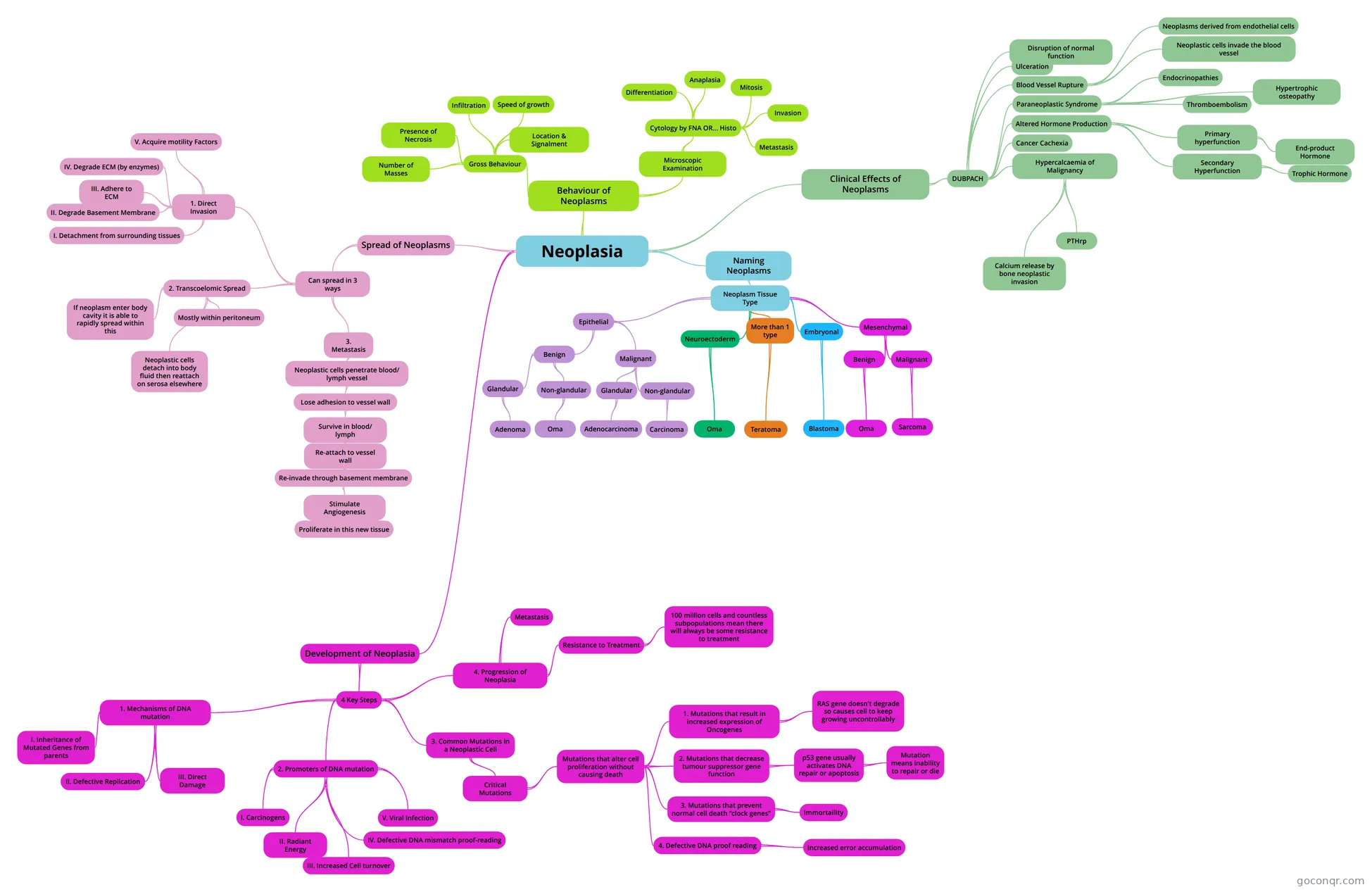
Mind map: Neoplasia
Inhalt der Mindmap
Neoplasia
Naming Neoplasms
- Neoplasm Tissue Type
- Epithelial
- Benign
- Glandular
- Adenoma
- Non-glandular
- Oma
- Glandular
- Malignant
- Glandular
- Adenocarcinoma
- Non-glandular
- Carcinoma
- Glandular
- Benign
- Neuroectoderm
- Oma
- More than 1 type
- Teratoma
- Embryonal
- Blastoma
- Mesenchymal
- Benign
- Oma
- Malignant
- Sarcoma
- Benign
- Epithelial
- Neoplasm Tissue Type
Behaviour of Neoplasms
- Gross Behaviour
- Location & Signalment
- Presence of Necrosis
- Infiltration
- Speed of growth
- Number of Masses
- Microscopic Examination
- Cytology by FNA OR... Histo
- Differentiation
- Anaplasia
- Mitosis
- Invasion
- Metastasis
- Cytology by FNA OR... Histo
- Gross Behaviour
Spread of Neoplasms
- Can spread in 3 ways
- 1. Direct Invasion
- I. Detachment from surrounding tissues
- II. Degrade Basement Membrane
- III. Adhere to ECM
- IV. Degrade ECM (by enzymes)
- V. Acquire motility Factors
- 2. Transcoelomic Spread
- If neoplasm enter body cavity it is able to rapidly spread within this
- Neoplastic cells detach into body fluid then reattach on serosa elsewhere
- Mostly within peritoneum
- 3. Metastasis
- Neoplastic cells penetrate blood/ lymph vessel
- Lose adhesion to vessel wall
- Survive in blood/ lymph
- Re-attach to vessel wall
- Re-invade through basement membrane
- Stimulate Angiogenesis
- Proliferate in this new tissue
- Stimulate Angiogenesis
- Re-invade through basement membrane
- Re-attach to vessel wall
- Survive in blood/ lymph
- Lose adhesion to vessel wall
- Neoplastic cells penetrate blood/ lymph vessel
- 1. Direct Invasion
- Can spread in 3 ways
Clinical Effects of Neoplasms
- DUBPACH
- Disruption of normal function
- Ulceration
- Blood Vessel Rupture
- Neoplasms derived from endothelial cells
- Neoplastic cells invade the blood vessel
- Altered Hormone Production
- Primary hyperfunction
- End-product Hormone
- Secondary Hyperfunction
- Trophic Hormone
- Primary hyperfunction
- Cancer Cachexia
- Paraneoplastic Syndrome
- Endocrinopathies
- Hypertrophic osteopathy
- Thromboembolism
- Hypercalcaemia of Malignancy
- PTHrp
- Calcium release by bone neoplastic invasion
- DUBPACH
Development of Neoplasia
- 4 Key Steps
- 1. Mechanisms of DNA mutation
- I. Inheritance of Mutated Genes from parents
- II. Defective Replication
- III. Direct Damage
- 2. Promoters of DNA mutation
- I. Carcinogens
- II. Radiant Energy
- III. Increased Cell turnover
- IV. Defective DNA mismatch proof-reading
- V. Viral Infection
- 3. Common Mutations in a Neoplastic Cell
- Critical Mutations
- Mutations that alter cell proliferation without causing death
- 1. Mutations that result in increased expression of Oncogenes
- RAS gene doesn't degrade so causes cell to keep growing uncontrollably
- 2. Mutations that decrease tumour suppressor gene function
- p53 gene usually activates DNA repair or apoptosis
- Mutation means inability to repair or die
- p53 gene usually activates DNA repair or apoptosis
- 3. Mutations that prevent normal cell death "clock genes"
- Immortaility
- 4. Defective DNA proof reading
- Increased error accumulation
- 1. Mutations that result in increased expression of Oncogenes
- Mutations that alter cell proliferation without causing death
- Critical Mutations
- 4. Progression of Neoplasia
- Metastasis
- Resistance to Treatment
- 100 million cells and countless subpopulations mean there will always be some resistance to treatment
- 1. Mechanisms of DNA mutation
- 4 Key Steps
Informationen
- Beschreibung
- Mindmap am Neoplasia, erstellt von jemmaguyton am 04/05/2015.
- Erstellt von
- jemmaguyton
- Aufrufe
- 3
- Bewertung