
Mindmap
MODALS VERBS
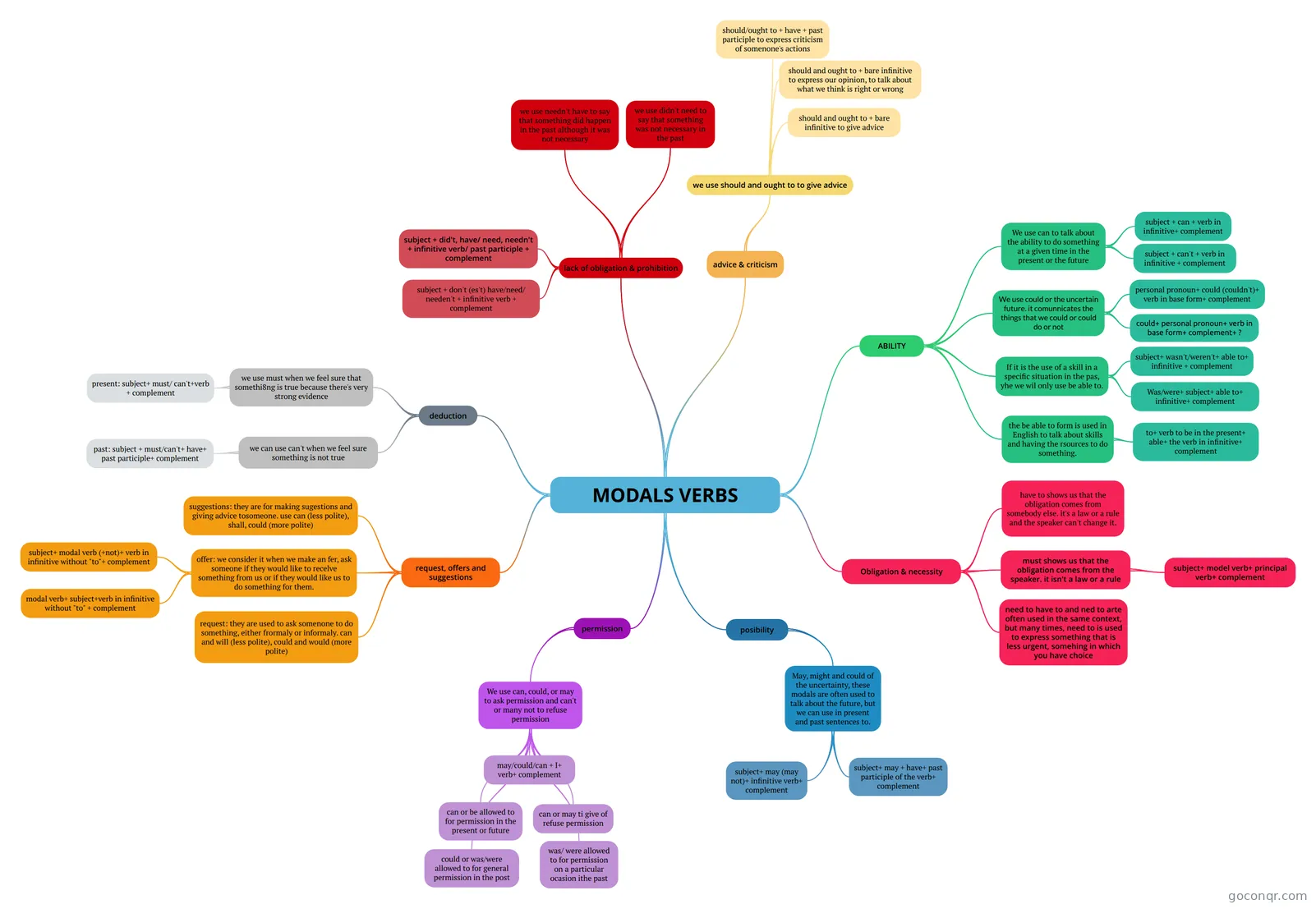
Mind map: modal verbs
Inhalt der Mindmap
MODALS VERBS
Obligation & necessity
- have to shows us that the obligation comes from somebody else. it's a law or a rule and the speaker can't change it.
- must shows us that the obligation comes from the speaker. it isn't a law or a rule
- subject+ model verb+ principal verb+ complement
- need to have to and ned to arte often used in the same context, but many times, need to is used to express something that is less urgent, somehing in which you have choice
deduction
- we use must when we feel sure that somethi8ng is true because there's very strong evidence
- present: subject+ must/ can't+verb + complement
- we can use can't when we feel sure something is not true
- past: subject + must/can't+ have+ past participle+ complement
- we use must when we feel sure that somethi8ng is true because there's very strong evidence
permission
- We use can, could, or may to ask permission and can't or many not to refuse permission
- can or may ti give of refuse permission
- could or was/were allowed to for general permission in the post
- can or be allowed to for permission in the present or future
- was/ were allowed to for permission on a particular ocasion ithe past
- may/could/can + I+ verb+ complement
- We use can, could, or may to ask permission and can't or many not to refuse permission
posibility
- May, might and could of the uncertainty, these modals are often used to talk about the future, but we can use in present and past sentences to.
- subject+ may + have+ past participle of the verb+ complement
- subject+ may (may not)+ infinitive verb+ complement
- May, might and could of the uncertainty, these modals are often used to talk about the future, but we can use in present and past sentences to.
advice & criticism
- we use should and ought to to give advice
- should and ought to + bare infinitive to give advice
- should and ought to + bare infinitive to express our opinion, to talk about what we think is right or wrong
- should/ought to + have + past participle to express criticism of somenone's actions
- we use should and ought to to give advice
lack of obligation & prohibition
- subject + don't (es't) have/need/ needen't + infinitive verb + complement
- subject + did't, have/ need, needn't + infinitive verb/ past participle + complement
- we use needn't have to say that something did happen in the past although it was not necessary
- we use didn't need to say that something was not necessary in the past
ABILITY
- We use could or the uncertain future. it comunnicates the things that we could or could do or not
- personal pronoun+ could (couldn't)+ verb in base form+ complement
- could+ personal pronoun+ verb in base form+ complement+ ?
- If it is the use of a skill in a specific situation in the pas, yhe we wil only use be able to.
- subject+ wasn't/weren't+ able to+ infinitive + complement
- Was/were+ subject+ able to+ infinitive+ complement
- the be able to form is used in English to talk about skills and having the rsources to do something.
- to+ verb to be in the present+ able+ the verb in infinitive+ complement
- We use can to talk about the ability to do something at a given time in the present or the future
- subject + can + verb in infinitive+ complement
- subject + can't + verb in infinitive + complement
- We use could or the uncertain future. it comunnicates the things that we could or could do or not
request, offers and suggestions
- offer: we consider it when we make an fer, ask someone if they would like to recelve something from us or if they would like us to do something for them.
- subject+ modal verb (+not)+ verb in infinitive without "to"+ complement
- modal verb+ subject+verb in infinitive without "to" + complement
- suggestions: they are for making sugestions and giving advice tosomeone. use can (less polite), shall, could (more polite)
- request: they are used to ask somenone to do something, either frormaly or informaly. can and will (less polite), could and would (more polite)
- offer: we consider it when we make an fer, ask someone if they would like to recelve something from us or if they would like us to do something for them.