
Modal Verbs
262 resources created by 220 users
This Modal Verbs page on GoConqr gathers community-made mind maps, quizzes, flashcards, slides and notes, from ability with can and could to obligation, advice and modals of deduction. It's built for school students practising modal verbs, and for teachers after ready-made material. There are over 2,900 resources here, including more than 200 quizzes, more than 2,200 mind maps and more than 200 flashcards, and most are pitched at secondary level. Try a quiz to find your gaps, then pick a mind map to revisit what tripped you up.
Top Modal Verbs resources
-
40 questionsquick test 4 (intermediate) interactive quiz
-
5 questionsIngles-examen final- Read the text and and decide if the statements are true or false. THE DEADLINE Maggie: Hi Tom, have you fin...
-
15 questionsSafety What sign number matches the following text: ALL VISITORS MUST WEAR A SAFETY HELMET Please report to recept...
-
20 questionsSpeculating about the past: possibility or certainty? Perfect modal verbs practice
-
22 questionsdrawing conclussions with must
-
Mind map MODAL VERBS
-
12 cardsSpeaking - Giving advice I have a job interview in English next week. I really want the job. How should I prepare?
-
Mind map MODALS OF DEDUCTION We use modal verbs to say how sure we are about something.
Quizzes
See all 74 quizzes-
40 questionsquick test 4 (intermediate) interactive quiz
-
5 questionsIngles-examen final- Read the text and and decide if the statements are true or false. THE DEADLINE Maggie: Hi Tom, have you fin...
-
15 questionsSafety What sign number matches the following text: ALL VISITORS MUST WEAR A SAFETY HELMET Please report to recept...
-
20 questionsSpeculating about the past: possibility or certainty? Perfect modal verbs practice
-
22 questionsdrawing conclussions with must
-
15 questionsModals of deduction Practice the use of modals to express deduction.
-
15 questionsModal verbs quiz for A2 students (Item number 1-5) For each question, choose the right answer to correct the sentences. (Item number 6-10) F...
-
20 questionsModal verbs Jonathan ski really well and he often wins his races.
Mind maps
See all 112 mind maps-
MODAL VERBS
-
MODALS OF DEDUCTION We use modal verbs to say how sure we are about something.
-
Modals & semi-modals Expressing asking for a permission , offers, making requests, suggestions , expressing ability , obligation...
-
MODALS OF DEDUCTION We use modal verbs to say how sure we are about something.
-
Must - Have to - Need Obligation - necessity - prohibition
-
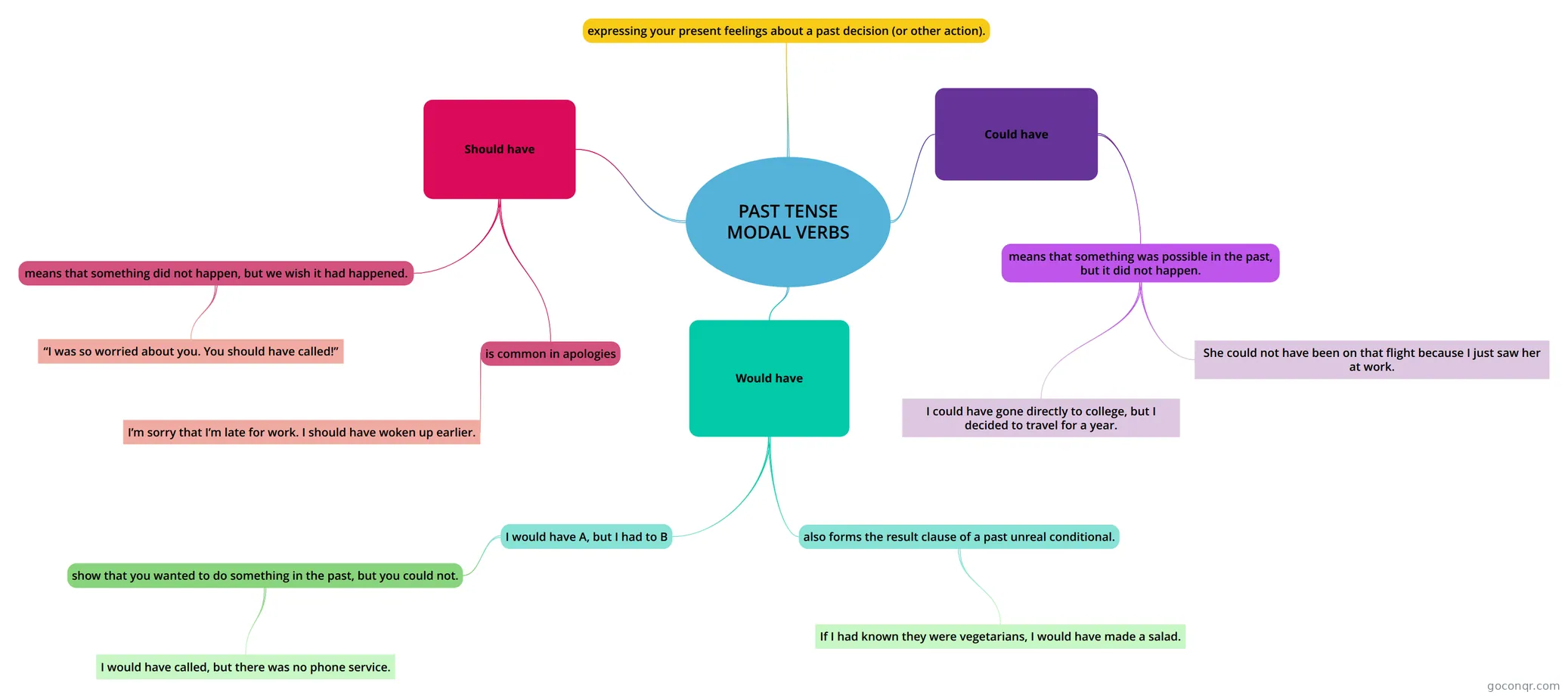 PAST TENSE MODAL VERBS
-
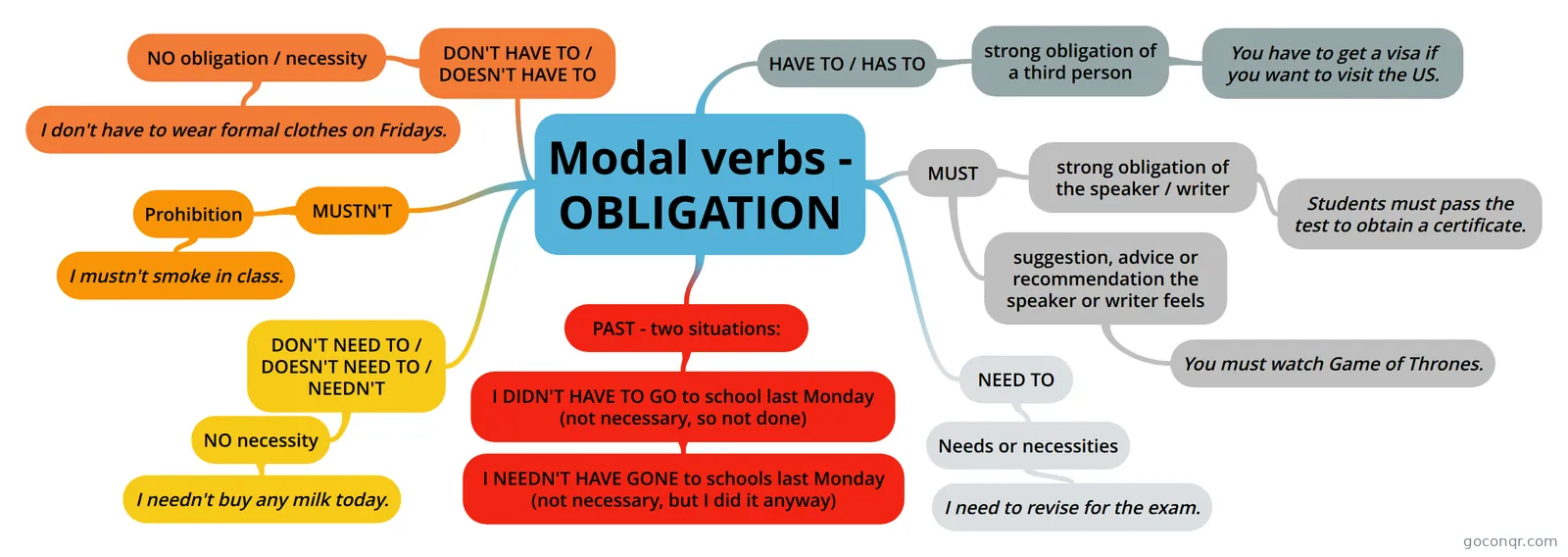 Modal verbs - OBLIGATION Unit 1 FCE Masterclass 2015
-
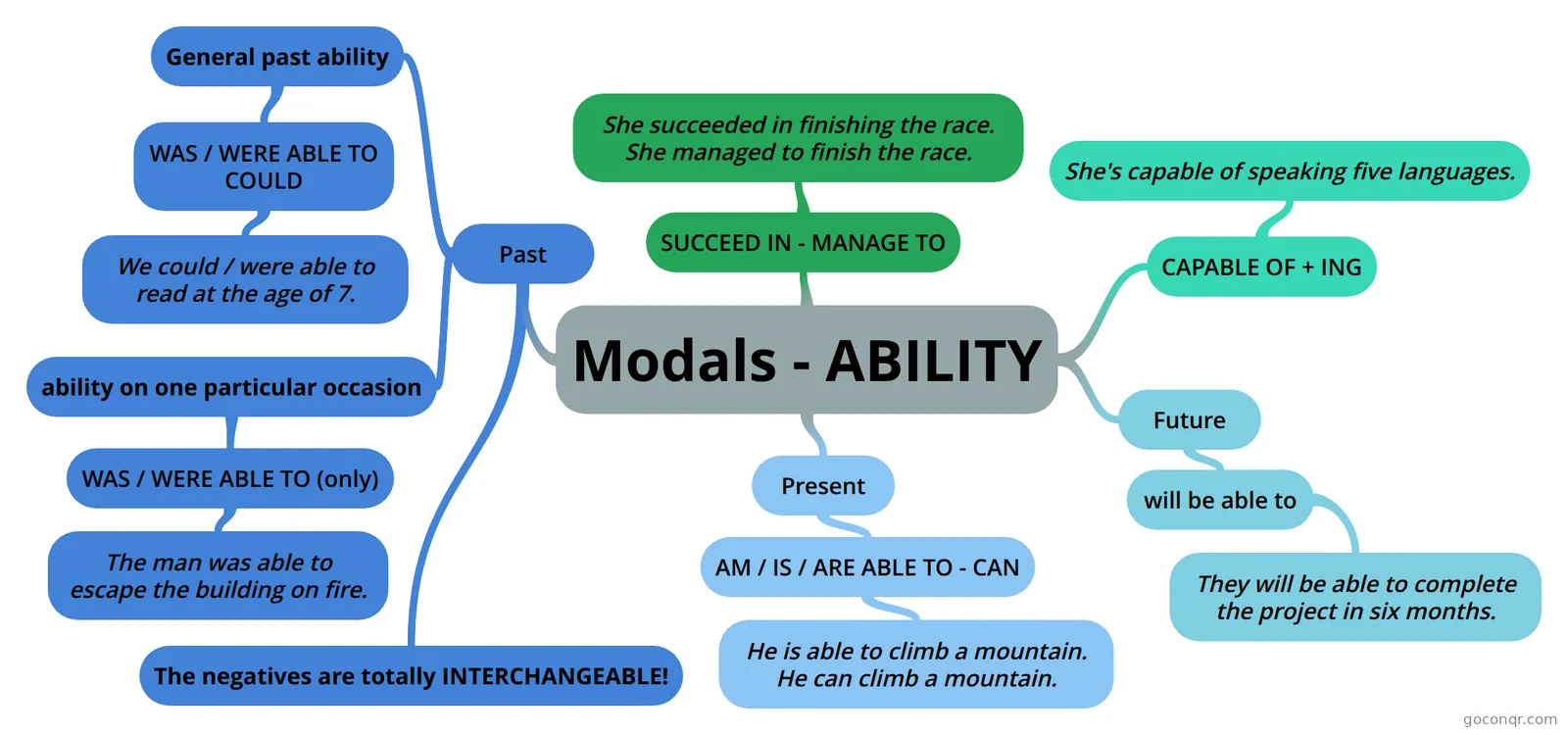 Modals - ABILITY Unit 2 FCE Masterclass 2015
Flashcards
See all 59 flashcards-
12 cardsSpeaking - Giving advice I have a job interview in English next week. I really want the job. How should I prepare?
-
9 cardsModals of Polite Requests A modal is a type of auxiliary (helping) verb that is used to express: ability, possibility, permission, re...
-
10 cardsMODAL VERBS EXERCISE lesson plan, practice.
-
15 cardsActivity to Practice sentences with CAN and CAN'T This is an activity to practice Yes/No Questions with CAN.
-
10 cardsModal Verbs of probability WHAT CAN MODAL VERBS OF PROBABILITY EXPRESS? OR BEEN USED FOR?
-
5 cardsModal verbs of probability Modal auxiliary verbs can express: ability, obligation, permission, request, probability or how certain a s...
-
17 cardsModals and similar expressions Types of modals and their uses
-
10 cardsActivity to practice Modals of Possibility MODALS OF POSSIBILITY
Flowcharts
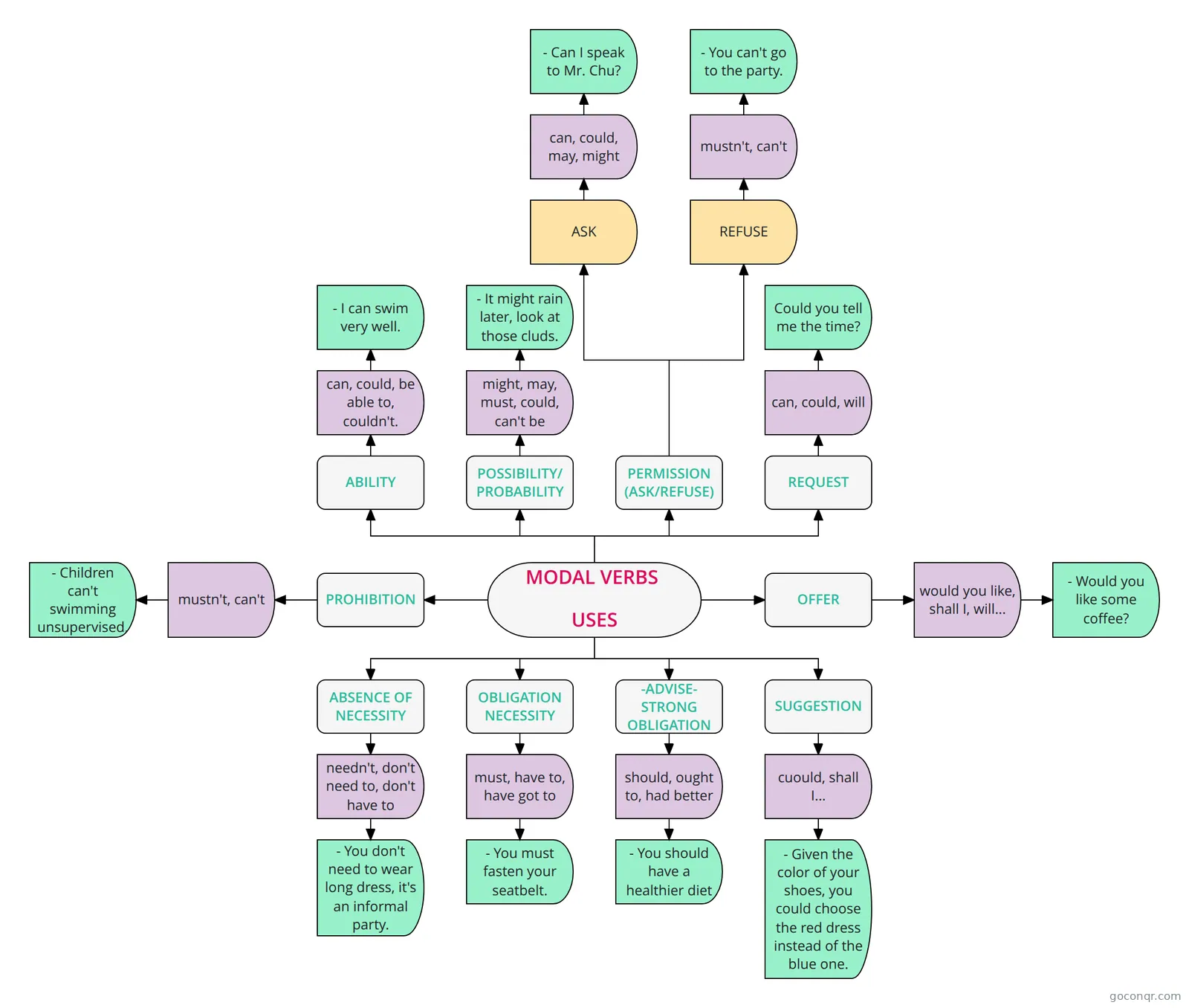
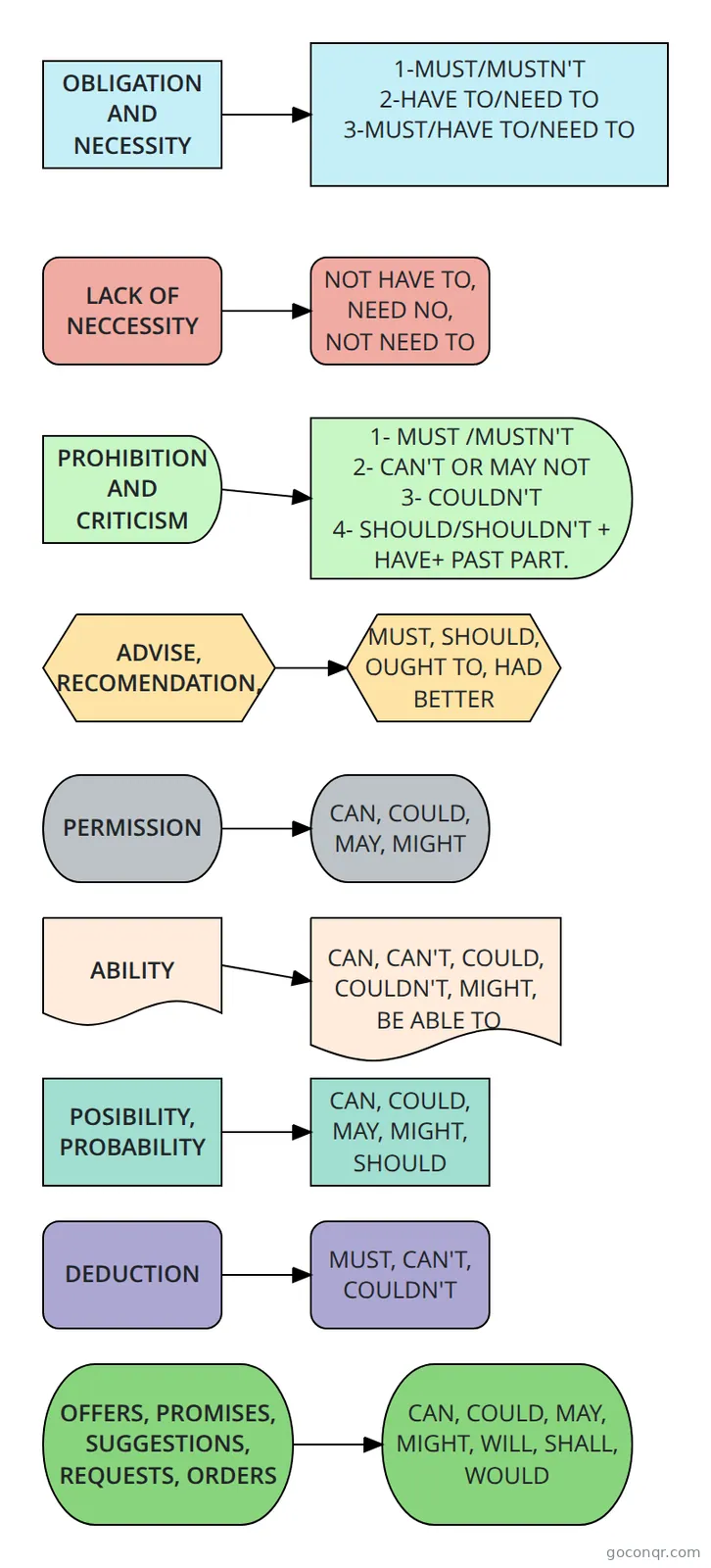
Notes
-
SHOULD / SHOULDN'T GIVING ADVICE WE USE SHOULD AND SHOULDN'TYou should means something like I think it is a good idea for you to do it. You should sleep 8 hours everydayYou shouldn't means something like I think it is a bad idea for you...
-
Can and Could Possibility We use the modal can to make general statements about what is possible:It can be very cold in winter. (= It is sometimes very cold in winter)You can easily lose ...
-
might - may might - may Might and may are used mainly to talk about possibility. They can also be used to make a request, to ask permission, or to make a suggestion. When might and may are used with the same meanin...
-
Modals of Permission, Obligation, Prohibition
-
Can / Could
Slides
More English language topics
About Modal Verbs
GoConqr OriginalWhat the page covers
The resources here deal with the main jobs that modal verbs do. The mind map MODAL VERBS opens with ability, using can, be able to and could, and sets out the pattern of subject, modal verb, verb and complement. Other resources move on to obligation, advice with should and shouldn't, possibility with may and might, and perfect modals for speculating about the past.
A large share of the page is about deduction. Several mind maps called MODALS OF DEDUCTION explain how modals show how sure we are about something. Must is used when the evidence is very strong, while might, may and could show less certainty, and can't shows we are sure something is not true.
Where to start
If modals are new to you, begin with the mind map MODAL VERBS and the flashcard deck Modals of Polite Requests. The deck explains that a modal is a helping verb, and that modal verbs are always followed by the base form. Then look at the slide set Modal Verbs: Ability and Possibility for a longer walk-through.
Using quizzes and maps together
Read a map first, then test yourself. After the ability map, try Exercises with Could and Couldn't, which asks you to choose between could and couldn't for past ability. For a mixed check, Modal verbs quiz for A2 students puts several modals into short dialogues. Whenever you get an answer wrong, go back to the matching map and read that section again.
- Ability: the maps and the can, could and be able to flashcards.
- Obligation: Modal Verbs: Obligation slides and the Must - Have to - Need map.
- Advice: Should / Shouldn't map and quizzes.
- Deduction: the deduction maps, then Modals of deduction quiz.
Where it fits
This unit sits in the strand Grammar: Verbs and Tenses, within English language. Most resources are written for secondary students, and some mention ESO or GCSE English, so they suit classroom practice and revision. Teachers can also pick slide sets and flashcard decks to use straight away.
Choose one topic, such as ability or deduction, and work through a map and a quiz. Then make your own flashcards from the sentences you found hardest.
Frequently asked questions
Which resource should I open first?
Start with the mind map MODAL VERBS, which introduces ability with can, be able to and could, and shows the basic sentence pattern. Then try the flashcard deck Modals of Polite Requests, which explains what a modal verb is and that it takes the base form.
What do the deduction mind maps cover?
The MODALS OF DEDUCTION maps explain how modal verbs show how sure you are about something. They cover must for strong evidence, plus might, may, could and can't. One version also separates present uses from past uses, with example sentences.
Are the resources free to use?
Yes. Every resource on this page is free to open, study and take, with no account needed. They were made by GoConqr users, not by GoConqr itself, so styles and difficulty vary from one resource to the next.
Which levels and exams do these resources suit?
Nearly all of them are aimed at secondary students. The listed resources mention ESO and GCSE English. There are a few at other levels, but this page is mainly useful for school students and their teachers.
Is there a quiz for practising past ability?
Yes. Exercises with Could and Couldn't is a quiz about ability and inability in the past, with gap-fill sentences. You can follow it with the quiz English training - can/could and be able to for more practice.
What if I can't find the topic I need?
Look through the other maps, flashcards and notes on the page, since topics such as should, may and might, and perfect modals have their own resources. With a free account you can also make your own quiz, mind map, flashcards or notes.