
Mindmap
Semantics
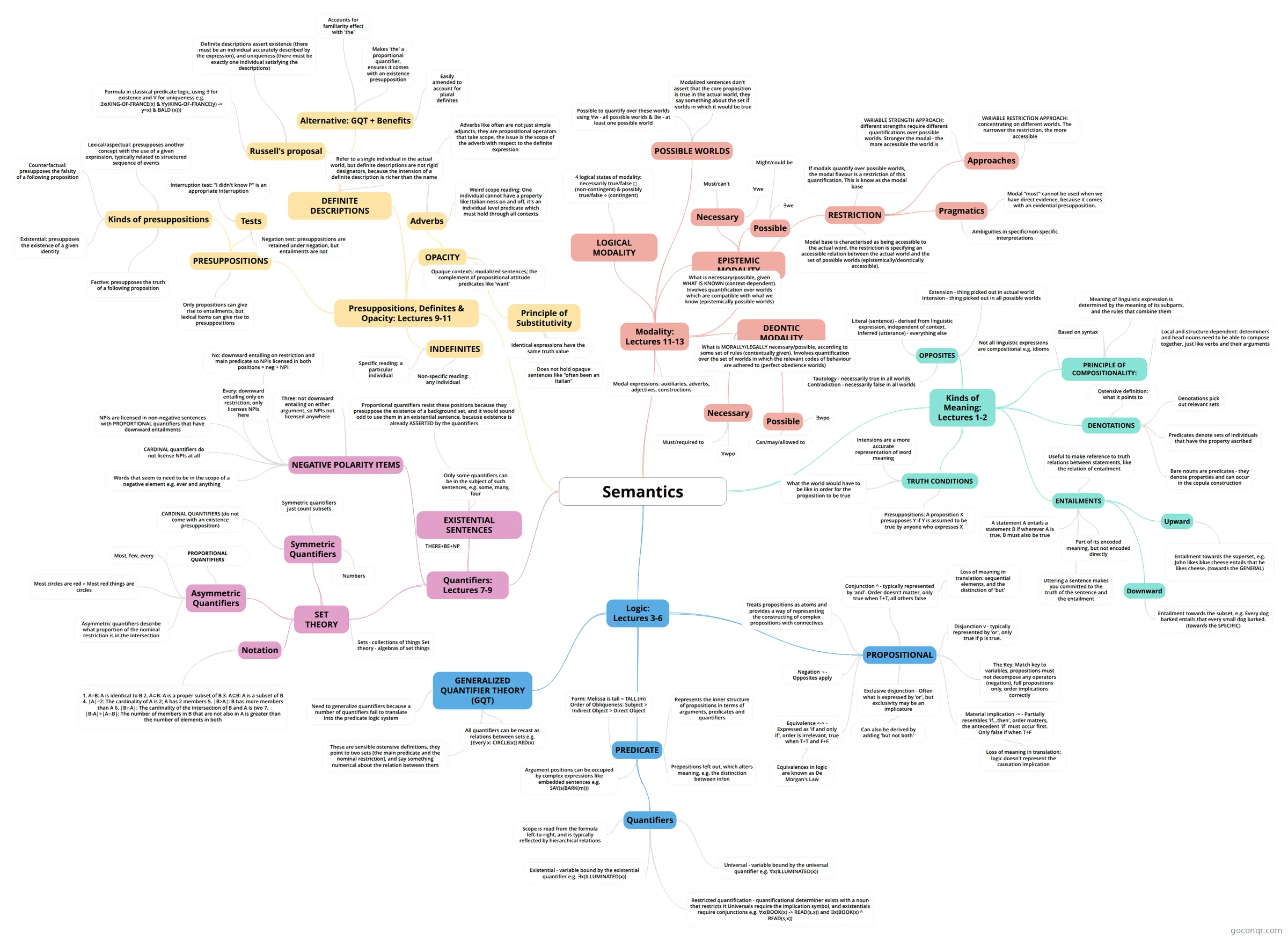
Mind map: Semantics
Inhalt der Mindmap
Semantics
Kinds of Meaning: Lectures 1-2
- PRINCIPLE OF COMPOSITIONALITY:
- Not all linguistic expressions are compositional e.g. idioms
- Local and structure-dependent: determiners and head nouns need to be able to compose together, just like verbs and their arguments
- Based on syntax
- Meaning of linguistic expression is determined by the meaning of its subparts, and the rules that combine them
- DENOTATIONS
- Ostensive definition: what it points to
- Denotations pick out relevant sets
- Bare nouns are predicates - they denote properties and can occur in the copula construction
- Predicates denote sets of individuals that have the property ascribed
- TRUTH CONDITIONS
- What the world would have to be like in order for the proposition to be true
- Intensions are a more accurate representation of word meaning
- Presuppositions: A proposition X presupposes Y if Y is assumed to be true by anyone who expresses X
- OPPOSITES
- Extension - thing picked out in actual world Intension - thing picked out in all possible worlds
- Literal (sentence) - derived from linguistic expression, independent of context. Inferred (utterance) - everything else
- Tautology - necessarily true in all worlds Contradiction - necessarily false in all worlds
- ENTAILMENTS
- Useful to make reference to truth relations between statements, like the relation of entailment
- Part of its encoded meaning, but not encoded directly
- Uttering a sentence makes you committed to the truth of the sentence and the entailment
- A statement A entails a statement B if wherever A is true, B must also be true
- Upward
- Entailment towards the superset, e.g. John likes blue cheese entails that he likes cheese. (towards the GENERAL)
- Downward
- Entailment towards the subset, e.g. Every dog barked entails that every small dog barked. (towards the SPECIFIC)
- PRINCIPLE OF COMPOSITIONALITY:
Logic: Lectures 3-6
- PROPOSITIONAL
- Treats propositions as atoms and provides a way of representing the constructing of complex propositions with connectives
- Conjunction ^ - typically represented by 'and'. Order doesn't matter, only true when T+T, all others false
- Loss of meaning in translation: sequential elements, and the distinction of 'but'
- Disjunction v - typically represented by 'or', only true if p is true.
- Negation ¬ - Opposites apply
- Material implication -> - Partially resembles 'if...then', order matters, the antecedent 'if' must occur first. Only false if when T+F
- Loss of meaning in translation: logic doesn't represent the causation implication
- Equivalence <-> - Expressed as 'if and only if', order is irrelevant, true when T+T and F+F
- Equivalences in logic are known as De Morgan's Law
- Exclusive disjunction - Often what is expressed by 'or', but exclusivity may be an implicature
- Can also be derived by adding 'but not both'
- The Key: Match key to variables, propositions must not decompose any operators (negation), full propositions only, order implications correctly
- PREDICATE
- Represents the inner structure of propositions in terms of arguments, predicates and quantifiers
- Form: Melissa is tall = TALL (m) Order of Obliqueness: Subject > Indirect Object > Direct Object
- Prepositions left out, which alters meaning, e.g. the distinction between in/on
- Quantifiers
- Universal - variable bound by the universal quantifier e.g. ∀x(ILLUMINATED(x))
- Existential - variable bound by the existential quantifier e.g. ∃x(ILLUMINATED(x))
- Scope is read from the formula left-to-right, and is typically reflected by hierarchical relations
- Restricted quantification - quantificational determiner exists with a noun that restricts it Universals require the implication symbol, and existentials require conjunctions e.g. ∀x(BOOK(x) -> READ(s,x)) and ∃x(BOOK(x) ^ READ(s,x))
- Argument positions can be occupied by complex expressions like embedded sentences e.g. SAY(s(BARK(m)))
- GENERALIZED QUANTIFIER THEORY (GQT)
- Need to generalize quantifiers because a number of quantifiers fail to translate into the predicate logic system
- All quantifiers can be recast as relations between sets e.g. [Every x: CIRCLE(x)] RED(x)
- These are sensible ostensive definitions, they point to two sets [the main predicate and the nominal restriction], and say something numerical about the relation between them
- PROPOSITIONAL
Quantifiers: Lectures 7-9
- SET THEORY
- Sets - collections of things Set theory - algebras of set things
- Notation
- 1. A=B: A is identical to B 2. A⊂B: A is a proper subset of B 3. A⊆B: A is a subset of B 4. |A|=2: The cardinality of A is 2; A has 2 members 5. |B>A|: B has more members than A 6. |B∩A|: The cardinality of the intersection of B and A is two 7. |B-A|>|A∩B|: The number of members in B that are not also in A is greater than the number of elements in both
- Asymmetric Quantifiers
- Most, few, every
- Asymmetric quantifiers describe what proportion of the nominal restriction is in the intersection
- Most circles are red ≠ Most red things are circles
- PROPORTIONAL QUANTIFIERS
- Symmetric Quantifiers
- Numbers
- Symmetric quantifiers just count subsets
- CARDINAL QUANTIFIERS (do not come with an existence presupposition)
- NEGATIVE POLARITY ITEMS
- Words that seem to need to be in the scope of a negative element e.g. ever and anything
- NPIs are licensed in non-negative sentences with PROPORTIONAL quantifiers that have downward entailments
- CARDINAL quantifiers do not license NPIs at all
- No: downward entailing on restriction and main predicate so NPIs licensed in both positions = neg + NPI
- Every: downward entailing only on restriction, only licenses NPIs here
- Three: not downward entailing on either argument, so NPIs not licensed anywhere
- EXISTENTIAL SENTENCES
- THERE+BE+NP
- Only some quantifiers can be in the subject of such sentences, e.g. some, many, four
- Proportional quantifiers resist these positions because they presuppose the existence of a background set, and it would sound odd to use them in an existential sentence, because existence is already ASSERTED by the quantifiers
- SET THEORY
Presuppositions, Definites & Opacity: Lectures 9-11
- PRESUPPOSITIONS
- Only propositions can give rise to entailments, but lexical items can give rise to presuppositions
- Tests
- Negation test: presuppositions are retained under negation, but entailments are not
- Interruption test: "I didn't know P" is an appropriate interruption
- Kinds of presuppositions
- Existential: presupposes the existence of a given identity
- Factive: presupposes the truth of a following proposition
- Counterfactual: presupposes the falsity of a following proposition
- Lexical/aspectual: presupposes another concept with the use of a given expression, typically related to structured sequence of events
- DEFINITE DESCRIPTIONS
- Refer to a single individual in the actual world, but definite descriptions are not rigid designators, because the intension of a definite description is richer than the name
- Russell's proposal
- Definite descriptions assert existence (there must be an individual accurately described by the expression), and uniqueness (there must be exactly one individual satisfying the descriptions)
- Formula in classical predicate logic, using ∃ for existence and ∀ for uniqueness e.g. ∃x(KING-OF-FRANCE(x) & ∀y(KING-OF-FRANCE(y) -> y=x) & BALD (x)))
- Alternative: GQT + Benefits
- Makes 'the' a proportional quantifier, ensures it comes with an existence presupposition
- Accounts for familiarity effect with 'the'
- Easily amended to account for plural definites
- OPACITY
- Principle of Substitutivity
- Identical expressions have the same truth value
- Does not hold opaque sentences like "often been an Italian"
- Opaque contexts: modalized sentences; the complement of propositional attitude predicates like 'want'
- Adverbs
- Adverbs like often are not just simple adjuncts, they are propositional operators that take scope, the issue is the scope of the adverb with respect to the definite expression
- Weird scope reading: One individual cannot have a property like Italian-ness on and off, it's an individual level predicate which must hold through all contexts
- Principle of Substitutivity
- INDEFINITES
- Specific reading: a particular individual
- Non-specific reading: any individual
- PRESUPPOSITIONS
Modality: Lectures 11-13
- Modal expressions: auxiliaries, adverbs, adjectives, constructions
- LOGICAL MODALITY
- 4 logical states of modality: necessarily true/false ◻ (non-contingent) & possibly true/false ⋄ (contingent)
- EPISTEMIC MODALITY
- What is necessary/possible, given WHAT IS KNOWN (context-dependent). Involves quantification over worlds which are compatible with what we know (epistemically possible worlds)
- Necessary
- Must/can't
- ∀we
- Possible
- Might/could be
- ∃we
- DEONTIC MODALITY
- What is MORALLY/LEGALLY necessary/possible, according to some set of rules (contextually given). Involves quantification over the set of worlds in which the relevant codes of behaviour are adhered to (perfect obedience worlds)
- Necessary
- Must/required to
- ∀wpo
- Possible
- Can/may/allowed to
- ∃wpo
- POSSIBLE WORLDS
- Modalized sentences don't assert that the core proposition is true in the actual world, they say something about the set if worlds in which it would be true
- Possible to quantify over these worlds using ∀w - all possible worlds & ∃w - at least one possible world
- RESTRICTION
- If modals quantify over possible worlds, the modal flavour is a restriction of this quantification. This is know as the modal base
- Modal base is characterised as being accessible to the actual word, the restriction is specifying an accessible relation between the actual world and the set of possible worlds (epistemically/deontically accessible).
- Approaches
- VARIABLE STRENGTH APPROACH: different strengths require different quantifications over possible worlds. Stronger the modal - the more accessible the world is
- VARIABLE RESTRICTION APPROACH: concentrating on different worlds. The narrower the restriction, the more accessible
- Pragmatics
- Modal "must" cannot be used when we have direct evidence, because it comes with an evidential presupposition.
- Ambiguities in specific/non-specific interpretations