
Mindmap
Physic - Energy
Inhalt der Mindmap
Physic - Energy
Heat
- Heat is transferred in 3 different ways
- Radiation
- Can be emitted by solids, liquids and gases
- The bigger the temperature difference between the body and its surroundings the faster the energy is transferred
- The hotter the object the more it radiates
- Dark, matt surfaces absorb infrared radiation best
- Light, shiny things reflect infrared radiation
- Flasks - have silver inner surfaces to keep the radiation from falling out
- Solar hot water panels uses matt black surfaces
- They heat the pipes underneath to produce hot water
- Light, shiny things reflect infrared radiation
- Conduction
- Main form of heat transfer for solids
- Because the particles are close together
- Collide more often - passing energy
- Faster in denser solids
- The heat moves from one part of a solid to another
- Because the particles are close together
- VIBRATING PARTICLES PASS ON THEIR KINETIC ENERGY TO NEIGHBOURING PARTICLES
- It doesn't mean they are hotter, just metals conduct quicker
- Main form of heat transfer for solids
- Convection
- Transferred energy through particales
- Main form of heat transfer for liquid and gases
- ENERGETIC PARTICLES MOVE FROM HOTTER REGION TO THE COOLER REGION AND TAKE HEAT WITH THEM.
- Can't happen in solids because the particles don't move enough
- Hot water rises and cool water sinks
- Convection currents is the most efficient in roundish containers
- CONVECTION CURRENTS ARE A CHANGE IN DENSITY
- A radiator works on convection currents also
- Radiation
- Heat radiation
- Heat radiation is the transfer of heat by infrared radiation (IR)
- Rate of heat transfer
- Heat is radiated from the surface of an object
- Larger the surfaces area the more infrared waves can be emitted so the quicker the transfer of heat
- Factors such as the material effect it also
- If they are a good conductor or not- moves heat away
- Objects designed to limit heat transfer
- Flasks are designed to stop heat transfer
- Vacuum walls to stop conduction and convection
- Silver- to keep radiation loss at a minimum
- Flasks are designed to stop heat transfer
- Heat is radiated from the surface of an object
- Heat is transferred in 3 different ways
Condensation and Evaporation
- Condensation
- Gas is turned to liquid
- When a gas cools the particles slow down
- Attractive forces pull them together
- Close enough together turn to liquid
- Can happen when comes into contact with cold surfaces
- Close enough together turn to liquid
- Attractive forces pull them together
- When a gas cools the particles slow down
- Gas is turned to liquid
- Evaporation
- When liquid turns to gas
- Particles escape form liquid
- Near the surfaces
- With enough kinetic energy
- Then the left over liquid has less kinetic energy
- Temperature falls - liquid cools
- Then the left over liquid has less kinetic energy
- With enough kinetic energy
- Near the surfaces
- Particles escape form liquid
- When liquid turns to gas
- Rate of EVAPORATION
- TEMPERATURE is higher
- DENSITY is lower
- SURFACES AREA is larger
- AIRFLOW of the liquid is greater
- Rate of CONDENSATION
- TEMPERATURE OF THE GAS is lower
- TEMPERATURE OF THE SURFACES AREA THE GAS TOUCHES is lower
- DENSITY is higher
- AIRFLOW IS LESS
- Condensation
Energy efficiency in the house
- PAYBACK TIME = INITIAL COST / ANNUAL SAVING
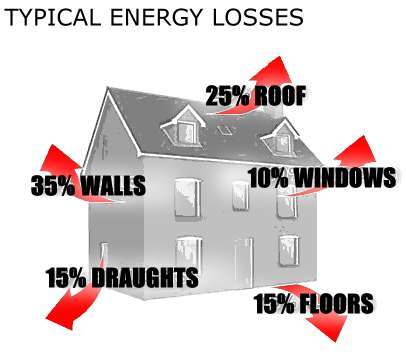
- The most effective are the ones with the larges annual saving
- The most cost effective tend to be the cheapest
- Short pay back time
- What can be done?
- CAVITY WALL INSULATION
- Foam squirted into the gap between the bricks
- Reduces CONVECTION + RADIATION across the gap
- Foam squirted into the gap between the bricks
- LOFT INSULATION
- DRAUGHT PROFFING
- Strips of foam and plastic around the door
- Stops CONDUCTION and CONVECTION
- Strips of foam and plastic around the door
- HOT WATER TANK JECKET
- Similar to flask, vacuum on the outside
- Reduces CONDUCTION AND RADIATION
- THICK CURTAINS
- Big bits of cloth over the windows
- Reduces CONDUCTION and RADIATION
- Big bits of cloth over the windows
- CAVITY WALL INSULATION
- MEASURE IN UV
- The lower the UV levels the slower heat loss is
Specific heat capacity
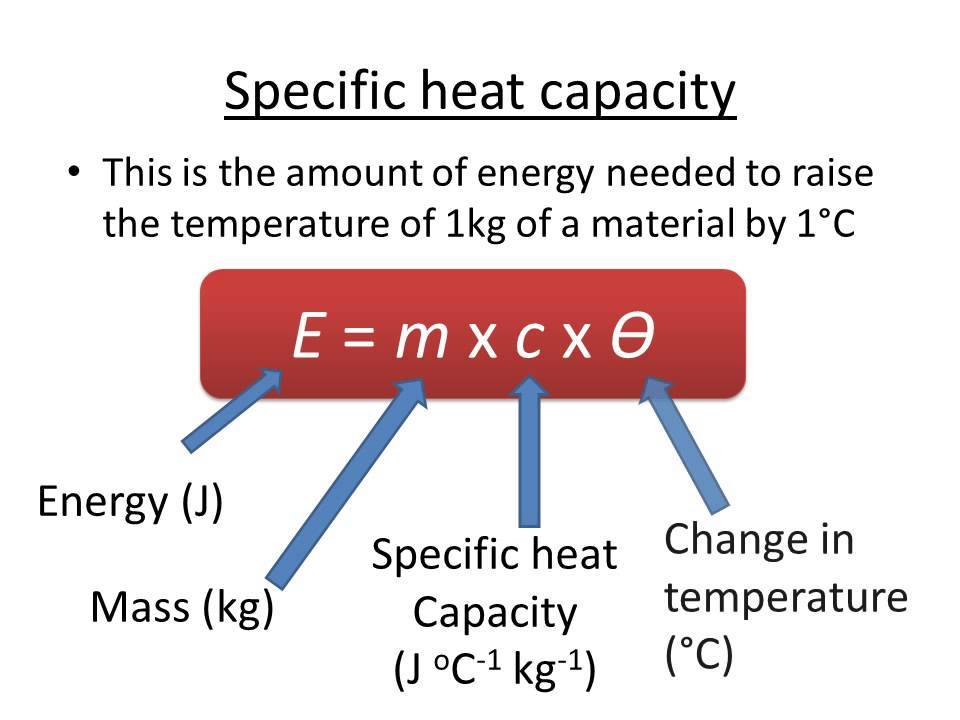
- TELLS YOU HOW MUCH ENERGY SOMETHING CAN STORE
- For example; you need 4000j to warm up 1 kg of water by 1°C
- Heaters
- Heaters have high SHC so they can store large amounts of heat energy
- Water has high SHC so good for heating in pipes
- Of oil = 2000J/°C
- Of water= 4200 J/°C
- TELLS YOU HOW MUCH ENERGY SOMETHING CAN STORE
Energy transfer
- Types of energy
- ELECTRICAL ENERGY
- Current flows
- LIGHT ENERGY
- From the light, sun ETC.
- SOUND ENERGY
- From anything noisy
- KINETIC ENERGY
- Anything that moves
- NUCLEAR ENERGY
- Released only from nuclear reactors
- HEAT ENERGY
- Flows from hot objects to cold objects
- GRAVAIATIONAL POTENTIAL ENERGY
- Processed by anything that can fall
- Stored energy
- ELASTIC POTENTIAL ENERGY
- Stretched springs, elastic ETC.
- Stored energy
- CHEMICAL ENERGY
- Processed by foods, fuels, batteries ETC.
- Stored energy
- ELECTRICAL ENERGY
- ENERGY IS NEVER CREATED OR DESTROYED
- CAN BE TRANSFERRED, STORED OR DISSIPATED
- Types of energy
Machines and Electrical appliances
- Losses
- Useful devices can transform energy form one form to another
- In the process there will always be energy loss
- Often as heat
- The less wasted the more efficient
- Formula
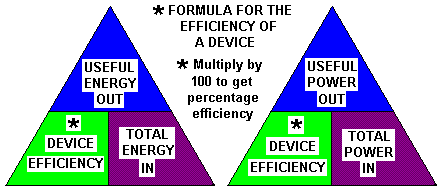
- EFFICIENCY=USEFUL ENERGY OUT/ TOTAL ENERGY IN
- Useful energy
- The energy ends up as heat and dissipates to other forms
- How to know what to choose?
- The costs may be higher at the beginning however, they end up being cheaper
- Think of the practical advantages
- Example comparison
- Clockwork Radios + Battery Radios
- Powering a clockwork radio is elastic potential energy which is free
- Sometimes tedious
- Better for the environment
- Batteries cost money
- Easy
- Not so good for the environment
- Powering a clockwork radio is elastic potential energy which is free
- Clockwork Radios + Battery Radios
- Could 'waste' energy be useful ?
- Heat exchangers reduce the amount of heat energy lost
- Pumping cold fluid through the escaping heat
- The temperature of the liquid rises and gains heat energy
- Then can be converted into a form that is useful again
- The temperature of the liquid rises and gains heat energy
- Pumping cold fluid through the escaping heat
- Heat exchangers reduce the amount of heat energy lost
- Standard of living
- Poor countries cant access electricity
- Refrigerators can help store food safely
- And store vaccines
- Hospitals rely on electricity
- Without a reduction in life expectancy
- Electricity can also effect communications
- Losses
Energy transformation graph
- SANKEY DIAGRAMS
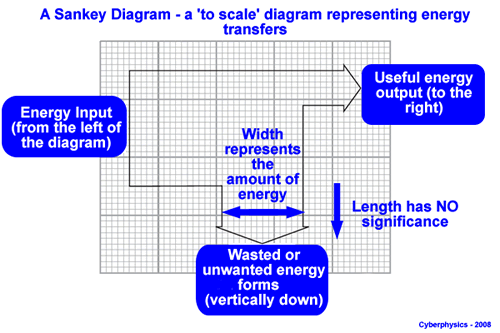
- The thickness of the line represents the amount of energy
- Tells you the energy used and wasted visually
- 100J in
- 80J lost in HEAT ENERGY
- 20J useful KINETIC ENERGY
- To do it precisely you can measure the small squares
- SANKEY DIAGRAMS
Bilder und Dateien der Mindmap
Informationen
- Beschreibung
- Mindmap am Physic - Energy, erstellt von bertram.lg am 27/05/2015.
- Erstellt von
- bertram.lg
- Aufrufe
- 1
- Bewertung