
Mindmap
Geography - Globalisation
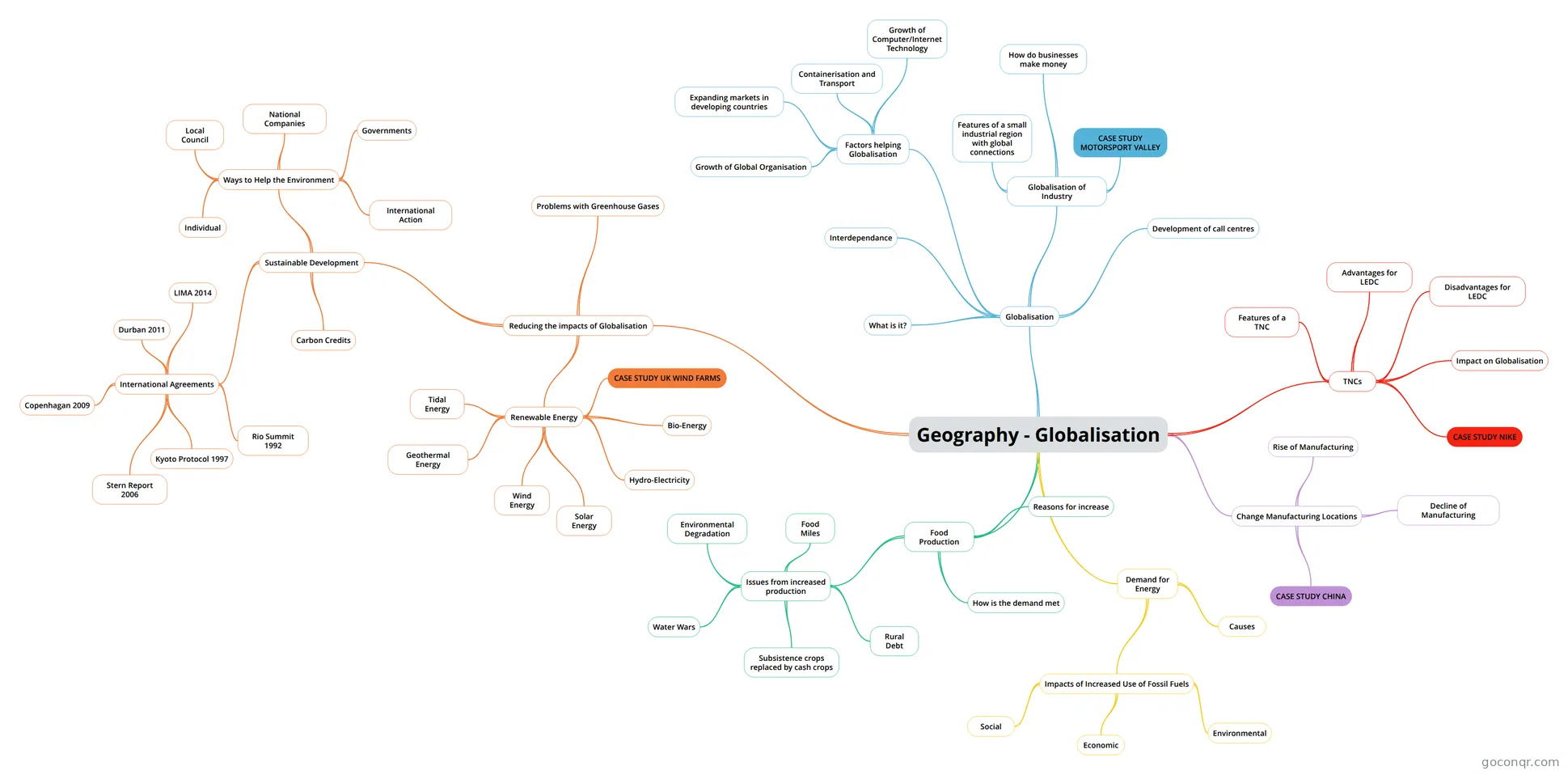
Mind map: Globalisation geography
Inhalt der Mindmap
Geography - Globalisation
Globalisation
- What is it?
- This is the increasing links between countries throughout the world, as well as all the world's economies becoming integrated. It happens because of international trade, international investment and improvement sin communications. Countries have also become interdependent as a result of globalisation, they rely on each other for resources or services.
- Interdependance
- Interdependence is the relationship between two or more countries and their reliance on each other, usually in terms of trade.
- What LEDCs can supply: -Variety of environments for tourism -Low priced manufacturing goods -Tropical foodstuffs -Raw materials eg minerals and timber
- What can MEDCs supply: -Knowledge of modern technology -High-tech manufactured goods -People seeking holiday locations -Highly skilled and educated workers eg engineers
- Factors helping Globalisation
- Containerisation and Transport
- Improvements in transport include more airports, high speed trains and larger ships. This has made it much quicker for people all over the world to communicate with each other face-to-face. It's also made it easier for companies to get supplies from all over the world and to distribute their product all over the world. They don't have to locate near to their suppliers or their product market anymore.
- Containerisation has helped increase globalisation due to: -Ease of transport: The containers are interchangeable between land and sea, enabling them to get to almost any location. -Cheapness: They are reusable and are just lifted from one type of transport to another by crane, simple and inexpensive. -Security: Kept in the factory/warehouse and are not opened until they reach their destination. This cuts out the timely customs process and there is visible evidence if they are tampered with.
- Growth of Computer/Internet Technology
- Improvements in ICT include email, the internet, mobile phones and phone lines that can carry more information and faster. This has made it quicker and easier for people all over the world to communicate with each other. For example, a company can have its headquarters in one country and easily communicate wit branches and factories in other countries. No time is lost so its very efficient.
- Growth of Global Organisation
- We recent times we have seen in a growth in the amount of Banks and Trans National Corporations (TNCs) like HSBC, Nike and McDonalds.
- Expanding markets in developing countries
- Places such as India, thanks to the expansion of its economy, has a growing middle class. This increases the demand for overseas goods and tech, eg iPhones
- Containerisation and Transport
- Globalisation of Industry
- Features of a small industrial region with global connections
- Traditionally British manufacturing industry was located in certain areas. The ground it was built on was called the SITE and the surrounding features called the SITUATION. Factors that would have been taken into account in the past for a factory location: -Flat land -Transport links -Room for expansion -A good labour supply -Raw materials -Market -Capital -Government attitude -Environment. Some of these are still needed today however with the increase of globalisation some are becoming less important.
- Features of a local Industry with global connections: -Good transport links (near major motorways, airports and ports) -Good labour supply (such as close to top universities) -Near to anywhere of importance for the testing or trail of products.
- CASE STUDY MOTORSPORT VALLEY
- Motorsport Valley Fact File Locations: Between Northampton and Oxford in the Southern part of the Midlands. Importance to Local Economy: -Employs over 40,000 people -Sales of around £6 billion -2,200 businesses relating to design, research, development, production and event organising. Global Market: -Provides over 80% of the worlds market in high performance engineering. Locational Factors: -Close to key motorways -Close to airports -Near to top universities -Near to Silverstone
- How do businesses make money
- For a business to make money it needs to sell its goods and services for more money than it cost to produce them. Price of goods - cost = profit How can businesses make more money? 1) Increase the price they sell the product for. However this could lead to people buying the product elsewhere 2) Sell more products. Eg by advertising or selling in more locations or to a wider audience. However these methods will have some more costs such as advertising costs. 3) Reduce the initial costs: For example by the bulk buying or reducing the quality of goods or reducing costs. However if reducing labour costs there may be less product produced.
- Many businesses have chosen to move to LEDCs to lower costs, especially labour and raw materials and to increase their markets. This has only been possible due to the advancements in technology, especially transport and communications.
- Features of a small industrial region with global connections
- Development of call centres
- Call Centres are offices where groups of people respond to telephone queries from customers. The "Call Centre Capital of the World" is India. This is due to several factors: -About 10% of the population speaks English fluently (about 100 million people) -Of the 787 million people living in towns, about 80% are literate and 18% of these are university graduates. -Salaries are lower eg £1,200 per year in contrast to £12,000 per year in the UK. -Low staff turnover, working 9 hour shifts at times to fit in with the origin country of the company. -Development in ICT allows for fast and clearer communications.
- Call centres were able to move abroad due to cheaper communications, such as the internet and submarine cables.Many companies have moved their call centres overseas such as banks (Lloyds TSB), supermarkets, insurance companies, tv/phone companies etc The main attraction of India for the call centres is that there are more skilled workers who will work for less money. The Indian call centres only recruit university/collage graduates. Call centres in India are also 40% cheaper to run than in Britain as workers in India are paid only £40 per week compared to £200 in Britain. Call centre jobs in India are very attractive for Indian workers as they are paid £40 per week, where as teachers are only paid £20.
- Impacts of call centres on India: Advantages -More highly paid jobs. This can have a positive multiplier effect ie if you pay people more, they will spend more, which creates more jobs. -It increases the rate of development -It can improve technology infrastructure Disadvantages -The multiplier effect could to price/wage inflation -It could also lead to a "brain drain" as less people are becoming teachers. Impact of call centres of the UK Advantages -Businesses make more money Disadvantages -Higher rates of unemployment, especially in already struggling areas ie old manufacturing towns.
- What is it?
TNCs
- Features of a TNC
- TNC stands for Transnational Corporations, these are large, wealthy international organisations.They usually have their headquarters in one country (usually a MEDC like the USA or Japan) and branches throughout the world. They usually carry out research and development in the same country as their headquarters however, due to the advances in technology, research can be carried out anywhere in the world and can easily be sent to the needed locations. They usually produce their goods in LEDCs where the labour costs are usually much lower, laws are more lenient or where governments want to seek investment.
- Advantages for LEDC
- Economic: -Provide money for new industrial projects -Help develop mineral wealth (sell natural resources)
- Social: -People may feel more secure with a job and regular income -Bring work and use local people -Improved education and work skills -Improve energy production -Improve roads, airports and services -Provide new technology -Develop trade links with other countries.
- Disadvantages for LEDC
- Economic: -Local labour is usually poorly paid -Most of the profits go overseas (leakage of profits) -Products being made are often of little value and are too expensive for local people.
- Social: -Working conditions are poor. Workers have to suffer hot, crowded conditions and work for many hours at a stretch. -Few skilled workers are employed, jobs are often repetitive and low skilled. -Companies may leave the country at any time leaving many locals with no jobs -The needs of the country are rarely considered
- Environmental: -Minerals are often exported -The factories often create lots of pollution.
- CASE STUDY NIKE
- Impact on Globalisation
- TNCs increase globalisation by linking together countries through the production and sale of goods.
- Features of a TNC
Change Manufacturing Locations
- Rise of Manufacturing
- Some countries that have traditionally relied on agriculture have seen a massive growth in their manufacturing industries recently - this process is called industrialisation These countries are called MICs (Newly Industrialisation Countries). They include places like India, China, Brazil etc. TNCs have increased manufacturing in NICs by basing factories there.
- Reasons why factories have moved:1) Cheap Labour: The minimum wage in the NICs is much lower than in countries like the UK which reduces the cost of manufacturing for companies as the workers are paid less. This means they are more profitable.2) Long working hours: The rules about working hours aren't as strict in NICs as in places like the EU. This means employees work longer hours so more product can be made in a day. 3) Laxer health and safety regulations: There are fewer healthy and safety regulations in NICs and they're often not enforced. This lowers the cost of manufacturing goods because less money is spent on increasing the safety of factories. 4) Prohibition of strikes: Some NICs don't allow employees to strike (eg protest against low pay). This means money isn't lost due to employees stopping work. 5) Tax incentives and tax free zones: Some NICs offer a tax reduction if they move their manufacturing to the country. Some NICs have tax free zones - the TNCs don't have to pay taxes if they move their manufacturing to a specific area of the country. Both of these increase the profits of the TNC because they pay lower taxes.
- Decline of Manufacturing
- Most rich countries have a history of manufacturing goods, eg cars have been manufactured in the UK for may years. In recent years manufacturing in some rich countries has decreased, this is called de
- CASE STUDY CHINA
- Rise of Manufacturing
Demand for Energy
- Causes
- Impacts of Increased Use of Fossil Fuels
- Social
- Economic
- Environmental
Reducing the impacts of Globalisation
- Renewable Energy
- CASE STUDY UK WIND FARMS
- Bio-Energy
- This uses plants (eg rape seed) to become oil to be used in cars or uses ethanol as fuel. Advantages: -Cheap -Potentially carbon neutral -Alternative fuel for cars Disadvantages: -Can produce methane (a greenhouse gas) -Uses up space that could be used for food crop
- Hydro-Electricity
- Uses the power of the falling water to drive a turbine which creates energy. Advantages: -Renewable -Relatively cheap -Limited pollution -Dams built store water which reduces the risk of flooding and water shortages. Disadvantages: -To build the dam is expensive -Large areas of farmland and wildlife habitat may be flooded forcing people to move. -Dams may burst and cause flooding -Decaying vegetation from when forests have been flooded can release CO2 and methane.
- Wind Energy
- Wind turns a propeller round which drives a generator to create electricity Advantages: -Minimal effect of local ecosystems -Safe and clean -Works well in winter and at night when demand is high Disadvantages: -No energy when its not windy -Visual pollution -Can be noisy -Expensive installation and maintenance costs -Not as efficient as some methods
- Tidal Energy
- Uses the rise and fall of waves to compress air in a chamber and out again which drives a turbine. Advantages: - High energy levels - No pollution -Renewable -Out to sea so no visual pollution Disadvantages: -Very expensive -Could destroy marine habitats
- Geothermal Energy
- Water is pumped into the ground in geothermal hotspots, the Earth's mantle heats the water and turns it into steam. This turns a turbine witch generates electricity. Advantages: - Renewable -Provides a constant supply of energy -Relatively pollution free Disadvantages: -High cost of construction -Limited to certain, volcanic areas -Threat to power stations from volcanic eruptions - Some emission of sulphuric gases
- Solar Energy
- Uses energy from the sun to create electricity or to heat water. Advantages: -Being safe -Pollution free -Efficient -Limitless supply Disadvantages: -Doesn't work well in winter/at night when energy is needed most -Expensive installation -Visual pollution
- Sustainable Development
- International Agreements
- Rio Summit 1992
- This was the worlds first attempt to limit global emissions after it was realised that human actions were causing change to happen quicker than ever before. However cuts to the amount of emissions were only voluntary and so countries could decide if they wanted to follow them.
- Kyoto Protocol 1997
- Many MEDCs agreed to reduce emissions to pre 1990 levels by 2012.Some LEDCs were allowed to increase their emissions.The Carbon Credits Trading Scheme was introduced. This scheme became legally binding in 2005 when enough countries signed on. The USA was one of the few MEDCs who did not.
- Stern Report 2006
- A UK government report that showed that it wold be cheaper for the world to stop climate change than it would be to just try to cope with it.
- Copenhagan 2009
- Unfortunately this meeting was a disappointment as no agreement was made
- Durban 2011
- This planned new legal framework to be established for 2015. They wanted to limit climate change to only 2 degrees above pre-industrial revolution levels. Developed countries were also accused of not fulfilling financial aid to poorer countries to help them develop. Key economies (eg China, India etc) wanted more financial support so that they could adopt clean energies.
- LIMA 2014
- The Green Climate Fund agreed to help pay for cleaner energy and would reward countries for keeping forests intact.
- Rio Summit 1992
- Ways to Help the Environment
- Governments
- -Fine companies who pollute the environment or break the rules on emissions which gives companies a monetary incentive to be more efficient. -Higher taxes on polluting cars and reduce taxes on efficient cars which discourages people from driving polluting cars and instead swap to more efficient, and therefore less polluting, cars.
- National Companies
- -Carbon offsetting (planting trees to offset the emissions created when making products). Trees absorb CO2 so planting more trees the more you produce means the trees theoretically take in the CO2 given out in production.
- Local Council
- -Build more bus and cycle lanes and charge for people to drive cars in cities. This encourages people to less polluting methods of transport. -Provide more recycling bins and facilities to reduce waste dumped (waste dumps emit greenhouse gases) as well as reduce the need for new production of glass, plastic etc.
- Individual
- -Cycle to work instead of driving which reduces emissions given off by cars if there are more cyclists. -Grow own crops which reduces the need to import crops, the transportation of which emits harmful gases. -Put more insulation in houses, use energy efficient light bulbs, switch things off etc. This reduces energy used/wasted meaning fuel production is more efficient.
- International Action
- -Set emission targets for countries; allowing those who exceed to trade with those who under produce (carbon credits). This again helps give a monetary incentive to be more efficient. -Invest in alternate energy sources which do not rely on fossil fuels or are more fuel efficient. This reduces the amount of fossil fuels burnt and therefore lessens the CO2 being put into the atmosphere.
- Governments
- Carbon Credits
- This was established under the 1997 Kyoto Protocol. Countries are only allowed to produce a certain number of tonnes of carbon and other emissions each year. If they don't use all of their allocation then they are given "credits", these "credits" can be sold to countries that have exceeded their limits so that global emissions stay the same. These levels are set at the international meetings to try to reduce the amount of global carbon production.
- International Agreements
- Problems with Greenhouse Gases
- Renewable Energy
Food Production
- Reasons for increase
- How is the demand met
- Issues from increased production
- Food Miles
- Environmental Degradation
- Water Wars
- Subsistence crops replaced by cash crops
- Rural Debt
Informationen
- Beschreibung
- Mindmap am Geography - Globalisation, erstellt von grace evans am 28/05/2015.
- Erstellt von
- grace evans
- Aufrufe
- 5
- Bewertung