
Mindmap
ED209 Book 2 Chapter 1 - Parenting & Attachment
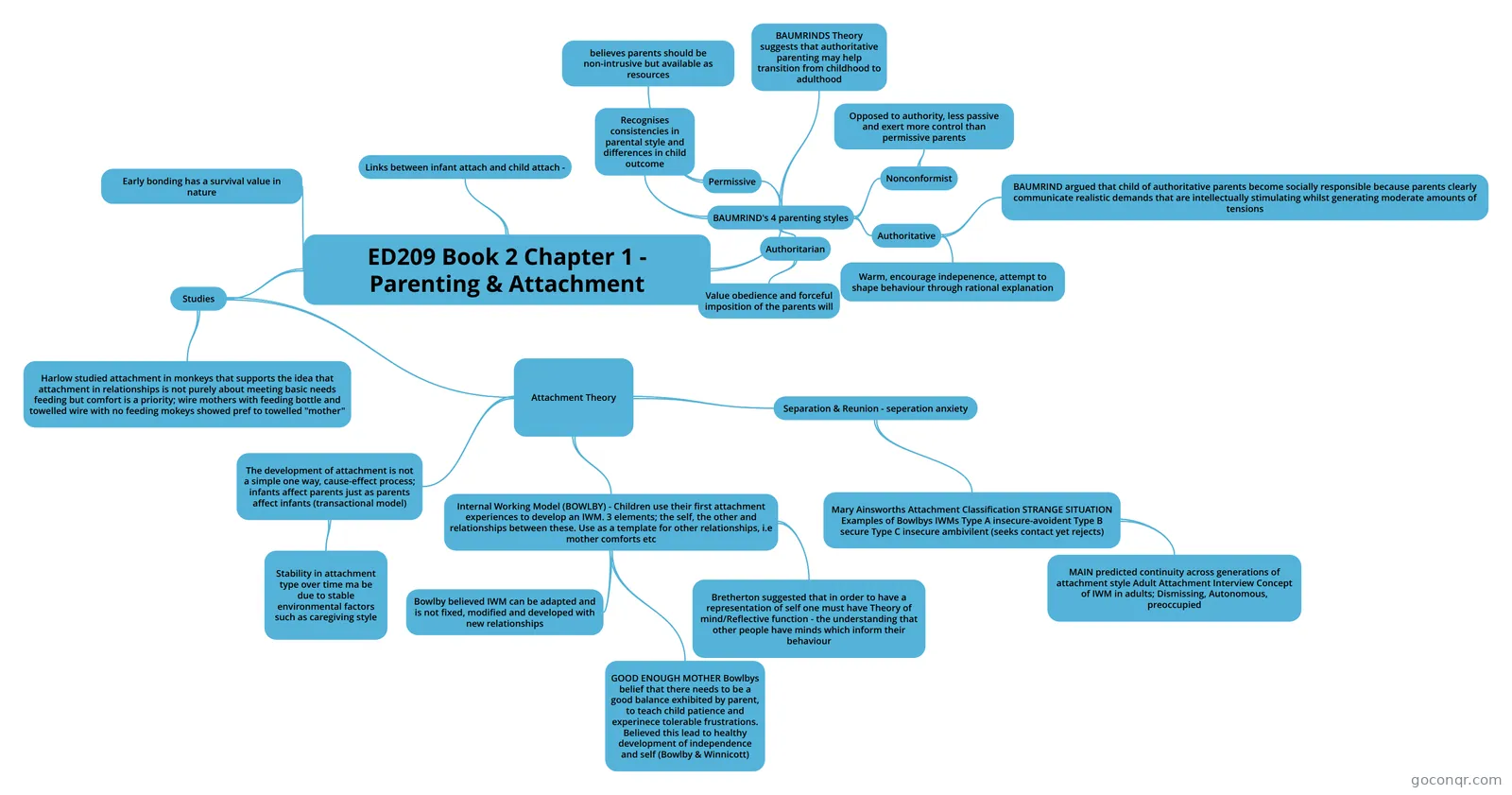
Mind map: parenting and attachment
Inhalt der Mindmap
ED209 Book 2 Chapter 1 - Parenting & Attachment
Studies
- Harlow studied attachment in monkeys that supports the idea that attachment in relationships is not purely about meeting basic needs feeding but comfort is a priority; wire mothers with feeding bottle and towelled wire with no feeding mokeys showed pref to towelled "mother"
- Attachment Theory
- Internal Working Model (BOWLBY) - Children use their first attachment experiences to develop an IWM. 3 elements; the self, the other and relationships between these. Use as a template for other relationships, i.e mother comforts etc
- Bowlby believed IWM can be adapted and is not fixed, modified and developed with new relationships
- GOOD ENOUGH MOTHER Bowlbys belief that there needs to be a good balance exhibited by parent, to teach child patience and experinece tolerable frustrations. Believed this lead to healthy development of independence and self (Bowlby & Winnicott)
- Bretherton suggested that in order to have a representation of self one must have Theory of mind/Reflective function - the understanding that other people have minds which inform their behaviour
- Separation & Reunion - seperation anxiety
- Mary Ainsworths Attachment Classification STRANGE SITUATION Examples of Bowlbys IWMs Type A insecure-avoident Type B secure Type C insecure ambivilent (seeks contact yet rejects)
- MAIN predicted continuity across generations of attachment style Adult Attachment Interview Concept of IWM in adults; Dismissing, Autonomous, preoccupied
- Mary Ainsworths Attachment Classification STRANGE SITUATION Examples of Bowlbys IWMs Type A insecure-avoident Type B secure Type C insecure ambivilent (seeks contact yet rejects)
- The development of attachment is not a simple one way, cause-effect process; infants affect parents just as parents affect infants (transactional model)
- Stability in attachment type over time ma be due to stable environmental factors such as caregiving style
- Internal Working Model (BOWLBY) - Children use their first attachment experiences to develop an IWM. 3 elements; the self, the other and relationships between these. Use as a template for other relationships, i.e mother comforts etc
Early bonding has a survival value in nature
BAUMRIND's 4 parenting styles
- Authoritarian
- Value obedience and forceful imposition of the parents will
- Authoritative
- Warm, encourage indepenence, attempt to shape behaviour through rational explanation
- BAUMRIND argued that child of authoritative parents become socially responsible because parents clearly communicate realistic demands that are intellectually stimulating whilst generating moderate amounts of tensions
- Nonconformist
- Opposed to authority, less passive and exert more control than permissive parents
- Permissive
- believes parents should be non-intrusive but available as resources
- BAUMRINDS Theory suggests that authoritative parenting may help transition from childhood to adulthood
- Recognises consistencies in parental style and differences in child outcome
- Authoritarian
Links between infant attach and child attach -
Informationen
- Beschreibung
- Mindmap am ED209 Book 2 Chapter 1 - Parenting & Attachment, erstellt von hayleyOUPsychology am 31/05/2015.
- Erstellt von
- hayleyOUPsychology
- Aufrufe
- 5
- Bewertung
Mehr zu Caregiver-infant interactions