
Mindmap
Modal Verbs
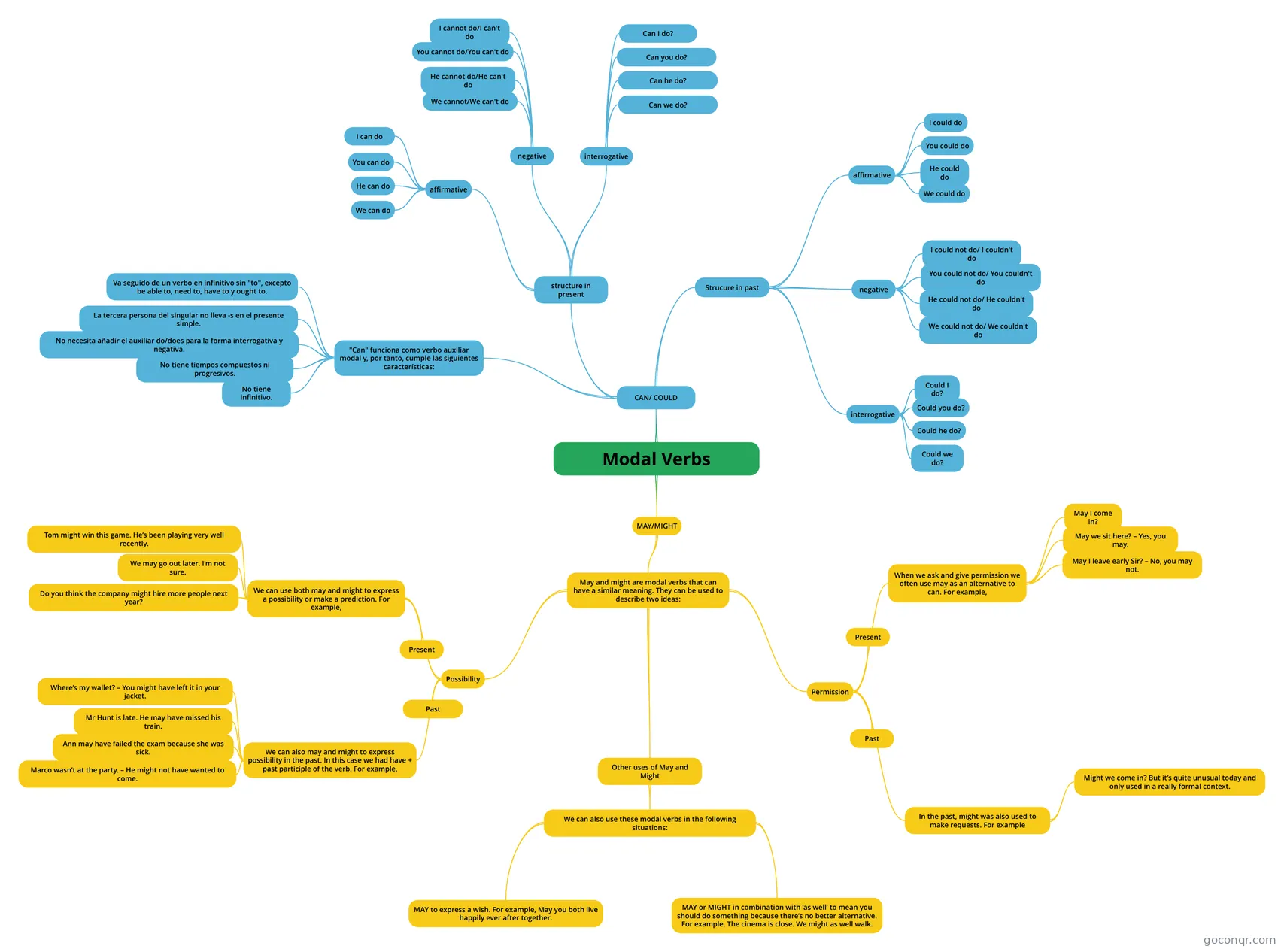
Mind map: Modal verbs
Inhalt der Mindmap
Modal Verbs
CAN/ COULD
- "Can" funciona como verbo auxiliar modal y, por tanto, cumple las siguientes características:
- Va seguido de un verbo en infinitivo sin "to", excepto be able to, need to, have to y ought to.
- La tercera persona del singular no lleva -s en el presente simple.
- No necesita añadir el auxiliar do/does para la forma interrogativa y negativa.
- No tiene tiempos compuestos ni progresivos.
- No tiene infinitivo.
- structure in present
- affirmative
- I can do
- You can do
- He can do
- We can do
- negative
- We cannot/We can't do
- He cannot do/He can't do
- You cannot do/You can't do
- I cannot do/I can't do
- interrogative
- Can I do?
- Can you do?
- Can he do?
- Can we do?
- affirmative
- Strucure in past
- affirmative
- I could do
- You could do
- He could do
- We could do
- negative
- I could not do/ I couldn't do
- You could not do/ You couldn't do
- He could not do/ He couldn't do
- We could not do/ We couldn't do
- interrogative
- Could I do?
- Could you do?
- Could he do?
- Could we do?
- affirmative
- "Can" funciona como verbo auxiliar modal y, por tanto, cumple las siguientes características:
MAY/MIGHT
- May and might are modal verbs that can have a similar meaning. They can be used to describe two ideas:
- Possibility
- We can use both may and might to express a possibility or make a prediction. For example,
- Tom might win this game. He’s been playing very well recently.
- We may go out later. I’m not sure.
- Do you think the company might hire more people next year?
- Present
- We can also may and might to express possibility in the past. In this case we had have + past participle of the verb. For example,
- Where’s my wallet? – You might have left it in your jacket.
- Mr Hunt is late. He may have missed his train.
- Ann may have failed the exam because she was sick.
- Marco wasn’t at the party. – He might not have wanted to come.
- Past
- We can use both may and might to express a possibility or make a prediction. For example,
- Permission
- When we ask and give permission we often use may as an alternative to can. For example,
- May I come in?
- May we sit here? – Yes, you may.
- May I leave early Sir? – No, you may not.
- Present
- In the past, might was also used to make requests. For example
- Might we come in? But it’s quite unusual today and only used in a really formal context.
- Past
- When we ask and give permission we often use may as an alternative to can. For example,
- Other uses of May and Might
- We can also use these modal verbs in the following situations:
- MAY to express a wish. For example, May you both live happily ever after together.
- MAY or MIGHT in combination with ‘as well’ to mean you should do something because there’s no better alternative. For example, The cinema is close. We might as well walk.
- We can also use these modal verbs in the following situations:
- Possibility
- May and might are modal verbs that can have a similar meaning. They can be used to describe two ideas:
Informationen
- Beschreibung
- Mindmap am Modal Verbs, erstellt von xian gamer am 03/03/2021.
- Erstellt von
- xian gamer
- Aufrufe
- 2
- Bewertung