
Mindmap
Atomic Structure and Bonding
Inhalt der Mindmap
Atomic Structure and Bonding
Fundamental Particles
- Protons have a mass and charge of 1. Neutrons have a mass of 1 and a charge of 0. Electrons have negligible mass and a charge of -1. The atomic number of an element is its chemical identity, it is its number of protons and electrons. The mass number is the number of nucleons in an atom, electrons are not counted as their mass is negligible.
Isotopes
- Isotopes of an element are atoms which have different numbers of neutrons, they are still the same element and will react the same however their densities will be different and they may be radioactive in some cases.
- Mass Spectrometry
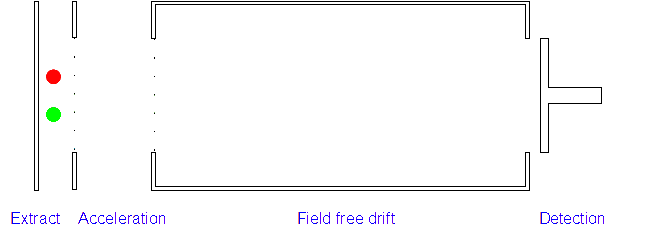
- Time of flight mass spectrometry is used to identify the abundance of various isotopes within a sample. First the sample is ionised into positively charged ions. The ions are attracted to the negatively charged plate causing them to travel into the flight tube. The light ions travel faster and reach the ion detector first, when it does the ion picks up an electron from the detector causing a current, the size of this current is proportion to the abundance of the isotope.
- Organic
- The sample is dissolved in a volatile, polar solvent. It is injected through a fine needle giving a fine mist or aerosol. The tip of needle has high voltage. At the tip of the needle the sample molecule, M, gains a proton, H+, from the solvent forming MH+. The solvent evaporates away while the MH+ ions move towards the negative plate. Electro Spray Ionisation is preferable for larger organic molecules. The ‘softer’ conditions of this technique mean fragmentation does not occur.
- Inorganic
- One way to ionise the sample is to inject a vaporised sample at low pressure. An electron gun fires high energy electrons at the sample. This knocks out an outer electron. Forming positive ions with different charges. Electron impact is used for elements and substances with low formula mass. Electron impact can cause larger organic molecules to fragment.
Electronic Configuration
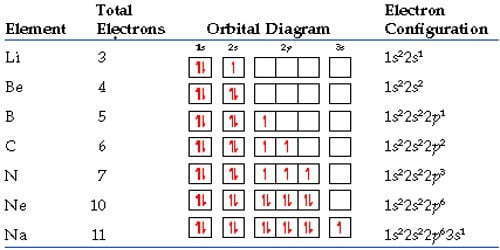
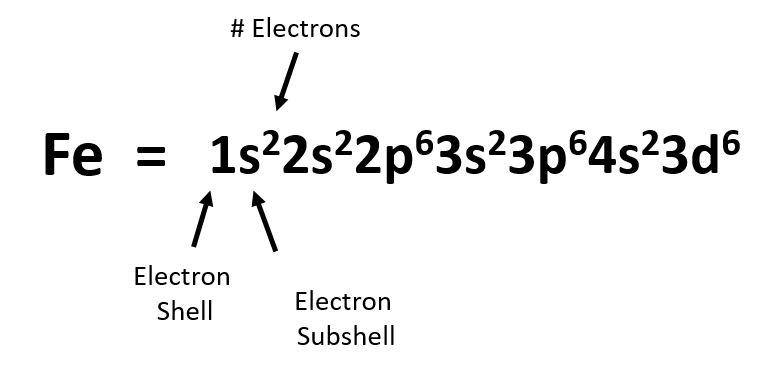
- Atoms have electrons which orbit in energy levels or shells. There are four sub shells S, P, D, and F (sharp, principal, diffuse, and fundamental). There can be one S (two e- ) ,three P ( six e- ), five D ( ten e- ), and seven F (fourteen e- ) per period however P is introduced in the second, d in the fourth and f in the sixth.
- Rules
- There are 4 key rules: Lower energy orbitals fill first, Orbitals fill singularly and then double up due to spin, No orbital can hold more than a pair of electrons, 4s fills before 3d.
- Exceptions
- There are exceptions. Copper is [Ar]4s13d10 and Chromium is [Ar]4s13d5 Additionally when d-block become ions 4s loses electrons before 3d.
- Ionisation Energy
- Ionisation energy is the energy required to remove 1 electron form each atom in one mole of gaseous atoms form one mole of positive ions. It is an endothermic process, It is measured in kJmol-1. It is shorted to IE. The general form for it is this: X(g) + energy ⟶ X+(g) + e− Doing it repeatedly is called sequential ionisation.
- Determining IE
- The factors that affect it are : Atomic radius, Nuclear charge, and Electron shielding or screening. Atomic radius is how far the electron you are trying to remove is from the positive nucleus, the closer it is the stronger the nucleus' pull is and the more energy required. Nuclear charge is how strongly charge thew nucleus is, if there are more protons in the nucleus then the pull on the electrons is stronger and more energy is required. Electron shielding is when the inner electrons repel the out ones, this means the less electrons there are in between the outer one and the nucleus the more energy is required.
- Successive Trends
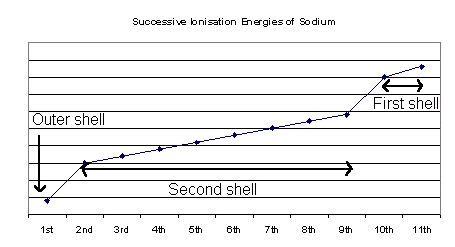
- Here is sodium's successive energies. Note the spikes when you start a new shell, this is because the atomic radius shrinks and the shielding reduces so more energy is needed.
- Period Trends
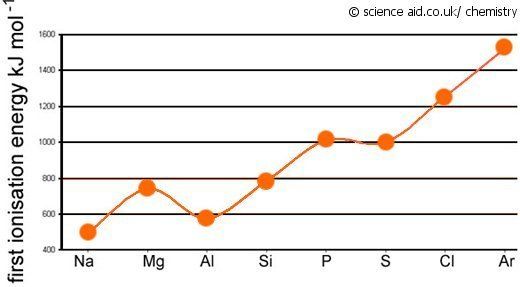
- Here is period 3's first ionisation energy. There is a general positive trend as the nuclear charge increases but the radius and screening are constant. The drop to Al is due to subshells, one electron in a subshell is very is easy to knock out. The Drop to sulfur is due to spin, sulfur is when the P shells have to have their second electron and the first one in is easy to remove.
- Group Trends
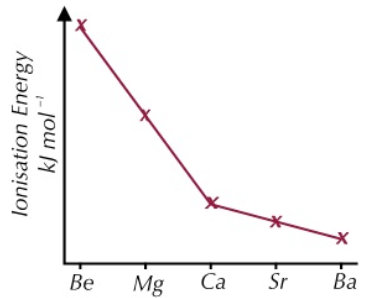
- Down a group looks like this. This is because the atomic radius increases massively, as does the electron shielding from the inner shells. And whilst the atomic charge does also increase is it not as strong as the two factors combined.
Bonding
- Covalent Bonding
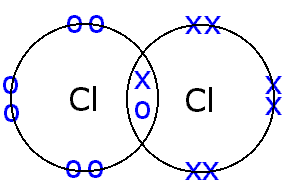
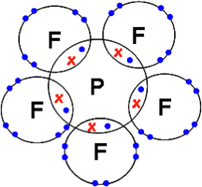
- Covalent bonding is bonding between two nonmetals for example CO2. In covalent bonding to atoms share a pair of electrons, one from each. Here is Cl2. Both chlorine molecules are stable as they now both have 8 electrons. Sometimes electron deficient compounds can form such as Boron Trifluoride where the boron only has 6 electrons but is still stable as all three fluorine have 8 and surround it. Other times nonmetals past the transition metals can expand their octet leading to molecules such as phosphorus pentachloride.
- Metalic Bonding
- Metallic bonding is often described as an array of positive ions in a sea of electrons. The metal is held together by the strong forces of attraction between the delocalised electrons and the positive ions.
- Ionic Bonding
- Ionic bonding is a metal and non-metal bonded together. The metal donates electrons to the non-metal and they get held together by electrostatic forces. An example of an ionic compound is NaCl which is made of the ions Na+ and Cl-. Ionic compounds have very high melting points as it takes a lot of energy to break their bonds. They can form giant lattice structures which makes them brittle as the ions can slide and then repel each other. They cannot normally conduct electricity however if their ions dissociate, like when molten or dissolved, then the ions can be moved to carry charge. There are several factors that determine the melting point of an ionic compound, they are: the number of electrons transferred, the ionic radii, and the number of ions in the compound. The more electrons transferred the stronger the bond and the higher the melting point. MgO is better than NaCl. The smaller the radii the stronger the bond. NaCl is better than KCl The number of ions is also relevant a compound like MgO the two charges are both going to the same ion but in MgCl2.
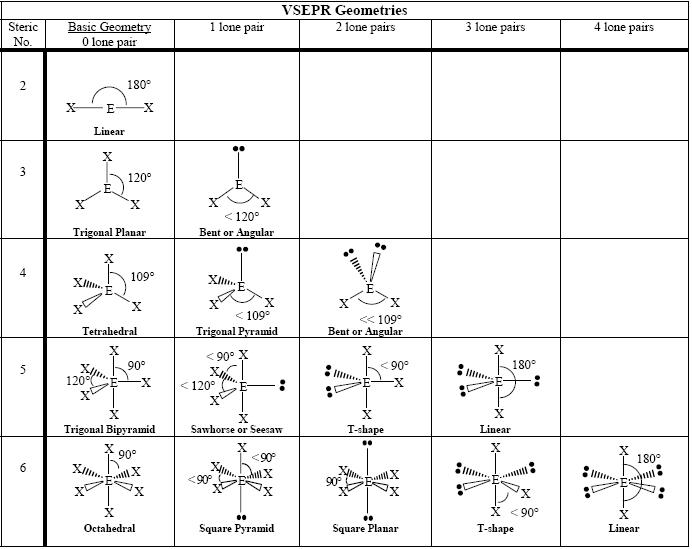
- Bond Angles
- IMF and Polarity
- Electronegativity is a measure of the tendency of an atom to attract a bonding pair of electrons. The Pauling scale is the most commonly used. Fluorine (the most electronegative element) is assigned a value of 4.0, and values range down to caesium and francium which are the least electronegative at 0.7. If one end is more electronegative one side of the bond has more than its fair share of electron density and so becomes slightly negative. At the same time, the other end (rather short of electrons) becomes slightly positive. This makes the bond polar.
- IMFs
- Intermolecular attractions are attractions between one molecule and a neighbouring molecule. Van der Waals: Random fluctuations in electron positions cause tiny charges in the atoms. This creates momentary attraction between particles. Dipole-Dipole :A molecule like HCl has a permanent dipole because chlorine is more electronegative than hydrogen. These permanent, in-built dipoles will cause the molecules to attract each other rather more than they otherwise would if they had to rely only on dispersion forces. Hydrogen Bonding: It exists where one of the most electronegative elements (fluorine, oxygen or nitrogen) is bonded to hydrogen. Hydrogen bonding causes stronger intermolecular forces than would otherwise be predicted. This increases the boiling point of substances such as water.
- Covalent Bonding
Bilder und Dateien der Mindmap
Informationen
- Beschreibung
- Mindmap am Atomic Structure and Bonding, erstellt von Nick Clements am 04/03/2021.
- Erstellt von
- Nick Clements
- Aufrufe
- 0
- Bewertung