
Mindmap
HUMANISM
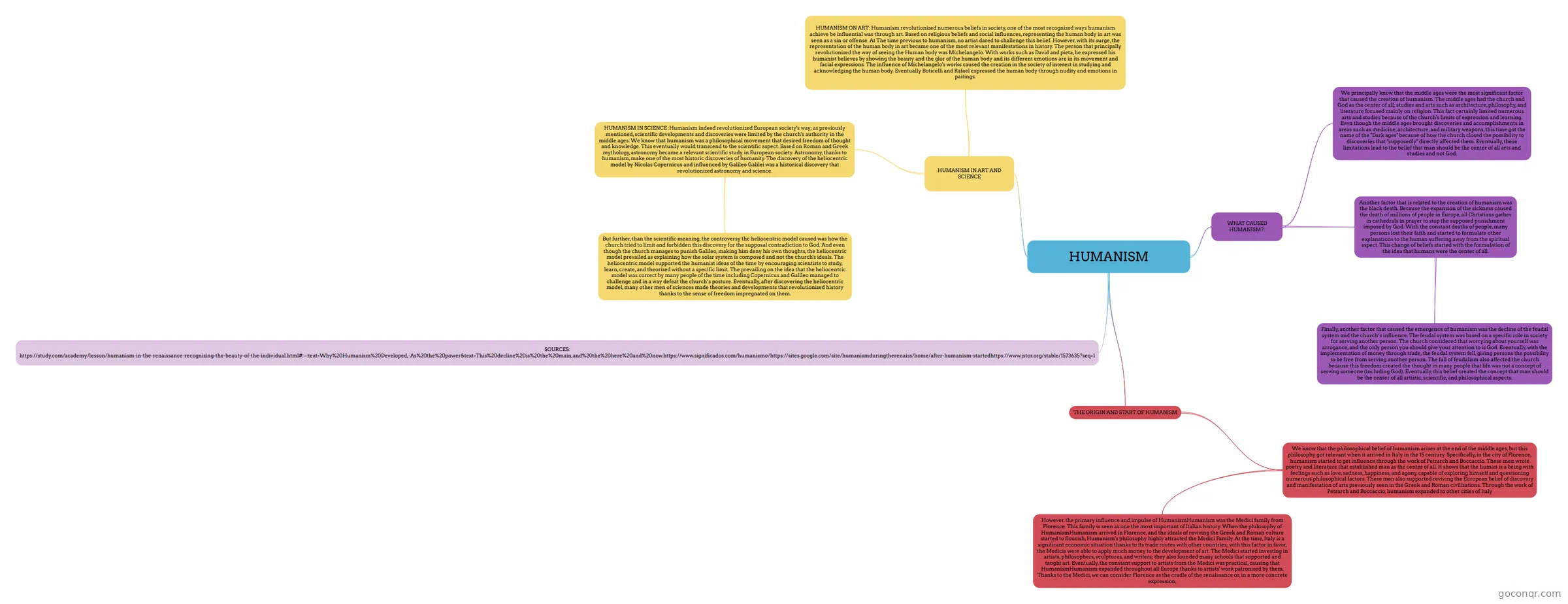
Mind map: Humanism in the Renaissance
Inhalt der Mindmap
HUMANISM
WHAT CAUSED HUMANISM?:
- We principally know that the middle ages were the most significant factor that caused the creation of humanism. The middle ages had the church and God as the center of all; studies and arts such as architecture, philosophy, and literature focused mainly on religion. This fact certainly limited numerous arts and studies because of the church's limits of expression and learning. Even though the middle ages brought discoveries and accomplishments in areas such as medicine, architecture, and military weapons, this time got the name of the "Dark ages" because of how the church closed the possibility to discoveries that "supposedly" directly affected them. Eventually, these limitations lead to the belief that man should be the center of all arts and studies and not God.
- Another factor that is related to the creation of humanism was the black death. Because the expansion of the sickness caused the death of millions of people in Europe, all Christians gather in cathedrals in prayer to stop the supposed punishment imposed by God. With the constant deaths of people, many persons lost their faith and started to formulate other explanations to the human suffering away from the spiritual aspect. This change of beliefs started with the formulation of the idea that humans were the center of all.
- Finally, another factor that caused the emergence of humanism was the decline of the feudal system and the church’s influence. The feudal system was based on a specific role in society for serving another person. The church considered that worrying about yourself was arrogance, and the only person you should give your attention to is God. Eventually, with the implementation of money through trade, the feudal system fell, giving persons the possibility to be free from serving another person. The fall of feudalism also affected the church because this freedom created the thought in many people that life was not a concept of serving someone (including God). Eventually, this belief created the concept that man should be the center of all artistic, scientific, and philosophical aspects.
THE ORIGIN AND START OF HUMANISM
- We know that the philosophical belief of humanism arises at the end of the middle ages, but this philosophy got relevant when it arrived in Italy in the 15 century. Specifically, in the city of Florence, humanism started to get influence through the work of Petrarch and Boccaccio. These men wrote poetry and literature that established man as the center of all. It shows that the human is a being with feelings such as love, sadness, happiness, and agony, capable of exploring himself and questioning numerous philosophical factors. These men also supported reviving the European belief of discovery and manifestation of arts previously seen in the Greek and Roman civilizations. Through the work of Petrarch and Boccaccio, humanism expanded to other cities of Italy
- However, the primary influence and impulse of HumanismHumanism was the Medici family from Florence. This family is seen as one the most important of Italian history. When the philosophy of HumanismHumanism arrived in Florence, and the ideals of reviving the Greek and Roman culture started to flourish, Humanism's philosophy highly attracted the Medici Family. At the time, Italy is a significant economic situation thanks to its trade routes with other countries; with this factor in favor, the Medicis were able to apply much money to the development of art. The Medici started investing in artists, philosophers, sculptures, and writers; they also founded many schools that supported and taught art. Eventually, the constant support to artists from the Medici was practical, causing that HumanismHumanism expanded throughout all Europe thanks to artists' work patronized by them. Thanks to the Medici, we can consider Florence as the cradle of the renaissance or, in a more concrete expression,
- We know that the philosophical belief of humanism arises at the end of the middle ages, but this philosophy got relevant when it arrived in Italy in the 15 century. Specifically, in the city of Florence, humanism started to get influence through the work of Petrarch and Boccaccio. These men wrote poetry and literature that established man as the center of all. It shows that the human is a being with feelings such as love, sadness, happiness, and agony, capable of exploring himself and questioning numerous philosophical factors. These men also supported reviving the European belief of discovery and manifestation of arts previously seen in the Greek and Roman civilizations. Through the work of Petrarch and Boccaccio, humanism expanded to other cities of Italy
HUMANISM IN ART AND SCIENCE
- HUMANISM ON ART: Humanism revolutionized numerous beliefs in society, one of the most recognized ways humanism achieve be influential was through art. Based on religious beliefs and social influences, representing the human body in art was seen as a sin or offense. At The time previous to humanism, no artist dared to challenge this belief. However, with its surge, the representation of the human body in art became one of the most relevant manifestations in history. The person that principally revolutionized the way of seeing the Human body was Michelangelo. With works such as David and pieta, he expressed his humanist believes by showing the beauty and the glor of the human body and its different emotions are in its movement and facial expressions. The influence of Michelangelo's works caused the creation in the society of interest in studying and acknowledging the human body. Eventually Boticelli and Rafael expressed the human body through nudity and emotions in paitings.
- HUMANISM IN SCIENCE :Humanism indeed revolutionized European society's way; as previously mentioned, scientific developments and discoveries were limited by the church's authority in the middle ages. We know that humanism was a philosophical movement that desired freedom of thought and knowledge. This eventually would transcend to the scientific aspect. Based on Roman and Greek mythology, astronomy became a relevant scientific study in European society. Astronomy, thanks to humanism, make one of the most historic discoveries of humanity. The discovery of the heliocentric model by Nicolas Copernicus and influenced by Galileo Galilei was a historical discovery that revolutionized astronomy and science.
- But further, than the scientific meaning, the controversy the heliocentric model caused was how the church tried to limit and forbidden this discovery for the supposal contradiction to God. And even though the church manages to punish Galileo, making him deny his own thoughts, the heliocentric model prevailed as explaining how the solar system is composed and not the church's ideals. The heliocentric model supported the humanist ideas of the time by encouraging scientists to study, learn, create, and theorized without a specific limit. The prevailing on the idea that the heliocentric model was correct by many people of the time including Copernicus and Galileo managed to challenge and in a way defeat the church’s posture. Eventually, after discovering the heliocentric model, many other men of sciences made theories and developments that revolutionized history thanks to the sense of freedom impregnated on them.
SOURCES: https://study.com/academy/lesson/humanism-in-the-renaissance-recognizing-the-beauty-of-the-individual.html#:~:text=Why%20Humanism%20Developed,-As%20the%20power&text=This%20decline%20is%20the%20main,and%20the%20here%20and%20now.https://www.significados.com/humanismo/https://sites.google.com/site/humanismduringtherenaiss/home/after-humanism-startedhttps://www.jstor.org/stable/1573635?seq=1
Informationen
- Beschreibung
- Mindmap am HUMANISM, erstellt von Daniel León am 20/04/2021.
- Erstellt von
- Daniel León
- Aufrufe
- 0
- Bewertung