
Mindmap
Communicative Methods
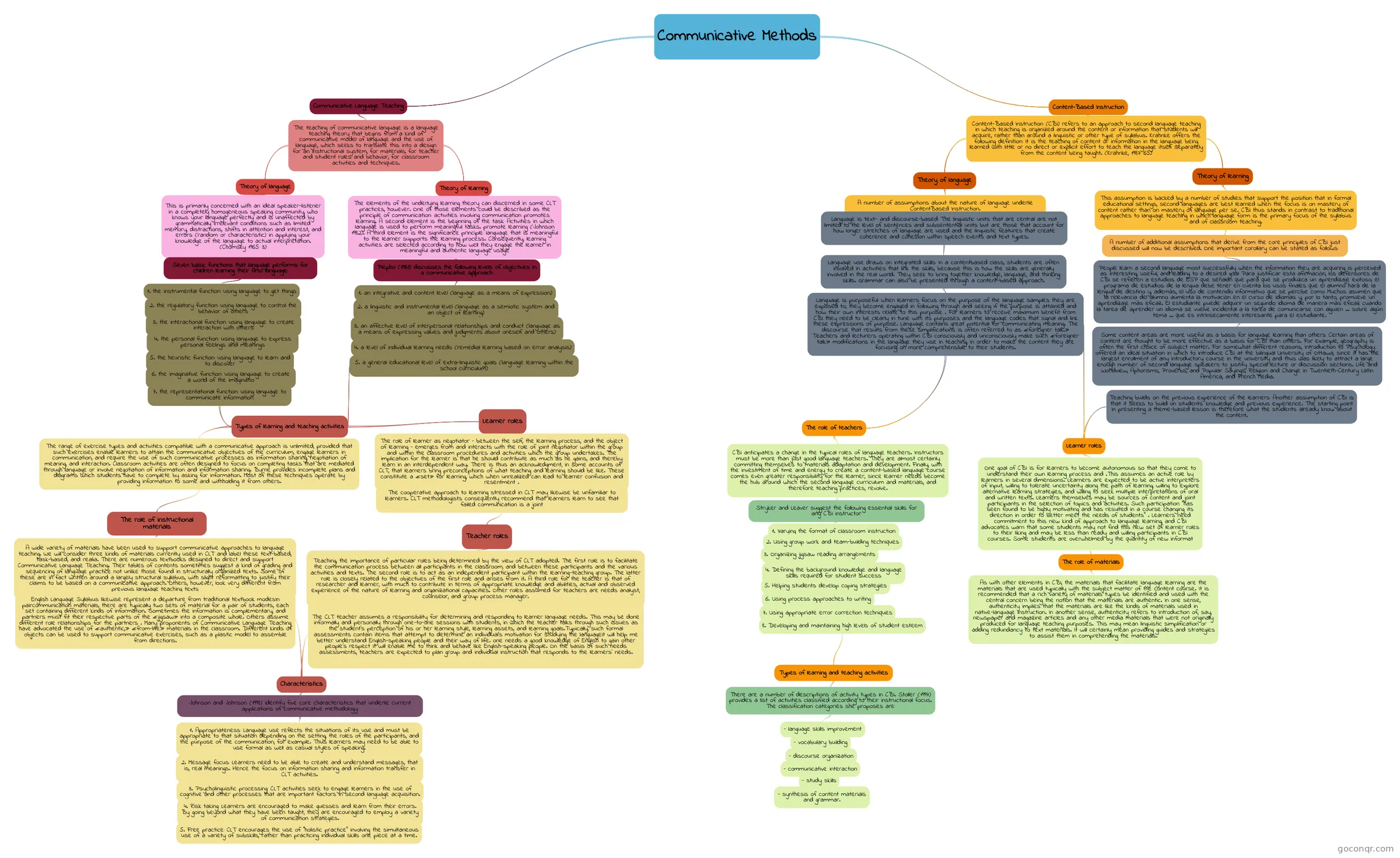
Mind map: Communicative methods
Inhalt der Mindmap
Communicative Methods
Communicative Language Teaching
- The teaching of communicative language is a language teaching theory that begins from a kind of communicative model of language and the use of language, which seeks to translate this into a design for an instructional system, for materials, for teacher and student roles and behavior, for classroom activities and techniques.
- Theory of language
- This is primarily concerned with an ideal speaker-listener in a completely homogeneous speaking community, who knows your language perfectly and is unaffected by grammatically irrelevant conditions such as limited memory, distractions, shifts in attention and interest, and errors (random or characteristic) in applying your knowledge of the language to actual interpretation. (Chomsky 1965: 3)
- Seven basic functions that language performs for children learning their first language:
- 1. the instrumental function: using language to get things
- 2. the regulatory function: using language to control the behavior of others
- 3. the interactional function: using language to create interaction with others
- 4. the personal function: using language to express personal feelings and meanings
- 5. the heuristic function: using language to learn and to discover
- 6. the imaginative function: using language to create a world of the imaginatio
- 7. the representational function: using language to communicate information
- Types of learning and teaching activities
- 5. a general educational level of extra-linguistic goals (language learning within the school curriculum)
- The range of exercise types and activities compatible with a communicative approach is unlimited, provided that such exercises enable learners to attain the communicative objectives of the curriculum, engage learners in communication, and require the use of such communicative processes as information sharing, negotiation of meaning, and interaction. Classroom activities are often designed to focus on completing tasks that are mediated through language or involve negotiation of information and information sharing. Byrne provides incomplete plans and diagrams which students have to complete by asking for information. Most of these techniques operate by providing information to some and withholding it from others.
- The role of instructional materials
- A wide variety of materials have been used to support communicative approaches to language teaching. We will consider three kinds of materials currently used in CLT and label these text-based, task-based, and realia. There are numerous textbooks designed to direct and support Communicative Language Teaching. Their tables of contents sometimes suggest a kind of grading and sequencing of language practice not unlike those found in structurally organized texts. Some of these are in fact written around a largely structural syllabus, with slight reformatting to justify their claims to be based on a communicative approach. Others, however, look very different from previous language teaching texts
- English Language Syllabus likewise represent a departure from traditional textbook modesIn paircommunication materials, there are typically two sets of material for a pair of students, each set containing different kinds of information. Sometimes the information is complementary, and partners must fit their respective parts of the «jigsaw» into a composite whole. Others assume different role relationships for the partners . Many proponents of Communicative Language Teaching have advocated the use of «authentic,» «from-life» materials in the classroom. Different kinds of objects can be used to support communicative exercises, such as a plastic model to assemble from directions.
- Characteristics
- The CLT teacher assumes a responsibility for determining and responding to learner language needs. This may be done informally and personally through one-to-one sessions with students, in which the teacher talks through such issues as the student’s perception of his or her learning style, learning assets, and learning goals.Typically, such formal assessments contain items that attempt to determine an individual’s motivation for studying the languageit will help me better understand English-speaking people and their way of life. one needs a good knowledge of English to gain other people’s respect it will enable me to think and behave like English-speaking people. On the basis of such needs assessments, teachers are expected to plan group and individual instruction that responds to the learners’ needs.
- Johnson and Johnson (1998) identify five core characteristics that underlie current applications of communicative methodology:
- 1. Appropriateness: Language use reflects the situations of its use and must be appropriate to that situation depending on the setting, the roles of the participants, and the purpose of the communication, for example. Thus learners may need to be able to use formal as well as casual styles of speaking.
- 2. Message focus: Learners need to be able to create and understand messages, that is, real meanings. Hence the focus on information sharing and information transfer in CLT activities.
- 3. Psycholinguistic processing: CLT activities seek to engage learners in the use of cognitive and other processes that are important factors in second language acquisition.
- 4. Risk taking: Learners are encouraged to make guesses and learn from their errors. By going beyond what they have been taught, they are encouraged to employ a variety of communication strategies.
- 5. Free practice: CLT encourages the use of “holistic practice” involving the simultaneous use of a variety of subskills, rather than practicing individual skills one piece at a time.
- 4. Risk taking: Learners are encouraged to make guesses and learn from their errors. By going beyond what they have been taught, they are encouraged to employ a variety of communication strategies.
- 3. Psycholinguistic processing: CLT activities seek to engage learners in the use of cognitive and other processes that are important factors in second language acquisition.
- 2. Message focus: Learners need to be able to create and understand messages, that is, real meanings. Hence the focus on information sharing and information transfer in CLT activities.
- 1. Appropriateness: Language use reflects the situations of its use and must be appropriate to that situation depending on the setting, the roles of the participants, and the purpose of the communication, for example. Thus learners may need to be able to use formal as well as casual styles of speaking.
- Characteristics
- English Language Syllabus likewise represent a departure from traditional textbook modesIn paircommunication materials, there are typically two sets of material for a pair of students, each set containing different kinds of information. Sometimes the information is complementary, and partners must fit their respective parts of the «jigsaw» into a composite whole. Others assume different role relationships for the partners . Many proponents of Communicative Language Teaching have advocated the use of «authentic,» «from-life» materials in the classroom. Different kinds of objects can be used to support communicative exercises, such as a plastic model to assemble from directions.
- A wide variety of materials have been used to support communicative approaches to language teaching. We will consider three kinds of materials currently used in CLT and label these text-based, task-based, and realia. There are numerous textbooks designed to direct and support Communicative Language Teaching. Their tables of contents sometimes suggest a kind of grading and sequencing of language practice not unlike those found in structurally organized texts. Some of these are in fact written around a largely structural syllabus, with slight reformatting to justify their claims to be based on a communicative approach. Others, however, look very different from previous language teaching texts
- The role of instructional materials
- Learner roles
- The role of learner as negotiator – between the self, the learning process, and the object of learning – emerges from and interacts with the role of joint negotiator within the group and within the classroom procedures and activities which the group undertakes. The implication for the learner is that he should contribute as much as he gains, and thereby learn in an interdependent way. There is thus an acknowledgment, in some accounts of CLT, that learners bring preconceptions of what teaching and learning should be like. These constitute a «set» for learning, which when unrealized can lead to learner confusion and resentment .
- The cooperative approach to learning stressed in CLT may likewise be unfamiliar to learners. CLT methodologists consequently recommend that learners learn to see that failed communication is a joint
- Teacher roles
- Teaching, the importance of particular roles being determined by the view of CLT adopted. The first role is to facilitate the communication process between all participants in the classroom, and between these participants and the various activities and texts. The second role is to act as an independent participant within the learning-teaching group. The latter role is closely related to the objectives of the first role and arises from it. A third role for the teacher is that of researcher and learner, with much to contribute in terms of appropriate knowledge and abilities, actual and observed experience of the nature of learning and organizational capacities. Other roles assumed for teachers are needs analyst, counselor, and group process manager.
- Teacher roles
- The cooperative approach to learning stressed in CLT may likewise be unfamiliar to learners. CLT methodologists consequently recommend that learners learn to see that failed communication is a joint
- The role of learner as negotiator – between the self, the learning process, and the object of learning – emerges from and interacts with the role of joint negotiator within the group and within the classroom procedures and activities which the group undertakes. The implication for the learner is that he should contribute as much as he gains, and thereby learn in an interdependent way. There is thus an acknowledgment, in some accounts of CLT, that learners bring preconceptions of what teaching and learning should be like. These constitute a «set» for learning, which when unrealized can lead to learner confusion and resentment .
- Types of learning and teaching activities
- 7. the representational function: using language to communicate information
- 6. the imaginative function: using language to create a world of the imaginatio
- 5. the heuristic function: using language to learn and to discover
- 4. the personal function: using language to express personal feelings and meanings
- 3. the interactional function: using language to create interaction with others
- 2. the regulatory function: using language to control the behavior of others
- 1. the instrumental function: using language to get things
- Seven basic functions that language performs for children learning their first language:
- This is primarily concerned with an ideal speaker-listener in a completely homogeneous speaking community, who knows your language perfectly and is unaffected by grammatically irrelevant conditions such as limited memory, distractions, shifts in attention and interest, and errors (random or characteristic) in applying your knowledge of the language to actual interpretation. (Chomsky 1965: 3)
- Theory of learning
- The elements of the underlying learning theory can discerned in some CLT practices, however. One of those elements could be described as the principle of communication: activities involving communication promotes learning. A second element is the beginning of the task: Activities in which language is used to perform meaningful tasks. promote learning (Johnson 1982). A third element is the significance principle: language that is meaningful to the learner supports the learning process. Consequently, learning activities are selected according to how well they engage the learner in meaningful and authentic language usage
- Piepho (1981) discusses the following levels of objectives in a communicative approach:
- 1. an integrative and content level (language as a means of expression)
- 2. a linguistic and instrumental level (language as a semiotic system and an object of learning)
- 3. an affective level of interpersonal relationships and conduct (language as a means of expressing values and judgments about oneself and others)
- 4. a level of individual learning needs (remedial learning based on error analysis)
- 3. an affective level of interpersonal relationships and conduct (language as a means of expressing values and judgments about oneself and others)
- 2. a linguistic and instrumental level (language as a semiotic system and an object of learning)
- 1. an integrative and content level (language as a means of expression)
- Piepho (1981) discusses the following levels of objectives in a communicative approach:
- The elements of the underlying learning theory can discerned in some CLT practices, however. One of those elements could be described as the principle of communication: activities involving communication promotes learning. A second element is the beginning of the task: Activities in which language is used to perform meaningful tasks. promote learning (Johnson 1982). A third element is the significance principle: language that is meaningful to the learner supports the learning process. Consequently, learning activities are selected according to how well they engage the learner in meaningful and authentic language usage
- Theory of language
- The teaching of communicative language is a language teaching theory that begins from a kind of communicative model of language and the use of language, which seeks to translate this into a design for an instructional system, for materials, for teacher and student roles and behavior, for classroom activities and techniques.
Content-Based Instruction
- Content-Based Instruction (CBI) refers to an approach to second language teaching in which teaching is organized around the content or information that students will acquire, rather than around a linguistic or other type of syllabus. Krahnke offers the following definition: It is the teaching of content or information in the language being learned with little or no direct or explicit effort to teach the language itself separately from the content being taught. (Krahnke, 1987: 65)
- Theory of language
- A number of assumptions about the nature of language underlie ContentBased Instruction.
- Language is text- and discourse-based: The linguistic units that are central are not limited to the level of sentences and subsentential units but are those that account for how longer stretches of language are used and the linguistic features that create coherence and cohesion within speech events and text types.
- Language use draws on integrated skills: In a contentbased class, students are often involved in activities that link the skills, because this is how the skills are generally involved in the real world. They seek to bring together knowledge, language, and thinking skills. Grammar can also be presented through a content-based approach.
- Language is purposeful: When learners focus on the purpose of the language samples they are exposed to, they become engaged in following through and seeing if the purpose is attained and how their own interests relate to this purpose . For learners to receive maximum benefit from CBI they need to be clearly in tune with its purposes and the language codes that signal and link these expressions of purpose. Language contains great potential for communicating meaning. The discourse that results from these simplifications is often referred to as «foreigner talk.» Teachers and lecturers operating within CBI consciously and unconsciously make such «foreigner talk» modifications in the language they use in teaching, in order to make the content they are focusing on more comprehensible to their students.
- Learner roles
- Teaching builds on the previous experience of the learners: Another assumption of CBI is that it seeks to build on students’ knowledge and previous experience. The starting point in presenting a theme-based lesson is therefore what the students already know about the content.
- One goal of CBI is for learners to become autonomous so that they come to understand their own learning process and .This assumes an active role by learners in several dimensions. Learners are expected to be active interpreters of input, willing to tolerate uncertainty along the path of learning, willing to explore alternative learning strategies, and willing to seek multiple interpretations of oral and written texts. Learners themselves may be sources of content and joint participants in the selection of topics and activities. Such participation "has been found to be highly motivating and has resulted in a course changing its direction in order to better meet the needs of students" . Learners need commitment to this new kind of approach to language learning, and CBI advocates warn that some students may not find this new set of learner roles to their liking and may be less than ready and willing participants in CBI courses. Some students are overwhelmed by the quantity of new informat
- The role of materials
- As with other elements in CBI, the materials that facilitate language learning are the materials that are used typically with the subject matter of the content course. It is recommended that a rich variety of materials types be identified and used with the central concern being the notion that the materials are authentic. In one sense, authenticity implies that the materials are like the kinds of materials used in native-language instruction. In another sense, authenticity refers to introduction of, say, newspaper and magazine articles and any other media materials that were not originally produced for language teaching purposes. This may mean linguistic simplification or adding redundancy to text materials. It will certainly mean providing guides and strategies to assist them in comprehending the materials.
- The role of materials
- The role of teachers
- CBI anticipates a change in the typical roles of language teachers. Instructors must be more than just good language teachers. They are almost certainly committing themselves to materials adaptation and development. Finally, with the investment of time and energy to create a content-based language course comes even greater responsibility for the learner, since learner needs become the hub around which the second language curriculum and materials, and therefore teaching practices, revolve.
- Stryker and Leaver suggest the following essential skills for any CBI instructor:
- 1. Varying the format of classroom instruction
- 2. Using group work and team-building techniques
- 3. Organizing jigsaw reading arrangements
- 4. Defining the background knowledge and language skills required for student success
- 5. Helping students develop coping strategies
- 6. Using process approaches to writing
- 7. Using appropriate error correction techniques
- 8. Developing and maintaining high levels of student esteem
- Types of learning and teaching activities
- There are a number of descriptions of activity types in CBI. Stoller (1997) provides a list of activities classified according to their instructional focus. The classification categories she proposes are:
- – language skills improvement
- – vocabulary building
- – discourse organization
- – communicative interaction
- – study skills
- – synthesis of content materials and grammar.
- – study skills
- – communicative interaction
- – discourse organization
- – vocabulary building
- – language skills improvement
- There are a number of descriptions of activity types in CBI. Stoller (1997) provides a list of activities classified according to their instructional focus. The classification categories she proposes are:
- Types of learning and teaching activities
- 8. Developing and maintaining high levels of student esteem
- 7. Using appropriate error correction techniques
- 6. Using process approaches to writing
- 5. Helping students develop coping strategies
- 4. Defining the background knowledge and language skills required for student success
- 3. Organizing jigsaw reading arrangements
- 2. Using group work and team-building techniques
- 1. Varying the format of classroom instruction
- Stryker and Leaver suggest the following essential skills for any CBI instructor:
- CBI anticipates a change in the typical roles of language teachers. Instructors must be more than just good language teachers. They are almost certainly committing themselves to materials adaptation and development. Finally, with the investment of time and energy to create a content-based language course comes even greater responsibility for the learner, since learner needs become the hub around which the second language curriculum and materials, and therefore teaching practices, revolve.
- Learner roles
- Language is purposeful: When learners focus on the purpose of the language samples they are exposed to, they become engaged in following through and seeing if the purpose is attained and how their own interests relate to this purpose . For learners to receive maximum benefit from CBI they need to be clearly in tune with its purposes and the language codes that signal and link these expressions of purpose. Language contains great potential for communicating meaning. The discourse that results from these simplifications is often referred to as «foreigner talk.» Teachers and lecturers operating within CBI consciously and unconsciously make such «foreigner talk» modifications in the language they use in teaching, in order to make the content they are focusing on more comprehensible to their students.
- Language use draws on integrated skills: In a contentbased class, students are often involved in activities that link the skills, because this is how the skills are generally involved in the real world. They seek to bring together knowledge, language, and thinking skills. Grammar can also be presented through a content-based approach.
- Language is text- and discourse-based: The linguistic units that are central are not limited to the level of sentences and subsentential units but are those that account for how longer stretches of language are used and the linguistic features that create coherence and cohesion within speech events and text types.
- A number of assumptions about the nature of language underlie ContentBased Instruction.
- Theory of learning
- This assumption is backed by a number of studies that support the position that in formal educational settings, second languages are best learned when the focus is on mastery of content rather than on mastery of language per se. CBI thus stands in contrast to traditional approaches to language teaching in which language form is the primary focus of the syllabus and of classroom teaching.
- A number of additional assumptions that derive from the core principles of CBI just discussed will now be described. One important corollary can be stated as follows:
- People learn a second language most successfully when the information they are acquiring is perceived as interesting, useful, and leading to a desired goal: Para justificar esta afirmación, los defensores de CBI se refieren a estudios de ESP que señalan que para que se produzca un aprendizaje exitoso, el programa de estudios de la lengua debe tener en cuenta los usos finales que el alumno hará de la lengua de destino y, además, el uso de contenido informativo que se percibe como Muchos asumen que la relevancia del alumno aumenta la motivación en el curso de idiomas y, por lo tanto, promueve un aprendizaje más eficaz. El estudiante puede adquirir un segundo idioma de manera más eficaz cuando la tarea de aprender un idioma se vuelve incidental a la tarea de comunicarse con alguien ... sobre algún tema ... que es intrínsecamente interesante para el estudiante.
- Some content areas are more useful as a basis for language learning than others: Certain areas of content are thought to be more effective as a basis for CBI than others. For example, geography is often the first choice of subject matter. For somewhat different reasons, Introduction to Psychology offered an ideal situation in which to introduce CBI at the bilingual University of Ottawa, since it has the largest enrollment of any introductory course in the university and thus was likely to attract a large enough number of second language speakers to justify special lecture or discussion sections. Life and Worldview, Aphorisms, Proverbs, and Popular Sayings, Religion and Change in Twentieth-Century Latin America, and French Media.
- People learn a second language most successfully when the information they are acquiring is perceived as interesting, useful, and leading to a desired goal: Para justificar esta afirmación, los defensores de CBI se refieren a estudios de ESP que señalan que para que se produzca un aprendizaje exitoso, el programa de estudios de la lengua debe tener en cuenta los usos finales que el alumno hará de la lengua de destino y, además, el uso de contenido informativo que se percibe como Muchos asumen que la relevancia del alumno aumenta la motivación en el curso de idiomas y, por lo tanto, promueve un aprendizaje más eficaz. El estudiante puede adquirir un segundo idioma de manera más eficaz cuando la tarea de aprender un idioma se vuelve incidental a la tarea de comunicarse con alguien ... sobre algún tema ... que es intrínsecamente interesante para el estudiante.
- A number of additional assumptions that derive from the core principles of CBI just discussed will now be described. One important corollary can be stated as follows:
- This assumption is backed by a number of studies that support the position that in formal educational settings, second languages are best learned when the focus is on mastery of content rather than on mastery of language per se. CBI thus stands in contrast to traditional approaches to language teaching in which language form is the primary focus of the syllabus and of classroom teaching.
- Theory of language
- Content-Based Instruction (CBI) refers to an approach to second language teaching in which teaching is organized around the content or information that students will acquire, rather than around a linguistic or other type of syllabus. Krahnke offers the following definition: It is the teaching of content or information in the language being learned with little or no direct or explicit effort to teach the language itself separately from the content being taught. (Krahnke, 1987: 65)
Informationen
- Beschreibung
- Mindmap am Communicative Methods, erstellt von luisa vargas am 26/04/2021.
- Erstellt von
- luisa vargas
- Aufrufe
- 13
- Bewertung