
Mindmap
Pressure
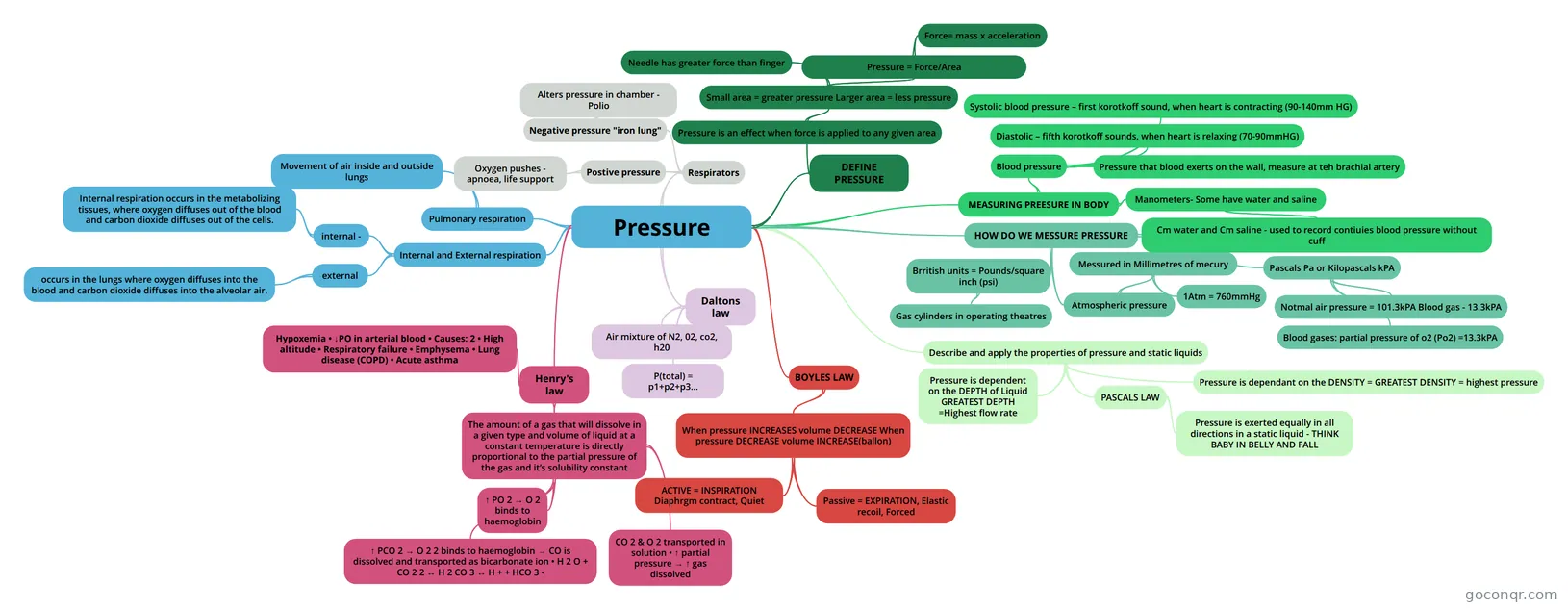
Mind map: pressure and gas laws
Inhalt der Mindmap
Pressure
DEFINE PRESSURE
- Pressure is an effect when force is applied to any given area
- Small area = greater pressure Larger area = less pressure
- Pressure = Force/Area
- Force= mass x acceleration
- Needle has greater force than finger
- Pressure = Force/Area
- Small area = greater pressure Larger area = less pressure
- Pressure is an effect when force is applied to any given area
HOW DO WE MESSURE PRESSURE
- Pascals Pa or Kilopascals kPA
- Notmal air pressure = 101.3kPA Blood gas - 13.3kPA
- Blood gases: partial pressure of o2 (Po2) =13.3kPA
- Brritish units = Pounds/square inch (psi)
- Gas cylinders in operating theatres
- Atmospheric pressure
- Messured in Millimetres of mecury
- 1Atm = 760mmHg
- Messured in Millimetres of mecury
- Pascals Pa or Kilopascals kPA
MEASURING PREESURE IN BODY
- Blood pressure
- Pressure that blood exerts on the wall, measure at teh brachial artery
- Systolic blood pressure – first korotkoff sound, when heart is contracting (90-140mm HG)
- Diastolic – fifth korotkoff sounds, when heart is relaxing (70-90mmHG)
- Manometers- Some have water and saline
- Cm water and Cm saline - used to record contiuies blood pressure without cuff
- Blood pressure
Describe and apply the properties of pressure and static liquids
- Pressure is dependent on the DEPTH of Liquid GREATEST DEPTH =Highest flow rate
- Pressure is dependant on the DENSITY = GREATEST DENSITY = highest pressure
- PASCALS LAW
- Pressure is exerted equally in all directions in a static liquid - THINK BABY IN BELLY AND FALL
BOYLES LAW
- When pressure INCREASES volume DECREASE When pressure DECREASE volume INCREASE(ballon)
- ACTIVE = INSPIRATION Diaphrgm contract, Quiet
- Passive = EXPIRATION, Elastic recoil, Forced
- When pressure INCREASES volume DECREASE When pressure DECREASE volume INCREASE(ballon)
Respirators
- Negative pressure "iron lung"
- Alters pressure in chamber - Polio
- Postive pressure
- Oxygen pushes - apnoea, life support
- Negative pressure "iron lung"
Daltons law
- P(total) = p1+p2+p3...
- Air mixture of N2, 02, co2, h20
Henry's law
- The amount of a gas that will dissolve in a given type and volume of liquid at a constant temperature is directly proportional to the partial pressure of the gas and it’s solubility constant
- CO 2 & O 2 transported in solution • ↑ partial pressure → ↑ gas dissolved
- ↑ PO 2 → O 2 binds to haemoglobin
- ↑ PCO 2 → O 2 2 binds to haemoglobin → CO is dissolved and transported as bicarbonate ion • H 2 O + CO 2 2 ↔ H 2 CO 3 ↔ H + + HCO 3 -
- Hypoxemia • ↓PO in arterial blood • Causes: 2 • High altitude • Respiratory failure • Emphysema • Lung disease (COPD) • Acute asthma
- The amount of a gas that will dissolve in a given type and volume of liquid at a constant temperature is directly proportional to the partial pressure of the gas and it’s solubility constant
Pulmonary respiration
- Movement of air inside and outside lungs
Internal and External respiration
- internal -
- Internal respiration occurs in the metabolizing tissues, where oxygen diffuses out of the blood and carbon dioxide diffuses out of the cells.
- external
- occurs in the lungs where oxygen diffuses into the blood and carbon dioxide diffuses into the alveolar air.
- internal -