
Mindmap
Situation Ethics
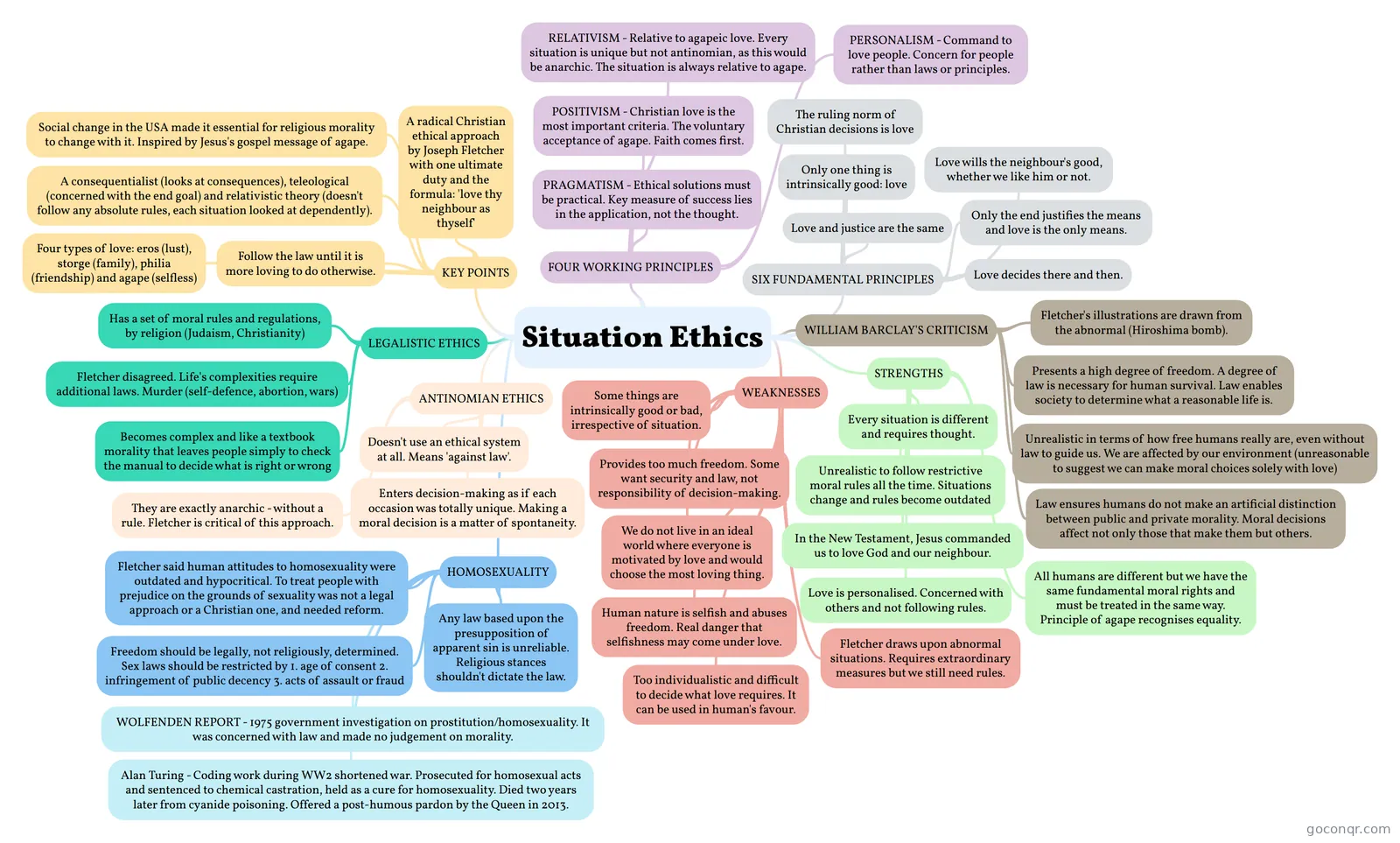
Mind map: Situation ethics
Inhalt der Mindmap
Situation Ethics
KEY POINTS
- A radical Christian ethical approach by Joseph Fletcher with one ultimate duty and the formula: 'love thy neighbour as thyself'
- A consequentialist (looks at consequences), teleological (concerned with the end goal) and relativistic theory (doesn't follow any absolute rules, each situation looked at dependently).
- Social change in the USA made it essential for religious morality to change with it. Inspired by Jesus's gospel message of agape.
- Follow the law until it is more loving to do otherwise.
- Four types of love: eros (lust), storge (family), philia (friendship) and agape (selfless)
LEGALISTIC ETHICS
- Has a set of moral rules and regulations, by religion (Judaism, Christianity)
- Fletcher disagreed. Life's complexities require additional laws. Murder (self-defence, abortion, wars)
- Becomes complex and like a textbook morality that leaves people simply to check the manual to decide what is right or wrong
ANTINOMIAN ETHICS
- Doesn't use an ethical system at all. Means 'against law'.
- Enters decision-making as if each occasion was totally unique. Making a moral decision is a matter of spontaneity.
- They are exactly anarchic - without a rule. Fletcher is critical of this approach.
FOUR WORKING PRINCIPLES
- PRAGMATISM - Ethical solutions must be practical. Key measure of success lies in the application, not the thought.
- POSITIVISM - Christian love is the most important criteria. The voluntary acceptance of agape. Faith comes first.
- RELATIVISM - Relative to agapeic love. Every situation is unique but not antinomian, as this would be anarchic. The situation is always relative to agape.
- PERSONALISM - Command to love people. Concern for people rather than laws or principles.
SIX FUNDAMENTAL PRINCIPLES
- Only one thing is intrinsically good: love
- The ruling norm of Christian decisions is love
- Love and justice are the same
- Love wills the neighbour's good, whether we like him or not.
- Only the end justifies the means and love is the only means.
- Love decides there and then.
WILLIAM BARCLAY'S CRITICISM
- Fletcher's illustrations are drawn from the abnormal (Hiroshima bomb).
- Presents a high degree of freedom. A degree of law is necessary for human survival. Law enables society to determine what a reasonable life is.
- Unrealistic in terms of how free humans really are, even without law to guide us. We are affected by our environment (unreasonable to suggest we can make moral choices solely with love)
- Law ensures humans do not make an artificial distinction between public and private morality. Moral decisions affect not only those that make them but others.
STRENGTHS
- Every situation is different and requires thought.
- Unrealistic to follow restrictive moral rules all the time. Situations change and rules become outdated
- In the New Testament, Jesus commanded us to love God and our neighbour.
- Love is personalised. Concerned with others and not following rules.
- All humans are different but we have the same fundamental moral rights and must be treated in the same way. Principle of agape recognises equality.
WEAKNESSES
- Some things are intrinsically good or bad, irrespective of situation.
- Provides too much freedom. Some want security and law, not responsibility of decision-making.
- We do not live in an ideal world where everyone is motivated by love and would choose the most loving thing.
- Human nature is selfish and abuses freedom. Real danger that selfishness may come under love.
- Too individualistic and difficult to decide what love requires. It can be used in human's favour.
- Fletcher draws upon abnormal situations. Requires extraordinary measures but we still need rules.
HOMOSEXUALITY
- Fletcher said human attitudes to homosexuality were outdated and hypocritical. To treat people with prejudice on the grounds of sexuality was not a legal approach or a Christian one, and needed reform.
- Any law based upon the presupposition of apparent sin is unreliable. Religious stances shouldn't dictate the law.
- Freedom should be legally, not religiously, determined. Sex laws should be restricted by 1. age of consent 2. infringement of public decency 3. acts of assault or fraud
- WOLFENDEN REPORT - 1975 government investigation on prostitution/homosexuality. It was concerned with law and made no judgement on morality.
- Alan Turing - Coding work during WW2 shortened war. Prosecuted for homosexual acts and sentenced to chemical castration, held as a cure for homosexuality. Died two years later from cyanide poisoning. Offered a post-humous pardon by the Queen in 2013.
Informationen
- Beschreibung
- A-Level R.S, Philosophy and Ethics Mindmap am Situation Ethics, erstellt von Mirha Butt am 28/06/2021.
- Erstellt von
- Mirha Butt
- Aufrufe
- 0
- Bewertung